
ATD Blog
Who’s Got Your Back? The 6 Stages of Trust
Wed Feb 11 2015
Content
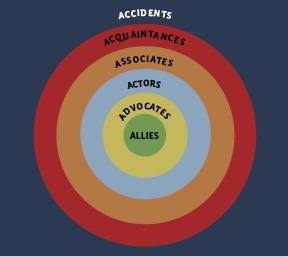
We friend, or we don’t friend. We like, or we don’t like. The yes/no, on/off nature of electronic networking can give you the mistaken idea that the people you know are either networking contact—or they’re not. But here’s the reality: Workplace relationships are more complex than that. The diagram below shows the six stages of trust development.
We friend, or we don’t friend. We like, or we don’t like. The yes/no, on/off nature of electronic networking can give you the mistaken idea that the people you know are either networking contact—or they’re not. But here’s the reality: Workplace relationships are more complex than that. The diagram below shows the six stages of trust development.
Content
Outside the outermost circle are Accidents. These are chance encounters, such as the person on the airplane sitting in 14A when you are in 14B. You meet only once, so a relationship won’t happen unless one of you deliberately initiates future contact.
Outside the outermost circle are Accidents. These are chance encounters, such as the person on the airplane sitting in 14A when you are in 14B. You meet only once, so a relationship won’t happen unless one of you deliberately initiates future contact.
Content
Acquaintances are people you don’t see regularly, but you could find them again if you want because you typically meet them through someone you know. For instance, when you went to a barbecue last summer at your cousin’s house, you met your cousin’s neighbor’s brother. Because you don’t run into or see Acquaintances regularly, building a relationship requires reaching out.
Acquaintances are people you don’t see regularly, but you could find them again if you want because you typically meet them through someone you know. For instance, when you went to a barbecue last summer at your cousin’s house, you met your cousin’s neighbor’s brother. Because you don’t run into or see Acquaintances regularly, building a relationship requires reaching out.
Content
Associates are people who have joined the same group that you’ve joined. You see each other over and over again, because you both:
Associates are people who have joined the same group that you’ve joined. You see each other over and over again, because you both:
Content
work on a committee at your professional association
work on a committee at your professional association
Content
belong to networking organization at work or outside of work
belong to networking organization at work or outside of work
Content
attend the same church, synagogue, or mosque
attend the same church, synagogue, or mosque
Content
work out at the same gym
work out at the same gym
Content
take part in alumni activities
take part in alumni activities
Content
enjoy similar leisure time activities.
enjoy similar leisure time activities.
Content
You and your contact become Actives when you get into activity together. Typically, you will exchange information, resources, and introductions. You pour your energy into having a rich conversation—one that uncovers a commonality or need.
You and your contact become Actives when you get into activity together. Typically, you will exchange information, resources, and introductions. You pour your energy into having a rich conversation—one that uncovers a commonality or need.
Content
You know how to get in touch with an Active. You look forward to seeing him, and you look for ways to offer special information, such as a favorite resource, a website, an article. Basically, an Active is a person you’re in exchange with. At the Active s tage, people are looking for two things from you: evidence of your character and evidence of your competence. If they see these two things exhibited in what you say and do, then they want more activity (more relationship) with you.
You know how to get in touch with an Active. You look forward to seeing him, and you look for ways to offer special information, such as a favorite resource, a website, an article. Basically, an Active is a person you’re in exchange with. At the Active stage, people are looking for two things from you: evidence of your character and evidence of your competence. If they see these two things exhibited in what you say and do, then they want more activity (more relationship) with you.
Content
People will only become your Advocates after they have experienced your character and competence and trust you. Advocates look for opportunities for you. Advocates say things like:
People will only become your Advocates after they have experienced your character and competence and trust you. Advocates look for opportunities for you. Advocates say things like:
Content
“Hey, I’ve got an idea for you.”
“Hey, I’ve got an idea for you.”
Content
“I ran across something you're going to love. I'll email it to you.”
“I ran across something you're going to love. I'll email it to you.”
Content
“I was at a conference last week, and I noticed a good opportunity/idea/resource/person that I think you’ll be interested in."
“I was at a conference last week, and I noticed a good opportunity/idea/resource/person that I think you’ll be interested in."
Content
Right in the center of the diagram, are your Allies. Think of Allies as being on the “Board of Directors” of your life. These are the people you turn to:
Right in the center of the diagram, are your Allies. Think of Allies as being on the “Board of Directors” of your life. These are the people you turn to:
Content
when you need advice
when you need advice
Content
when you want to commiserate or celebrate
when you want to commiserate or celebrate
Content
when you have an important decision to make.
when you have an important decision to make.
Content
Allies care about your well-being and your career. You’re going through life together, so they’re involved in many aspects of your life—both personal and professional. You’ve known them for a long time and have a high degree of confidentiality with them. They’ll go to extraordinary lengths to help you succeed. Expect to have only a few Allies, as it takes a lot of time and attention to develop that kind of trust.
Allies care about your well-being and your career. You’re going through life together, so they’re involved in many aspects of your life—both personal and professional. You’ve known them for a long time and have a high degree of confidentiality with them. They’ll go to extraordinary lengths to help you succeed. Expect to have only a few Allies, as it takes a lot of time and attention to develop that kind of trust.
Content
When you tune in to the stage of trust you’ve earned in a relationship, you’ll be able to choose a good next step toward collaboration. You’ll avoid asking for too much too soon, or asking for too little too late. Bottom line: Let the stage of trust you’ve earned guide you to be professional—not too pushy and not too passive.
When you tune in to the stage of trust you’ve earned in a relationship, you’ll be able to choose a good next step toward collaboration. You’ll avoid asking for too much too soon, or asking for too little too late. Bottom line: Let the stage of trust you’ve earned guide you to be professional—not too pushy and not too passive.