
ATD Blog
You Negotiate What?
Tue Aug 15 2017

Content
“Am I comfortable negotiating in this situation?” “Will negotiating meet my need?” “Is the expenditure of energy and time on my part worth the benefits that I can receive?”
“Am I comfortable negotiating in this situation?” “Will negotiating meet my need?” “Is the expenditure of energy and time on my part worth the benefits that I can receive?”
Content
Almost everything is negotiable. Therefore, you must develop a negotiator’s mindset. Look around you and see all you can negotiate, because negotiation is how you use information and power to create an outcome.
Almost everything is negotiable. Therefore, you must develop a negotiator’s mindset. Look around you and see all you can negotiate, because negotiation is how you use information and power to create an outcome.
Content
You can control one or more of three crucial negotiation variables:
You can control one or more of three crucial negotiation variables:
Content
Power
Power
Content
Title—your ability to use your position for official standing
Title—your ability to use your position for official standing
Content
Reward—your ability to reward others
Reward—your ability to reward others
Content
Coercion—your ability to punish
Coercion—your ability to punish
Content
Charisma—your ability to use charm and appeal to generate respect
Charisma—your ability to use charm and appeal to generate respect
Content
Expertise—your ability to use your subject matter expertise
Expertise—your ability to use your subject matter expertise
Content
Time
Time
Content
Deadline—your ability to manage your time
Deadline—your ability to manage your time
Content
Strength—your ability to sustain tension
Strength—your ability to sustain tension
Content
Patience—your ability to be calm
Patience—your ability to be calm
Content
Information
Information
Content
Knowledge—your ability to know when, where, and how to share information
Knowledge—your ability to know when, where, and how to share information
Content
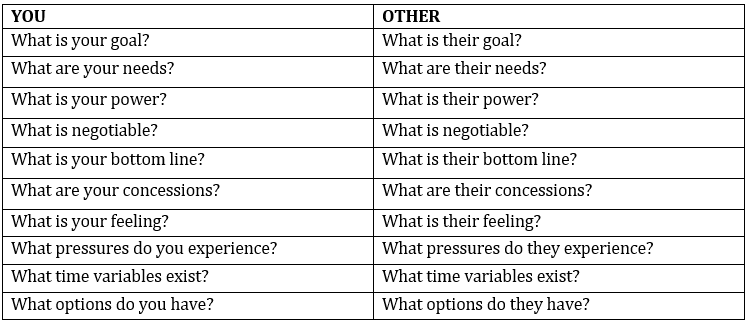
You need, first and foremost, to prepare for negotiation by asking the following questions of your position and the position of the other party:
You need, first and foremost, to prepare for negotiation by asking the following questions of your position and the position of the other party:
Content
Which of the following best describes you?
Which of the following best describes you?
Content
A. You feel competitive, blaming and intimidating others.
A. You feel competitive, blaming and intimidating others.
Content
B. You feel powerless and guarded.
B. You feel powerless and guarded.
Content
C. You gloss over conflict.
C. You gloss over conflict.
Content
D. You search for common ground, concerned about satisfying both.
D. You search for common ground, concerned about satisfying both.
Content
Positional negotiation is about locking yourself into one position. When this happens, egos flare, and less attention is given to underlying concerns and harms the relationship.
Positional negotiation is about locking yourself into one position. When this happens, egos flare, and less attention is given to underlying concerns and harms the relationship.
Content
Principled negotiation is about separating the person from the problem; focusing on interest, not positions; and generating options for mutual gain to benefit the ongoing relationship.
Principled negotiation is about separating the person from the problem; focusing on interest, not positions; and generating options for mutual gain to benefit the ongoing relationship.
Content
According to some experts, four things can hinder inventing options: premature judgment, searching for a single answer, assumptions, and thinking that problem solving is someone else’s responsibility.
According to some experts, four things can hinder inventing options: premature judgment, searching for a single answer, assumptions, and thinking that problem solving is someone else’s responsibility.
Content
Your negotiation style can be adversarial (A), play it safe (B), harmonizing (C), or participative (D).
Your negotiation style can be adversarial (A), play it safe (B), harmonizing (C), or participative (D).
Content
Here are three steps to effective negotiations:
Here are three steps to effective negotiations:
Content
Commit to personal integrity and positive outcome.
Commit to personal integrity and positive outcome.
Content
Exchange information and clarify issues by focusing on interests, not positions. Recognize and uncover (if necessary) any emotional issues to find options that can be agreed upon.
Exchange information and clarify issues by focusing on interests, not positions. Recognize and uncover (if necessary) any emotional issues to find options that can be agreed upon.
Content
Commit to a formal approval process for the agreed-upon option and follow up to assure the option is working as planned.
Commit to a formal approval process for the agreed-upon option and follow up to assure the option is working as planned.
Content
In next month’s post, we’ll explore more about the four negotiation styles and explain how you can use these three steps to negotiate effectively.
In next month’s post, we’ll explore more about the four negotiation styles and explain how you can use these three steps to negotiate effectively.