
CTDO Magazine Article
Master Evaluation
Content
Companies are struggling to evaluate learning programs because staff lack the necessary evaluation skills.
Companies are struggling to evaluate learning programs because staff lack the necessary evaluation skills.
Wed Jan 15 2020

Content
Many organizations find it challenging to use evaluation to meet greater goals. ATD's research report Effective Evaluation: Measuring Learning Programs for Success found that just 50 percent of respondents said their organization's evaluation efforts were effective in meeting learning goals, and 40 percent said these efforts were effective in meeting business goals.
Many organizations find it challenging to use evaluation to meet greater goals. ATD's research report Effective Evaluation: Measuring Learning Programs for Success found that just 50 percent of respondents said their organization's evaluation efforts were effective in meeting learning goals, and 40 percent said these efforts were effective in meeting business goals.
Content
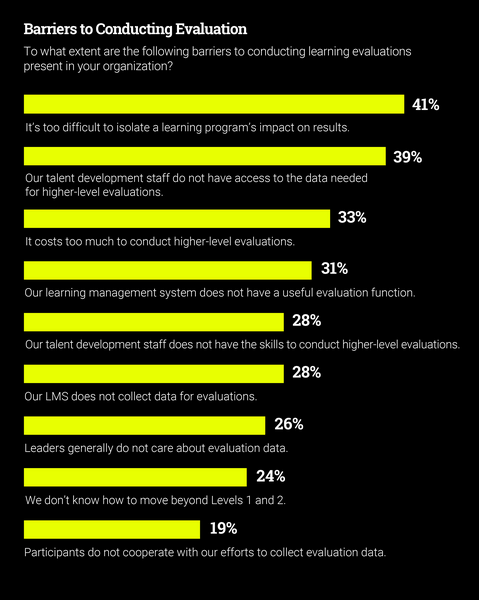
Based on a survey of 779 talent development professionals, Effective Evaluation examines how organizations are evaluating learning programs, as well as the barriers they face. About four in 10 companies (41 percent) had difficulties isolating a learning program's impact on results, and nearly as many (39 percent) had talent development staff who lacked access to the data needed to conduct higher-level evaluations.
Based on a survey of 779 talent development professionals, Effective Evaluation examines how organizations are evaluating learning programs, as well as the barriers they face. About four in 10 companies (41 percent) had difficulties isolating a learning program's impact on results, and nearly as many (39 percent) had talent development staff who lacked access to the data needed to conduct higher-level evaluations.
Content
Another barrier concerned the necessary skills: Twenty-eight percent of respondents said their talent development staff lacked the skills to conduct higher-level evaluations. This reflects another area organizations struggled with: attracting and retaining staff with evaluation skills.
Another barrier concerned the necessary skills: Twenty-eight percent of respondents said their talent development staff lacked the skills to conduct higher-level evaluations. This reflects another area organizations struggled with: attracting and retaining staff with evaluation skills.
Content
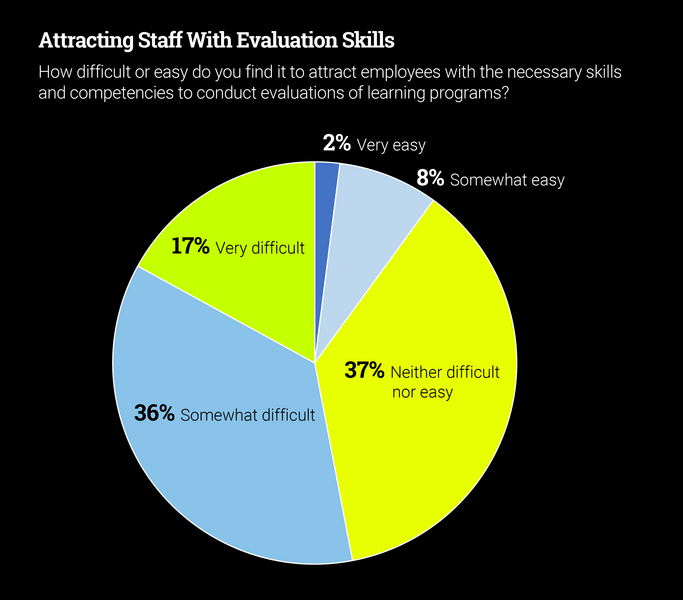
Just 10 percent of respondents said it was easy for their organizations to attract staff with evaluation skills, and only 15 percent found it easy to retain staff with those skills.
Just 10 percent of respondents said it was easy for their organizations to attract staff with evaluation skills, and only 15 percent found it easy to retain staff with those skills.
Content
The report uncovered that organizations with dedicated staff responsible for evaluating learning were significantly more likely to report high learning and business effectiveness than those without. However, because just 30 percent of companies have a dedicated evaluator, it's clear that the majority of them spread evaluation tasks among talent development staff with other primary responsibilities.
The report uncovered that organizations with dedicated staff responsible for evaluating learning were significantly more likely to report high learning and business effectiveness than those without. However, because just 30 percent of companies have a dedicated evaluator, it's clear that the majority of them spread evaluation tasks among talent development staff with other primary responsibilities.
Content
That may partly explain why attracting and retaining employees with evaluation skills was so difficult. Organizations may need to look for employees with skills that align with their primary responsibilities, rather than focusing on evaluation skills.
That may partly explain why attracting and retaining employees with evaluation skills was so difficult. Organizations may need to look for employees with skills that align with their primary responsibilities, rather than focusing on evaluation skills.
Content
Effective Evaluation offers several recommendations for how companies can overcome these barriers.
Effective Evaluation offers several recommendations for how companies can overcome these barriers.
Content
Kristopher Newbauer, chief human resources officer and head of global people and talent at Rotary International, says it is crucial for firms to demonstrate that they value evaluation.
Kristopher Newbauer, chief human resources officer and head of global people and talent at Rotary International, says it is crucial for firms to demonstrate that they value evaluation.
Content
"Organizations that value evaluation are much more likely to attract and retain employees with evaluation skills," Newbauer explains. "To the extent that evaluation work is taken seriously and used with good intention for improvement, their work feels more meaningful. And meaningful work is critically important to engagement and retention."
"Organizations that value evaluation are much more likely to attract and retain employees with evaluation skills," Newbauer explains. "To the extent that evaluation work is taken seriously and used with good intention for improvement, their work feels more meaningful. And meaningful work is critically important to engagement and retention."
Content
Those without dedicated evaluation staff can develop evaluation skills in existing employees. "Learning and development staff can develop the skills for evaluation if they're given the time and resources to do it," says Tom Atkinson, president of Atkinson Analytics.
Those without dedicated evaluation staff can develop evaluation skills in existing employees. "Learning and development staff can develop the skills for evaluation if they're given the time and resources to do it," says Tom Atkinson, president of Atkinson Analytics.
Content
Skills important for conducting evaluations include business acumen, critical thinking, problem solving, project management, and communication. If organizations can develop those skills in existing staff, they may be able to improve their approach to evaluation and find greater effectiveness meeting learning and business goals.
Skills important for conducting evaluations include business acumen, critical thinking, problem solving, project management, and communication. If organizations can develop those skills in existing staff, they may be able to improve their approach to evaluation and find greater effectiveness meeting learning and business goals.
Content
Read more from CTDO magazine : Essential talent development content for C-suite leaders.
Read more from CTDO magazine: Essential talent development content for C-suite leaders.