ATD, association for talent development

CTDO Magazine Article

Skills Gap Is the Biggest Threat to Business

Content

The skills gap has garnered significant attention in the United States and globally in recent years. Communities, states, regions, and entire nations—now more than ever given the globalization of business—pay a heavy price when they cannot find or equip workers with the right skills for critical jobs. Simply stated, they fail to flourish and falter when meeting customer demands. In fact, PricewaterhouseCoopers's 2015 Global CEO Survey found that three-quarters of 1,322 responding CEOs in 77 countries say the skills shortage is the biggest threat to their business. But why is there such a substantial skills gap in a growing number of industries and across so many skill sets? Why aren't potential workers learning the right skills for high-demand jobs in their regions? More importantly, what are the consequences of the growing skills gap?

The skills gap has garnered significant attention in the United States and globally in recent years. Communities, states, regions, and entire nations—now more than ever given the globalization of business—pay a heavy price when they cannot find or equip workers with the right skills for critical jobs. Simply stated, they fail to flourish and falter when meeting customer demands. In fact, PricewaterhouseCoopers's 2015 Global CEO Survey found that three-quarters of 1,322 responding CEOs in 77 countries say the skills shortage is the biggest threat to their business. But why is there such a substantial skills gap in a growing number of industries and across so many skill sets? Why aren't potential workers learning the right skills for high-demand jobs in their regions? More importantly, what are the consequences of the growing skills gap?

By

Tue Dec 15 2015

Loading...
Skills Gap Is the Biggest Threat to Business-d29227531380d9ce4b54cb3692c1428a60c83e7586753230b6090a74c9864a2c

Content

The skills gap has garnered significant attention in the United States and globally in recent years. Communities, states, regions, and entire nations—now more than ever given the globalization of business—pay a heavy price when they cannot find or equip workers with the right skills for critical jobs. Simply stated, they fail to flourish and falter when meeting customer demands. In fact, PricewaterhouseCoopers's 2015 Global CEO Survey found that three-quarters of 1,322 responding CEOs in 77 countries say the skills shortage is the biggest threat to their business.

The skills gap has garnered significant attention in the United States and globally in recent years. Communities, states, regions, and entire nations—now more than ever given the globalization of business—pay a heavy price when they cannot find or equip workers with the right skills for critical jobs. Simply stated, they fail to flourish and falter when meeting customer demands. In fact, PricewaterhouseCoopers's 2015 Global CEO Survey found that three-quarters of 1,322 responding CEOs in 77 countries say the skills shortage is the biggest threat to their business.

Content

But why is there such a substantial skills gap in a growing number of industries and across so many skill sets? Why aren't potential workers learning the right skills for high-demand jobs in their regions? More importantly, what are the consequences of the growing skills gap? The Association for Talent Development's (ATD) 2015 Skills Gap Survey addresses these questions and other key business issues affected by the skills gap. The findings of the survey, paired with meta-analyses and case studies, are reported in the whitepaper Bridging the Skills Gap: Workforce Development Is Everyone's Business.

But why is there such a substantial skills gap in a growing number of industries and across so many skill sets? Why aren't potential workers learning the right skills for high-demand jobs in their regions? More importantly, what are the consequences of the growing skills gap? The Association for Talent Development's (ATD) 2015 Skills Gap Survey addresses these questions and other key business issues affected by the skills gap. The findings of the survey, paired with meta-analyses and case studies, are reported in the whitepaper Bridging the Skills Gap: Workforce Development Is Everyone's Business.

How big is the problem?

Content

ATD defines a skills gap as a significant breach between an organization's current capabilities and the skills needed to achieve its goals and meet customer demands. It is the point at which an organization may not be able to grow or remain competitive because it cannot fill critical jobs with employees who have the right knowledge, skills, and abilities.

ATD defines a skills gap as a significant breach between an organization's current capabilities and the skills needed to achieve its goals and meet customer demands. It is the point at which an organization may not be able to grow or remain competitive because it cannot fill critical jobs with employees who have the right knowledge, skills, and abilities.

Content

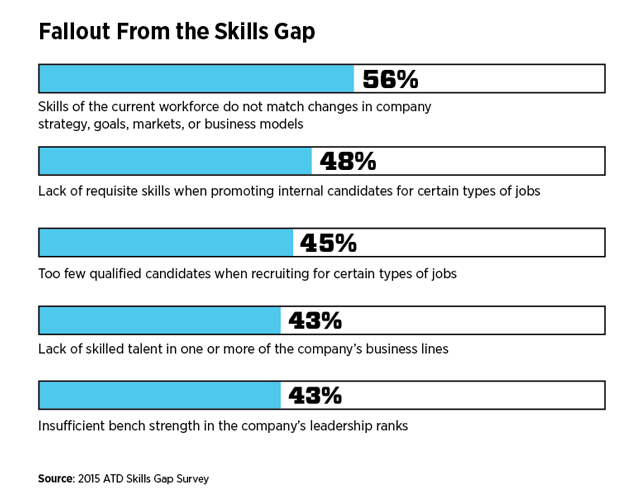
Unfortunately, 84 percent of respondents to the ATD survey said there is a definite skills gap in their organizations, and more than half (56 percent) noted that the skills of the current workforce do not match changes in company strategy, goals, markets, or business models. In addition, a lack of requisite skills when promoting internal candidates for certain types of jobs is a problem for 48 percent of respondents, and 45 percent said there are too few qualified candidates when hiring for certain types of jobs.

Unfortunately, 84 percent of respondents to the ATD survey said there is a definite skills gap in their organizations, and more than half (56 percent) noted that the skills of the current workforce do not match changes in company strategy, goals, markets, or business models. In addition, a lack of requisite skills when promoting internal candidates for certain types of jobs is a problem for 48 percent of respondents, and 45 percent said there are too few qualified candidates when hiring for certain types of jobs.

Content

[

[

Skills Gap Is the Biggest Threat to Business-e9430008f6b79a2b8274396cd17f1106849743261e8d99665589035f103c9e00

Content

Skills Gap Is the Biggest Threat to Business-9c0538377bc29369ce5de1b9035325f6eca1ae9988bcbba742f3f43afeade65d

Content

A new ATD whitepaper offers insight into what it takes to close the skills gap.

A new ATD whitepaper offers insight into what it takes to close the skills gap.

Content

These data concur with a July 2014 Financial Sense article, which states that "the proportion of business owners reporting that they can't find qualified applicants has been trending steeply upward since the end of the recession," according to the National Federation of Independent Business (NFIB), an advocacy group for small business.

These data concur with a July 2014 Financial Sense article, which states that "the proportion of business owners reporting that they can't find qualified applicants has been trending steeply upward since the end of the recession," according to the National Federation of Independent Business (NFIB), an advocacy group for small business.

Content

What's more, 87 percent of respondents of the ATD survey reported that the skills gap is affecting their performance, with customer service, growth, and service delivery being the most affected. "We have turned down or not even pursued certain projects because we do not have the qualified people to lead the projects," said one respondent.

What's more, 87 percent of respondents of the ATD survey reported that the skills gap is affecting their performance, with customer service, growth, and service delivery being the most affected. "We have turned down or not even pursued certain projects because we do not have the qualified people to lead the projects," said one respondent.

Where are the widest gaps?

Content

Not surprisingly, NFIB found that "the most commonly cited shortages are in technical trades such as welding and industrial machinery maintenance, as well as in supervisory and management positions." The skills required for these jobs point to where the real work of closing the skills gap needs to happen. However, in addition to gaps in science, technology, engineering, and math (STEM), there are also significant gaps in communication and other soft skills.

Not surprisingly, NFIB found that "the most commonly cited shortages are in technical trades such as welding and industrial machinery maintenance, as well as in supervisory and management positions." The skills required for these jobs point to where the real work of closing the skills gap needs to happen. However, in addition to gaps in science, technology, engineering, and math (STEM), there are also significant gaps in communication and other soft skills.

Content

For instance, a 2013 Adecco Staffing study,]( https://files.astd.org/CTDO-Images/Winter2016/StateofTD1-SB1-L.png ) Mind the Skills Gap , notes that communication skills are of critical importance: "For all the traditional talk about a skills gap in technical skills, 44 percent of respondents cited soft skills—such as communication, critical thinking, creativity, and collaboration—as the area with the largest gap."

For instance, a 2013 Adecco Staffing study,](https://files.astd.org/CTDO-Images/Winter2016/StateofTD1-SB1-L.png) Mind the Skills Gap, notes that communication skills are of critical importance: "For all the traditional talk about a skills gap in technical skills, 44 percent of respondents cited soft skills—such as communication, critical thinking, creativity, and collaboration—as the area with the largest gap."

Content

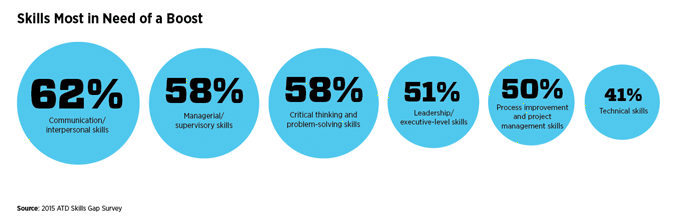
Communication and interpersonal skills (62 percent) also scored higher on the ATD survey than technical skills (41 percent), followed closely by managerial skills and critical thinking and problem-solving skills at 58 percent. Other soft skills gaps also rated high by at least 50 percent of respondents include leadership/executive-level skills and process improvement and project management skills.

Communication and interpersonal skills (62 percent) also scored higher on the ATD survey than technical skills (41 percent), followed closely by managerial skills and critical thinking and problem-solving skills at 58 percent. Other soft skills gaps also rated high by at least 50 percent of respondents include leadership/executive-level skills and process improvement and project management skills.

What can businesses do?

Content

The truth is there are many contributing factors to why and how the skills gap manifests, although experts agree that the major culprits are likely the changing nature of work, technology, and how the knowledge economy has converged in a powerful way. Innovation, the pace of change, and the presence of multiple generations in the workforce are other significant contributors. The ATD survey also found that more than one-third of organizations (35 percent) feel that the gap is due in part to cuts in training investments and lack of commitment to talent development by senior leaders.

The truth is there are many contributing factors to why and how the skills gap manifests, although experts agree that the major culprits are likely the changing nature of work, technology, and how the knowledge economy has converged in a powerful way. Innovation, the pace of change, and the presence of multiple generations in the workforce are other significant contributors. The ATD survey also found that more than one-third of organizations (35 percent) feel that the gap is due in part to cuts in training investments and lack of commitment to talent development by senior leaders.

Content

Clearly, leaving the skills gap issue untended would be costly. But to close the gap, it's important to know where to start. A Deloitte/Manufacturing Institute study examining the skills gap in 2015 and beyond found that 94 percent of the executives polled believed that internal employee and training and development programs should be used to mitigate the effects of the existing skills shortage for the skilled production workforce. Additionally, 72 percent felt that involvement with local schools and community colleges would be beneficial, and 64 percent said that external training and certification programs would be beneficial.

Clearly, leaving the skills gap issue untended would be costly. But to close the gap, it's important to know where to start. A Deloitte/Manufacturing Institute study examining the skills gap in 2015 and beyond found that 94 percent of the executives polled believed that internal employee and training and development programs should be used to mitigate the effects of the existing skills shortage for the skilled production workforce. Additionally, 72 percent felt that involvement with local schools and community colleges would be beneficial, and 64 percent said that external training and certification programs would be beneficial.

Content

The ATD survey also uncovered several key solutions:

The ATD survey also uncovered several key solutions:

  • Content

    64 percent suggest more internal training would close specific skills gaps

    64 percent suggest more internal training would close specific skills gaps

  • Content

    55 percent encourage organizations to identify and target development of core competencies

    55 percent encourage organizations to identify and target development of core competencies

  • Content

    50 percent endorse a closer examination of skills the organization needs to be successful now and in the future.

    50 percent endorse a closer examination of skills the organization needs to be successful now and in the future.

Content

Whatever tactic business takes to address the skills gap, talent development professionals will play a critical role in achieving success. With deep expertise in adult learning and an understanding for the need to have a knowledgeable and skilled workforce, they are uniquely positioned to implement training, coaching, and other performance improvement strategies that can bridge distressing skills gaps.

Whatever tactic business takes to address the skills gap, talent development professionals will play a critical role in achieving success. With deep expertise in adult learning and an understanding for the need to have a knowledgeable and skilled workforce, they are uniquely positioned to implement training, coaching, and other performance improvement strategies that can bridge distressing skills gaps.

Content

Read more from CTDO magazine : Essential talent development content for C-suite leaders.

Read more from CTDO magazine: Essential talent development content for C-suite leaders.

You've Reached ATD Member-only Content

Become an ATD member to continue

Already a member?Sign In


Copyright © 2026 ATD

ASTD changed its name to ATD to meet the growing needs of a dynamic, global profession.

Terms of UsePrivacy NoticeCookie Policy