
Press Release
Missed Opportunities for Business: Developing New Managers Strengthens Organizations
Tue Apr 23 2019
**(ALEXANDRIA, VA), April 23, 2019—**Managers are a key resource for organizations because they contribute to employee engagement and retention. New research from the Association for Talent Development (ATD) shows that organizations can improve at developing their managers. According to Developing New Managers: Key Elements of Success, the new research report from ATD sponsored by The Ken Blanchard Companies, while 75 percent of organizations offer first-time manager training, most organizations can better develop this critical cohort.
While the study found that some organizations achieved strong results from developing new managers, it also revealed issues and missed opportunities that could, if constructively addressed, enable talent development professionals to better prepare those managers for the challenges they will face.
When managers succeed, so do their employers; that’s even more important with new managers. Companies may heighten talent risk when failing to spot struggling new managers. The study found only 37 percent of companies identify new managers who are excelling in the role, and only 42 percent have additional training and support for new managers who are struggling.
Key Findings:
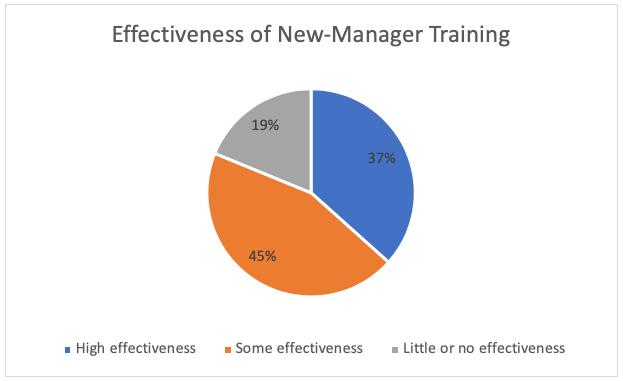
· There’s room for new-manager training to improve. Of those with new-manager training, 37 percent of employees rated it as highly effective and 45 percent say it’s somewhat effective; 19 percent claim little or no effectiveness.
37 percent of organizations rate their new-manager training as highly effective.
· Management training begins too late. Among those companies with first-time manager training, only 27 percent say they offer training to employees before they start managing others.
· A skills gap persists for first-time people managers. The biggest skills gaps for first-time people managers are leadership skills, soft/people skills, and management skills.
· Most learning professionals favor in-person training methods. Even those charged with providing scalable development virtually still find ways to instill the human touch in their approaches.
“Developing new managers is about finding effective ways to help people understand how well they do or don’t make that bring-out-the-best connection with others and then helping them build those capabilities in themselves,” says Casey Wilson, vice president of learning and organizational effectiveness at Evolent Health, who is quoted in the study.
For talent development, the study recommends identifying and developing potential management talent early; hiring for the right reasons, then continuing new-manager training through the first year on the job; and designing training to fit your organization and your managers’ needs.
The Developing New Managers report can be found here. To learn more about the report, register for a free webcast on April 24 at 2 p.m. EDT.
About ATD
The Association for Talent Development (ATD) is the world’s largest professional membership organization supporting those who develop the knowledge and skills of employees, improve performance, and help to achieve results for the organizations they serve. Originally established in 1943, the association was previously known as the American Society for Training & Development (ASTD).
ATD’s members come from more than 120 countries and work in public and private organizations in every industry sector. ATD supports talent development professionals who gather locally in volunteer-led U.S. chapters and international member networks, and with international strategic partners. For more information, visit www.td.org.
View Courses Recommended for You