
The Public Manager Magazine Article
Member Benefit
Unlocking a Federal Coaching Culture
Content
Through training, collaboration, and strategic planning, the Federal Coaching Network is spreading the practice of coaching across the government.
Through training, collaboration, and strategic planning, the Federal Coaching Network is spreading the practice of coaching across the government.
Fri Feb 10 2017

Content
"I celebrate this community of caring and courageous human beings!" reads a sticky note on the training room wall after the first day of the 2016 Federal Internal Coach Training Program. Over the past three years, the U.S. Office of Personnel Management (OPM), in partnership with the Chief Learning Officers Council, has established and grown the Federal Coaching Network, a community of individuals bound by a mission to foster a culture of coaching across government. The network identified four initial objectives:
"I celebrate this community of caring and courageous human beings!" reads a sticky note on the training room wall after the first day of the 2016 Federal Internal Coach Training Program. Over the past three years, the U.S. Office of Personnel Management (OPM), in partnership with the Chief Learning Officers Council, has established and grown the Federal Coaching Network, a community of individuals bound by a mission to foster a culture of coaching across government. The network identified four initial objectives:
Content
Develop a federal internal coach training program.
Develop a federal internal coach training program.
Content
Build a database of coaches in government, and share services between agencies.
Build a database of coaches in government, and share services between agencies.
Content
Conduct a return on investment (ROI) study to determine the value of coaching.
Conduct a return on investment (ROI) study to determine the value of coaching.
Content
Create coaching guidance and policy.
Create coaching guidance and policy.
Content
On the quest to achieve these goals, a space was created for federal employees across government to feel heard, valued, and engaged in a way that allows them to maximize their potential in both their personal and professional lives.
On the quest to achieve these goals, a space was created for federal employees across government to feel heard, valued, and engaged in a way that allows them to maximize their potential in both their personal and professional lives.
The Need for a Federal Coaching Culture
Content
In times of fiscal constraint, training and development is often pushed to the bottom of the priority list. Coincidentally, now, more than ever, the effectiveness of the federal government depends on strong leadership. Coaching is one of many powerful tools that help support and develop the type of leaders the nation needs for the 21st century.
In times of fiscal constraint, training and development is often pushed to the bottom of the priority list. Coincidentally, now, more than ever, the effectiveness of the federal government depends on strong leadership. Coaching is one of many powerful tools that help support and develop the type of leaders the nation needs for the 21st century.
Content
Building a federal coaching culture demonstrates an investment in and a commitment to the civil servants who carry out the mission of each organization day to day. Not only do employees improve by learning coaching skills they can apply on the job, but they are given the opportunity to further their own performance and professional development by having access to a coach. In achieving a coaching culture, an organization stands to gain a host of positive outcomes, including, but not limited to:
Building a federal coaching culture demonstrates an investment in and a commitment to the civil servants who carry out the mission of each organization day to day. Not only do employees improve by learning coaching skills they can apply on the job, but they are given the opportunity to further their own performance and professional development by having access to a coach. In achieving a coaching culture, an organization stands to gain a host of positive outcomes, including, but not limited to:
Content
improved working relationships
improved working relationships
Content
increased productivity
increased productivity
Content
reduced absenteeism and turnover
reduced absenteeism and turnover
Content
reduced grievances and complaints
reduced grievances and complaints
Content
increased employee engagement
increased employee engagement
Content
improved customer service
improved customer service
Content
higher-quality performance conversations.
higher-quality performance conversations.
What Does a Coaching Culture Look Like?
Content
Fundamentally, a coaching culture promotes candid and respectful conversations between employees that foster reflection, self-awareness, and empowerment. A coaching culture does not focus on a specific program; instead, it integrates coaching skills and approaches into the everyday interactions of managers, employees, and their peers.
Fundamentally, a coaching culture promotes candid and respectful conversations between employees that foster reflection, self-awareness, and empowerment. A coaching culture does not focus on a specific program; instead, it integrates coaching skills and approaches into the everyday interactions of managers, employees, and their peers.
Content
Hallmarks of a coaching culture include these facets:
Hallmarks of a coaching culture include these facets:
Content
Employees at all levels use coaching behavior as a means of effective interaction.
Employees at all levels use coaching behavior as a means of effective interaction.
Content
There is common coaching practice and language throughout the organization.
There is common coaching practice and language throughout the organization.
Content
Feedback is valued as a form of ongoing development.
Feedback is valued as a form of ongoing development.
Content
Conversations are engaging, and solutions are collaborative.
Conversations are engaging, and solutions are collaborative.
Content
Mistakes are viewed as opportunities to learn.
Mistakes are viewed as opportunities to learn.
Content
In many organizations, daily work, challenges, and communications tend to be reactive rather than proactive, leaving employees and managers feeling overloaded. Coaching brings focus on the future and on creating action plans to achieve goals and outcomes. A coaching culture supports the individual and larger team, empowering all to be at their best in any situation—to learn how to create a future they desire and move from the present reality toward that desired future state.
In many organizations, daily work, challenges, and communications tend to be reactive rather than proactive, leaving employees and managers feeling overloaded. Coaching brings focus on the future and on creating action plans to achieve goals and outcomes. A coaching culture supports the individual and larger team, empowering all to be at their best in any situation—to learn how to create a future they desire and move from the present reality toward that desired future state.
The Beginning of the Federal Coaching Network
Content
In December 2012, OPM released the Executive Development Best Practices Guide , which compiled information from leading public and private sector organizations on the continued learning of executives. This research highlighted a common difference between sectors: Coaching was an integral part of private sector leadership development programs, whereas in government it was often used as a remedy for poor performance or to close specific competency gaps.
In December 2012, OPM released the Executive Development Best Practices Guide, which compiled information from leading public and private sector organizations on the continued learning of executives. This research highlighted a common difference between sectors: Coaching was an integral part of private sector leadership development programs, whereas in government it was often used as a remedy for poor performance or to close specific competency gaps.
Content
Since the release of this guidance, OPM worked with agencies to shift the emphasis of coaching in government. A closer look revealed small pockets of progressive thought—namely the departments of the Treasury, Agriculture, and Health and Human Services, which had started the conversation around creating an internal coaching community of practice.
Since the release of this guidance, OPM worked with agencies to shift the emphasis of coaching in government. A closer look revealed small pockets of progressive thought—namely the departments of the Treasury, Agriculture, and Health and Human Services, which had started the conversation around creating an internal coaching community of practice.
Content
In early 2013, the Chief Learning Officers Council included coaching in its strategic plan. The goal was to develop an inventory of certified coaches within the federal government and to facilitate the sharing of coaching services across agencies at no cost. OPM took the lead on this effort, and a core group of representatives were designated from each agency. The team identified itself as the Federal Coaching Network, and members quickly bonded over their passion for coaching and established the four objectives noted earlier.
In early 2013, the Chief Learning Officers Council included coaching in its strategic plan. The goal was to develop an inventory of certified coaches within the federal government and to facilitate the sharing of coaching services across agencies at no cost. OPM took the lead on this effort, and a core group of representatives were designated from each agency. The team identified itself as the Federal Coaching Network, and members quickly bonded over their passion for coaching and established the four objectives noted earlier.
Content
OPM created a portal on the U.S. Office of Management and Budget's (OMB) max.gov website (only accessible by federal employees) to support the Federal Coaching Network. The ROI research was consolidated and posted on the site as a resource for anyone looking to build a business case for coaching. The coaching guidance document is drafted and expected to be released in 2017.
OPM created a portal on the U.S. Office of Management and Budget's (OMB) max.gov website (only accessible by federal employees) to support the Federal Coaching Network. The ROI research was consolidated and posted on the site as a resource for anyone looking to build a business case for coaching. The coaching guidance document is drafted and expected to be released in 2017.
Federal Internal Coach Training Program
Content
In early 2014, the Federal Coaching Network developed and launched the inaugural Federal Internal Coach Training Program (FICTP), which has been designated by the International Coach Federation (ICF) as Approved Coach Specific Training Hours. Successful graduates of this program can leverage the program to obtain an ICF Credential and other formal coaching credentials.
In early 2014, the Federal Coaching Network developed and launched the inaugural Federal Internal Coach Training Program (FICTP), which has been designated by the International Coach Federation (ICF) as Approved Coach Specific Training Hours. Successful graduates of this program can leverage the program to obtain an ICF Credential and other formal coaching credentials.
Content
To date, more than 20 of our students have achieved the Associate Certified Coach ICF status. Many others are in the process of accruing the 100 hours of coaching needed to become certified. The program also received the 2014 Best Leadership Development Program Award from Human Capital Management in Government.
To date, more than 20 of our students have achieved the Associate Certified Coach ICF status. Many others are in the process of accruing the 100 hours of coaching needed to become certified. The program also received the 2014 Best Leadership Development Program Award from Human Capital Management in Government.
Content
For the initial training program cohort, chief learning officers of each agency were invited to select up to five employees to attend the 136-hour training program, which took place over eight months. The participants were required to perform and receive many hours of coaching practice and mentoring in addition to 11 days of in-person training.
For the initial training program cohort, chief learning officers of each agency were invited to select up to five employees to attend the 136-hour training program, which took place over eight months. The participants were required to perform and receive many hours of coaching practice and mentoring in addition to 11 days of in-person training.
Content
The FICTP launch initially produced 70 internal coaches from 18 different agencies. A second cohort that started in June 2015 has 53 graduates, and a third cohort of 60 began the eight-month training in November 2016. There is no tuition cost incurred on agencies; the investment is in program participants' time and their salaries, as well as the time and salaries of the federal instructors and program coordinators. Participants are required to complete a two-year minimum continued service agreement to protect the investment their agencies made.
The FICTP launch initially produced 70 internal coaches from 18 different agencies. A second cohort that started in June 2015 has 53 graduates, and a third cohort of 60 began the eight-month training in November 2016. There is no tuition cost incurred on agencies; the investment is in program participants' time and their salaries, as well as the time and salaries of the federal instructors and program coordinators. Participants are required to complete a two-year minimum continued service agreement to protect the investment their agencies made.
Content
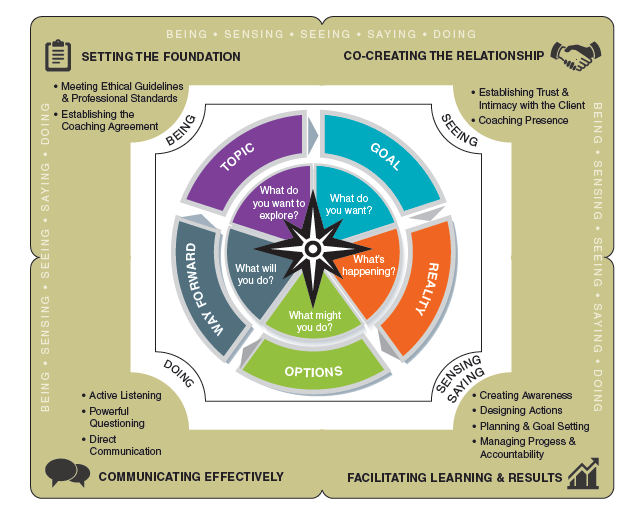
Figure 1 shows the framework used as a model to guide the training. Through the program, students acquire a thorough understanding of the foundations of professional coaching and how to apply them in the federal context. Students explore the similarities and differences between coaching and related disciplines and the scope of coaching's potential. In addition, they learn and practice coaching skills in real-time conversations and observe and experience the effect of these skills as a coachee.
Figure 1 shows the framework used as a model to guide the training. Through the program, students acquire a thorough understanding of the foundations of professional coaching and how to apply them in the federal context. Students explore the similarities and differences between coaching and related disciplines and the scope of coaching's potential. In addition, they learn and practice coaching skills in real-time conversations and observe and experience the effect of these skills as a coachee.
Figure 1. Federal Internal Coach Framework
Content
[
[
Content
Through training, collaboration, and strategic planning, the Federal Coaching Network is spreading the practice of coaching across the government.
Through training, collaboration, and strategic planning, the Federal Coaching Network is spreading the practice of coaching across the government.
Content
The Federal Internal Training Program is on track to save the government more than $3.8 million through fiscal year 2016, when 233 coaches will have been trained and more than 7,700 collective hours of coaching will have occurred. The anecdotal evidence, encapsulated in participants' comments, also speaks volumes.
The Federal Internal Training Program is on track to save the government more than $3.8 million through fiscal year 2016, when 233 coaches will have been trained and more than 7,700 collective hours of coaching will have occurred. The anecdotal evidence, encapsulated in participants' comments, also speaks volumes.
Database of Internal Federal Coaches
Content
In June 2015, OPM launched a government-wide database of internal federal coaches to help agencies enhance their development efforts while minimizing costs and maximizing impact. The database is on OMB's max.gov website and is accessible only to designated points of contact within each agency. Points of contact are responsible for submitting information on currently available coaches within their agency, as well as matching coaches from the database with employees who have expressed an interest in receiving coaching. There are currently 95 coaches listed in the database.
In June 2015, OPM launched a government-wide database of internal federal coaches to help agencies enhance their development efforts while minimizing costs and maximizing impact. The database is on OMB's max.gov website and is accessible only to designated points of contact within each agency. Points of contact are responsible for submitting information on currently available coaches within their agency, as well as matching coaches from the database with employees who have expressed an interest in receiving coaching. There are currently 95 coaches listed in the database.
Content
Individuals may seek coaching for any number of reasons. Coaching engagements typically focus on one or more of the following goals:
Individuals may seek coaching for any number of reasons. Coaching engagements typically focus on one or more of the following goals:
Content
facilitating personal or professional transitions
facilitating personal or professional transitions
Content
organizing and prioritizing professional responsibilities
organizing and prioritizing professional responsibilities
Content
clarifying vision, creating meaningful goals, and developing achievable action steps
clarifying vision, creating meaningful goals, and developing achievable action steps
Content
achieving professional goals
achieving professional goals
Content
solving individual leadership challenges
solving individual leadership challenges
Content
excelling in self-awareness and self-management
excelling in self-awareness and self-management
Content
identifying core strengths and recognizing how best to leverage them
identifying core strengths and recognizing how best to leverage them
Content
gaining clarity in decision making and purpose
gaining clarity in decision making and purpose
Content
developing strategies for managing work and life
developing strategies for managing work and life
Content
addressing an urgent or compelling challenge, stretch goal, or opportunity.
addressing an urgent or compelling challenge, stretch goal, or opportunity.
Content
Coaching engagements typically last for at least six one-hour sessions, but they can vary depending on the coachee's need or agenda. In some instances, the coachee may find it beneficial to work with a coach for a shorter or longer period of time. Factors that may affect the length of a coaching engagement include the type of goal, the way individuals or teams prefer to work, the frequency of coaching meetings, and, for external coaches, financial resources available to support coaching.
Coaching engagements typically last for at least six one-hour sessions, but they can vary depending on the coachee's need or agenda. In some instances, the coachee may find it beneficial to work with a coach for a shorter or longer period of time. Factors that may affect the length of a coaching engagement include the type of goal, the way individuals or teams prefer to work, the frequency of coaching meetings, and, for external coaches, financial resources available to support coaching.
The Way Forward
Content
This is only the beginning of an effort that will transform the way we work. The Federal Coaching Network has just begun to gain momentum, and the prevalence of coaching is expected to increase as the evidence of its value spreads. Agencies are slowly beginning to recognize the impact of coaching and are incorporating the skill set into job descriptions and performance plans.
This is only the beginning of an effort that will transform the way we work. The Federal Coaching Network has just begun to gain momentum, and the prevalence of coaching is expected to increase as the evidence of its value spreads. Agencies are slowly beginning to recognize the impact of coaching and are incorporating the skill set into job descriptions and performance plans.
Content
The focus for the coming year is to build coaching capacity in our federal leaders. We encourage leaders at all levels to utilize a "coach approach" when engaging employees and stakeholders. Integrating coaching into the fabric of an organization's talent management process—from recruitment and hiring, to training and development, to performance management, to career transitions and retirement—supports a coaching culture that will enable employees to maximize their potential on the job.
The focus for the coming year is to build coaching capacity in our federal leaders. We encourage leaders at all levels to utilize a "coach approach" when engaging employees and stakeholders. Integrating coaching into the fabric of an organization's talent management process—from recruitment and hiring, to training and development, to performance management, to career transitions and retirement—supports a coaching culture that will enable employees to maximize their potential on the job.
What Coaching Should Be
Content
"Coaching is not merely a technique to be wheeled out and rigidly applied to certain prescribed circumstances. It is a way of managing, a way of treating people, a way of thinking, a way of being. Roll on the day when the word coaching disappears from our lexicon altogether and it just becomes the way we relate to one another at work, and elsewhere too."
"Coaching is not merely a technique to be wheeled out and rigidly applied to certain prescribed circumstances. It is a way of managing, a way of treating people, a way of thinking, a way of being. Roll on the day when the word coaching disappears from our lexicon altogether and it just becomes the way we relate to one another at work, and elsewhere too."
Content
—John Whitmore, Coaching for Performance: GROWing Human Potential and Purpose
—John Whitmore, Coaching for Performance: GROWing Human Potential and Purpose
FICTP Participant Comments
Content
How has your participation in the FICTP improved your job performance?
How has your participation in the FICTP improved your job performance?
Content
I find I am more cognizant of using coaching skills in discussions with my supervisees, which allows them to grow more in their professional development.
I find I am more cognizant of using coaching skills in discussions with my supervisees, which allows them to grow more in their professional development.
Content
As a senior leader, I am coaching workforce personnel within my agency. I am advocating the importance of coaching to the professional and personal development of our workforce.
As a senior leader, I am coaching workforce personnel within my agency. I am advocating the importance of coaching to the professional and personal development of our workforce.
Content
I manage the coaching program for a federal agency. My knowledge and experience in coaching have helped me guide the process and take more effective actions. I also facilitate leadership and supervisory courses and have used and taught coaching skills in these courses.
I manage the coaching program for a federal agency. My knowledge and experience in coaching have helped me guide the process and take more effective actions. I also facilitate leadership and supervisory courses and have used and taught coaching skills in these courses.
Content
More enthusiasm and engagement. Renewed sense of purpose. Feel providing coaching is value-added.
More enthusiasm and engagement. Renewed sense of purpose. Feel providing coaching is value-added.
Content
As a supervisor, I have learned to apply my coaching skills to engage employees to take an active part in improving customer relations, service, and our processes. My skills learned were also complimented by the coaching I received from my program coach.
As a supervisor, I have learned to apply my coaching skills to engage employees to take an active part in improving customer relations, service, and our processes. My skills learned were also complimented by the coaching I received from my program coach.
Content
How have you or your agency specifically benefited from your participation in the FICTP?
How have you or your agency specifically benefited from your participation in the FICTP?
Content
The insights gained from participating in the FICTP have led to stronger leadership curriculum design, more informed selection processes, and richer performance reviews.
The insights gained from participating in the FICTP have led to stronger leadership curriculum design, more informed selection processes, and richer performance reviews.
Content
I'm about to reach a long-term goal of getting ICF certified; several teams and a couple of offices have used our services to provide coaching to individuals that would not have had access to coaching without this program. At least two individuals have found new positions with increased responsibility within the agency as a result of coaching.
I'm about to reach a long-term goal of getting ICF certified; several teams and a couple of offices have used our services to provide coaching to individuals that would not have had access to coaching without this program. At least two individuals have found new positions with increased responsibility within the agency as a result of coaching.
Content
Increased awareness of coaching and its impact, which contributes towards creating a coaching culture. I have also been personally rewarded for my work as a coach, which demonstrates the support that I have from my leadership team.
Increased awareness of coaching and its impact, which contributes towards creating a coaching culture. I have also been personally rewarded for my work as a coach, which demonstrates the support that I have from my leadership team.
ATD Resources
Content
]( http://files.astd.org/TPM-Article-Images/2017/January/Figure1Feature3Waymon.png)_The Coaching Approach: A Key Tool for Successful Managers_ (ATD Research Report)
](http://files.astd.org/TPM-Article-Images/2017/January/Figure1Feature3Waymon.png)_The Coaching Approach: A Key Tool for Successful Managers_ (ATD Research Report)
Content
"Creating an Internal Coaching Program" (TD at Work)
"Creating an Internal Coaching Program" (TD at Work)
Content
Coaching Basics (ATD Book)
Coaching Basics (ATD Book)
Content
ATD's Best on Coaching (ATD Book)
ATD's Best on Coaching (ATD Book)
Content
"Building a Coaching Organization" (TD at Work)
"Building a Coaching Organization" (TD at Work)
Content
Organizational Coaching (ATD Book)
Organizational Coaching (ATD Book)
Content
10 Steps to Successful Coaching (ATD Book)
10 Steps to Successful Coaching (ATD Book)
Content
"Unleashing the Power of Peer Coaching" ( TPM Article)
"Unleashing the Power of Peer Coaching" (TPM Article)