
Talent Development Leader
The Talent Leap
Content
Develop convergence translators to restructure your talent pipeline for learning velocity.
Develop convergence translators to restructure your talent pipeline for learning velocity.
Mon Jul 20 2026

Content
Eighteen months. That's how long my team at Cisco spent on a project we called "Convergence." The work involved connecting systems, bridging what existed with what needed to exist, and navigating the dependencies between them. When finished, it would touch millions of users across 195 countries. Getting it wrong meant disrupting the user experience and damaging one of the world's most recognized brands. Getting it right meant something exciting for all of us: an integrated architecture capable of scaling and improving for years in ways the old systems simply couldn't.
Eighteen months. That's how long my team at Cisco spent on a project we called "Convergence." The work involved connecting systems, bridging what existed with what needed to exist, and navigating the dependencies between them. When finished, it would touch millions of users across 195 countries. Getting it wrong meant disrupting the user experience and damaging one of the world's most recognized brands. Getting it right meant something exciting for all of us: an integrated architecture capable of scaling and improving for years in ways the old systems simply couldn't.
Content
What I remember most about that intense project wasn’t the technology, or the calls at all hours to accommodate everyone’s time zones, or even the end result (which was a success). I remember the people who made the project move. I mean really move in meaningful ways, not just incrementally. Since completing that project, I’ve been thinking about why, regardless of title, those people excelled. What skills did they have? How did they combine certain skills? What factors made the expression of their skills so important to the project’s success?
What I remember most about that intense project wasn’t the technology, or the calls at all hours to accommodate everyone’s time zones, or even the end result (which was a success). I remember the people who made the project move. I mean really move in meaningful ways, not just incrementally. Since completing that project, I’ve been thinking about why, regardless of title, those people excelled. What skills did they have? How did they combine certain skills? What factors made the expression of their skills so important to the project’s success?
Enter Convergence Translators
Content
We had marketing leaders collaborating with software engineers. Developers sitting across from change management. Operations threading into sales. Many of these teams not only saw problems differently but also used different languages to describe the same things, so that apparent conflicts were often just translation failures. But the leaders who emerged as essential had deep expertise in their own domain, genuine curiosity about other domains (enough to have built at least one into a second, but shallower expertise), and the pedagogical skills to ask great questions, teach when the moment called for it, and translate across differences.
We had marketing leaders collaborating with software engineers. Developers sitting across from change management. Operations threading into sales. Many of these teams not only saw problems differently but also used different languages to describe the same things, so that apparent conflicts were often just translation failures. But the leaders who emerged as essential had deep expertise in their own domain, genuine curiosity about other domains (enough to have built at least one into a second, but shallower expertise), and the pedagogical skills to ask great questions, teach when the moment called for it, and translate across differences.
Content
The leaders who drove alignment across previously disconnected teams weren't generalists. They were something more specific and more rare. I came to think of these leaders as convergence translators. AI has both accelerated the pace of organizational change and signaled its capacity to do so for the foreseeable future. What’s more, I believe convergence translators are the most vital and underbuilt role in talent development.
The leaders who drove alignment across previously disconnected teams weren't generalists. They were something more specific and more rare. I came to think of these leaders as convergence translators. AI has both accelerated the pace of organizational change and signaled its capacity to do so for the foreseeable future. What’s more, I believe convergence translators are the most vital and underbuilt role in talent development.
The H-Shaped Skills Profile
Content
McKinsey popularized the T-shaped skills profile : deep expertise in one domain, paired with a broad working knowledge across others. It was, and I believe still is, a useful concept. But the convergence challenges organizations face today—old systems converging into new and core skills converging with the pace of new skills—require something more. I'd argue for an H-shaped profile.
McKinsey popularized the T-shaped skills profile: deep expertise in one domain, paired with a broad working knowledge across others. It was, and I believe still is, a useful concept. But the convergence challenges organizations face today—old systems converging into new and core skills converging with the pace of new skills—require something more. I'd argue for an H-shaped profile.
Content
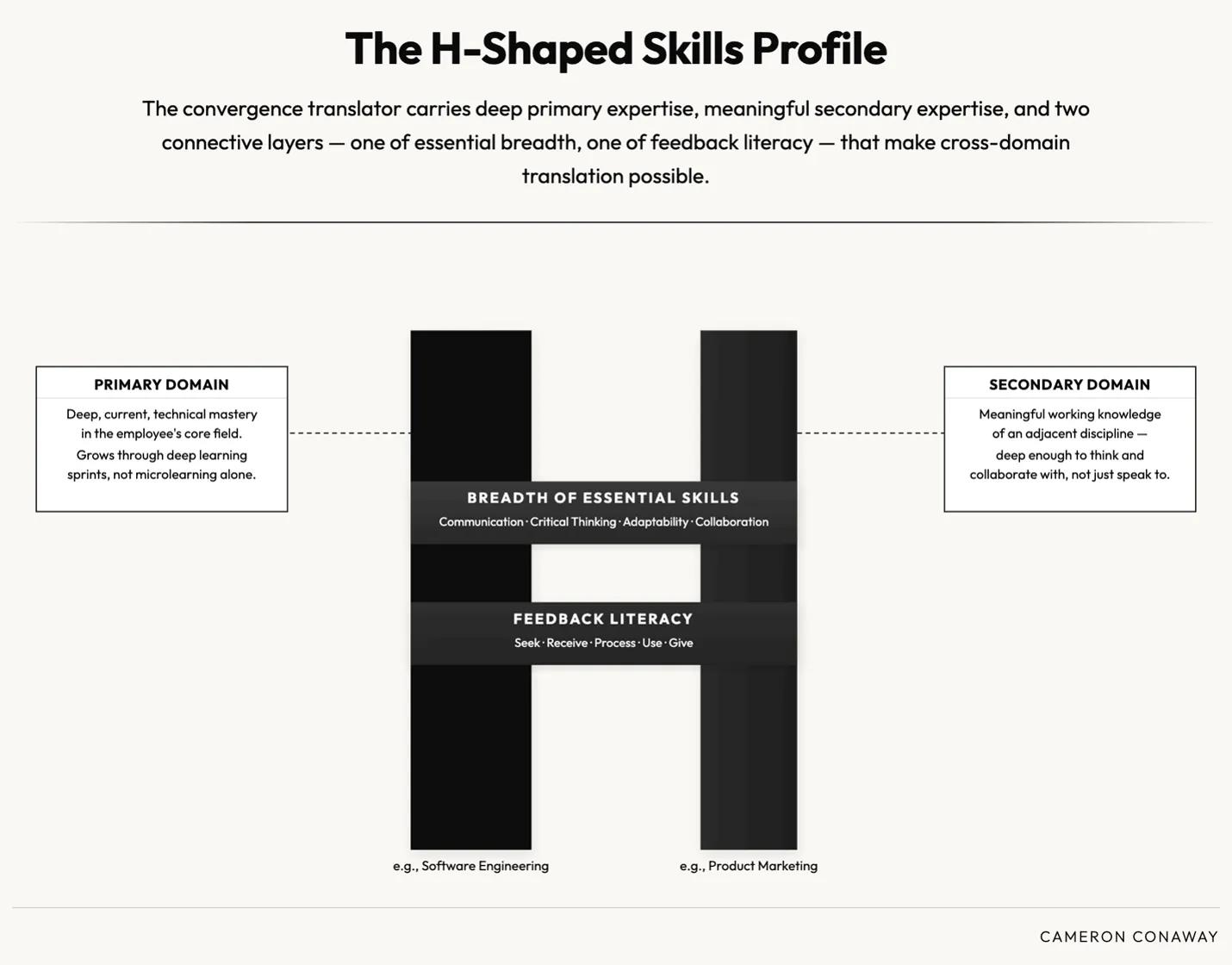
Two vertical pillars: The first represents primary domain expertise that is deep, technical, and current (let’s say software engineering). The second represents a meaningful secondary expertise that people develop to the point where they can think strategically and ask great questions of those whose primary domain is product marketing, for example. There are two horizontal bars connecting them. The first, like McKinsey's T, represents the breadth of foundational skills every professional needs: communication, critical thinking, adaptability, and collaboration. The second horizontal bar, the one that makes the H distinct, represents feedback literacy, which I define as the capacity to seek, receive, process, use, and give feedback across domains, teams, and hierarchies.
Two vertical pillars: The first represents primary domain expertise that is deep, technical, and current (let’s say software engineering). The second represents a meaningful secondary expertise that people develop to the point where they can think strategically and ask great questions of those whose primary domain is product marketing, for example. There are two horizontal bars connecting them. The first, like McKinsey's T, represents the breadth of foundational skills every professional needs: communication, critical thinking, adaptability, and collaboration. The second horizontal bar, the one that makes the H distinct, represents feedback literacy, which I define as the capacity to seek, receive, process, use, and give feedback across domains, teams, and hierarchies.
Content
That second bar is what makes the H-shaped professional genuinely different. In my experience at Cisco, the individuals who unlocked cross-functional collaboration weren't simply those who could speak multiple disciplinary languages or who were on all the calls with various teams. They were driving real and meaningful progress with those teams. And they could give and receive feedback across those differences. One engineering leader who comes to mind could hear a concern from an operations leader, understand what was being said beneath the language, and translate it into something the marketing team could help act on. In this way, I came to see feedback literacy as the connective tissue of convergence.
That second bar is what makes the H-shaped professional genuinely different. In my experience at Cisco, the individuals who unlocked cross-functional collaboration weren't simply those who could speak multiple disciplinary languages or who were on all the calls with various teams. They were driving real and meaningful progress with those teams. And they could give and receive feedback across those differences. One engineering leader who comes to mind could hear a concern from an operations leader, understand what was being said beneath the language, and translate it into something the marketing team could help act on. In this way, I came to see feedback literacy as the connective tissue of convergence.
Look for Signals to Identify Your Potential Translators
Content
Talent development leaders seeking to develop convergence translators should start by identifying individuals who already do so informally. It’s happening, for sure. Find those whom others often bring into cross-functional conversations because they make the room work and help move projects forward. Those strengths are worth doubling down on.
Talent development leaders seeking to develop convergence translators should start by identifying individuals who already do so informally. It’s happening, for sure. Find those whom others often bring into cross-functional conversations because they make the room work and help move projects forward. Those strengths are worth doubling down on.
Content
Talent development leaders seeking to develop convergence translators should start by identifying individuals who already do so informally. To start, they can look for these three signals.
Talent development leaders seeking to develop convergence translators should start by identifying individuals who already do so informally. To start, they can look for these three signals.
Content
Signal #1: Look for colleagues who are often invited to conversations outside their domain (often without being formally assigned to the project). This often happens organically, as with a software engineer who consistently adds value during product strategy meetings. At Cisco, there was a program manager on the operations team whom I always wanted on calls involving projects between our engineering and marketing teams. Why? This takes us to the next signal.
Signal #1: Look for colleagues who are often invited to conversations outside their domain (often without being formally assigned to the project). This often happens organically, as with a software engineer who consistently adds value during product strategy meetings. At Cisco, there was a program manager on the operations team whom I always wanted on calls involving projects between our engineering and marketing teams. Why? This takes us to the next signal.
Content
Signal #2: Find someone who translates rather than just communicates. This program manager helped me understand the engineering team's more technical challenges and helped the marketing team convey the importance of their requests and questions, giving engineering a better sense of what to prioritize. Translation in this way isn't about relaying; it's about reframing one domain's language so others can better understand it.
Signal #2: Find someone who translates rather than just communicates. This program manager helped me understand the engineering team's more technical challenges and helped the marketing team convey the importance of their requests and questions, giving engineering a better sense of what to prioritize. Translation in this way isn't about relaying; it's about reframing one domain's language so others can better understand it.
Content
Signal #3: Who has the feedback literacy to give effective feedback across different domains? In cross-functional settings, cultural and hierarchical norms may mean feedback stays within domains. The convergence translator is someone others trust enough to share their challenges with and is skilled at relaying those challenges in ways that foster mutual understanding.
Signal #3: Who has the feedback literacy to give effective feedback across different domains? In cross-functional settings, cultural and hierarchical norms may mean feedback stays within domains. The convergence translator is someone others trust enough to share their challenges with and is skilled at relaying those challenges in ways that foster mutual understanding.
Developing the H Takes Depth
Content
Identifying H-shaped potential is only the first step. Developing the secondary expertise and feedback literacy requires concentrated (and protected) periods of immersion so deep learning can occur. Without space to play and project-based learning, employees can complete module after module on, for example, agentic AI, and still struggle to see how the pieces fit together in a way that is meaningful for the company.
Identifying H-shaped potential is only the first step. Developing the secondary expertise and feedback literacy requires concentrated (and protected) periods of immersion so deep learning can occur. Without space to play and project-based learning, employees can complete module after module on, for example, agentic AI, and still struggle to see how the pieces fit together in a way that is meaningful for the company.
Content
Given the pace of technological change, a gap between completed learning and the capacity to use it has a massive impact on the bottom line. This is why I believe talent must have opportunities to take leaps in their learning. Not catch up and not stitch modules together to have a sense of how things work, but leap towards developing a practical understanding they can use.
Given the pace of technological change, a gap between completed learning and the capacity to use it has a massive impact on the bottom line. This is why I believe talent must have opportunities to take leaps in their learning. Not catch up and not stitch modules together to have a sense of how things work, but leap towards developing a practical understanding they can use.
Content
Fragmented learning often produces fragmented understanding. Talent, and the organizations they power, can no longer afford to incrementally learn everything. Employees can complete module after module on agentic AI and still struggle to see how the pieces fit together—let alone have the time and space to be playful and develop the confidence to build something meaningful with them.
Fragmented learning often produces fragmented understanding. Talent, and the organizations they power, can no longer afford to incrementally learn everything. Employees can complete module after module on agentic AI and still struggle to see how the pieces fit together—let alone have the time and space to be playful and develop the confidence to build something meaningful with them.
Content
That gap between completion and capability is what I call incremental lag: the widening distance between how fast technology moves and how deeply humans can absorb it when learning is always squeezed between everything else. Today, talent must leap in their learning. Yes, this may mean leaping just to catch up. To do so, talent development leaders must provide concentrated periods of time for deep learning , the kind that can allow employees to develop enough topical expertise that they can discover ways to apply what they learn to the work in front of them.
That gap between completion and capability is what I call incremental lag: the widening distance between how fast technology moves and how deeply humans can absorb it when learning is always squeezed between everything else. Today, talent must leap in their learning. Yes, this may mean leaping just to catch up. To do so, talent development leaders must provide concentrated periods of time for deep learning, the kind that can allow employees to develop enough topical expertise that they can discover ways to apply what they learn to the work in front of them.
Content
Let's say leadership flags a high-potential software engineer as H-shaped. They note that she is consistently pulled into product strategy conversations and has an instinct for translating technical constraints into language the business can act on. To develop her into a convergence translator, her organization designs a 90-day deep learning plan in which she spends every Friday with the product marketing team in ways she can not only observe but also contribute: attending planning sessions, co-presenting a roadmap to leadership, and working alongside them on a product launch. By the end of the sprint, both pillars of her H are stronger.
Let's say leadership flags a high-potential software engineer as H-shaped. They note that she is consistently pulled into product strategy conversations and has an instinct for translating technical constraints into language the business can act on. To develop her into a convergence translator, her organization designs a 90-day deep learning plan in which she spends every Friday with the product marketing team in ways she can not only observe but also contribute: attending planning sessions, co-presenting a roadmap to leadership, and working alongside them on a product launch. By the end of the sprint, both pillars of her H are stronger.
Content
The best learning environments share a quality that is increasingly rare at work: they feel like genuine extensions of education at its most practical. Employees need time to play with new tools, to fail cheaply, to be uncomfortable in safe environments, to ask questions that feel too basic to ask in a meeting. That only happens when leadership grants and protects margin for experimentation, failure, and learning— when a growth plan is intentional and competes with nothing else.
The best learning environments share a quality that is increasingly rare at work: they feel like genuine extensions of education at its most practical. Employees need time to play with new tools, to fail cheaply, to be uncomfortable in safe environments, to ask questions that feel too basic to ask in a meeting. That only happens when leadership grants and protects margin for experimentation, failure, and learning— when a growth plan is intentional and competes with nothing else.
Make Feedback Literacy Foundational, and Not Siloed
Content
Here is where many organizations leave the most value on the table.
Here is where many organizations leave the most value on the table.
Content
Feedback training often splits employees into two camps that focus only on two components: 1) people managers learn to give feedback and 2) individual contributors learn to receive it. The division is understandable but false. In the 18-month Cisco project, some of the most important feedback came from individual contributors, the people closest to the user experience, whose observations dramatically improved both the product and the strategic direction.
Feedback training often splits employees into two camps that focus only on two components: 1) people managers learn to give feedback and 2) individual contributors learn to receive it. The division is understandable but false. In the 18-month Cisco project, some of the most important feedback came from individual contributors, the people closest to the user experience, whose observations dramatically improved both the product and the strategic direction.
Content
Feedback literacy has five components: seeking, receiving, processing, using, and giving. Every employee, at every level, needs capacity in all five. And when embedded across all L&D programs—including deep learning plans, onboarding, and cross-functional projects—those five components become the connective tissue that makes convergence translators effective.
Feedback literacy has five components: seeking, receiving, processing, using, and giving. Every employee, at every level, needs capacity in all five. And when embedded across all L&D programs—including deep learning plans, onboarding, and cross-functional projects—those five components become the connective tissue that makes convergence translators effective.
Content
Consider the example of the software engineer. Midway through her 90-day plan, she seeks feedback from a product marketing colleague about how her technical presentation landed with non-technical stakeholders. She receives feedback that she assumed too much shared context. She resists the urge to agree or disagree immediately and instead asks for time to process it. Part of her processing phase involves watching the recording of her performance. In doing so, she realizes that, yes, she went too deep into the technical waters.
Consider the example of the software engineer. Midway through her 90-day plan, she seeks feedback from a product marketing colleague about how her technical presentation landed with non-technical stakeholders. She receives feedback that she assumed too much shared context. She resists the urge to agree or disagree immediately and instead asks for time to process it. Part of her processing phase involves watching the recording of her performance. In doing so, she realizes that, yes, she went too deep into the technical waters.
Content
She uses that feedback to redesign the way she frames technical trade-offs in future cross-functional conversations. Also, at this midway point, she has seen enough of how marketing operates to give them feedback on how using a P0/P1 ranking system could both help them set boundaries as new requests come in and help engineering better prioritize which of their asks to work on first. Each of the five feedback literacy components deepens her H and strengthens her ability to translate across the organization.
She uses that feedback to redesign the way she frames technical trade-offs in future cross-functional conversations. Also, at this midway point, she has seen enough of how marketing operates to give them feedback on how using a P0/P1 ranking system could both help them set boundaries as new requests come in and help engineering better prioritize which of their asks to work on first. Each of the five feedback literacy components deepens her H and strengthens her ability to translate across the organization.
Content
When feedback training siphons colleagues into camps and focuses only on giving and receiving, it leaves three vital skills on the table. Even a colleague strong in two domains will struggle to translate across them.
When feedback training siphons colleagues into camps and focuses only on giving and receiving, it leaves three vital skills on the table. Even a colleague strong in two domains will struggle to translate across them.
Building Learning Velocity
Content
Tenure and credentials, that 1–2 punch, were once reasonable signals of learning in environments where change moved slowly enough that topical depth could accumulate and then hold for decent stretches of time.
Tenure and credentials, that 1–2 punch, were once reasonable signals of learning in environments where change moved slowly enough that topical depth could accumulate and then hold for decent stretches of time.
Content
The most valuable talent question an organization can ask in the AI era isn't "how long has this person been doing this?" It's "how fast does this person go from learning to doing, and how well do they share their learnings and doings?" Learning velocity—the rate at which someone can absorb new capabilities and apply them—is the new talent currency. And it is trainable, provided the architecture supports it.
The most valuable talent question an organization can ask in the AI era isn't "how long has this person been doing this?" It's "how fast does this person go from learning to doing, and how well do they share their learnings and doings?" Learning velocity—the rate at which someone can absorb new capabilities and apply them—is the new talent currency. And it is trainable, provided the architecture supports it.
Content
TD leaders who want to restructure pipelines around learning velocity should focus on three moves. First, audit how learning is currently structured and identify where fragmented learning is a substitute for depth rather than a complement to it. Second, design at least one deep learning sprint per year for teams in high-velocity domains—a protected, resourced period where they can go genuinely deep and even embed themselves in another domain (as in the Friday example). Third, make the identification and development of convergence translators, tailoring their H-shape to your needs, an explicit part of your talent strategy.
TD leaders who want to restructure pipelines around learning velocity should focus on three moves. First, audit how learning is currently structured and identify where fragmented learning is a substitute for depth rather than a complement to it. Second, design at least one deep learning sprint per year for teams in high-velocity domains—a protected, resourced period where they can go genuinely deep and even embed themselves in another domain (as in the Friday example). Third, make the identification and development of convergence translators, tailoring their H-shape to your needs, an explicit part of your talent strategy.
Content
The organizations that take the talent leap will be those that create the conditions for dramatic, deep learning and develop the convergence translators who can move what was learned across teams, domains, and silos. In this way and with these skills, rising talent can lift all talent.
The organizations that take the talent leap will be those that create the conditions for dramatic, deep learning and develop the convergence translators who can move what was learned across teams, domains, and silos. In this way and with these skills, rising talent can lift all talent.
View Courses Recommended for You