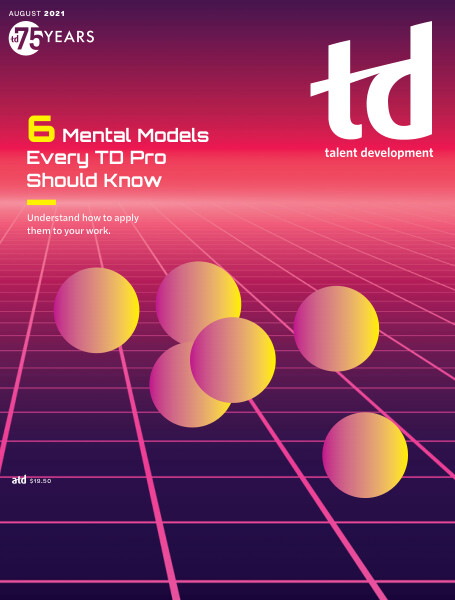
TD Magazine Article
Member Benefit
August 2021 TD Authors: What's on Your Bookshelf?
Content
Contributors to the August 2021 issue of TD magazine offer their book recommendations.
Contributors to the August 2021 issue of TD magazine offer their book recommendations.
Fri Jul 30 2021
Content
Contributors to the August 2021 issue of TD magazine offer their book recommendations.
Contributors to the August 2021 issue of TD magazine offer their book recommendations.
Content
Kathryn Zukof
Kathryn Zukof
Content
Big Magic: Creative Living Beyond Fear by Elizabeth Gilbert
Big Magic: Creative Living Beyond Fear by Elizabeth Gilbert
Content
This book provides inspiration and practical advice on how to develop the courage and discipline to incorporate more creativity into your life. Gilbert provides an incredibly accurate description, at least for me, of the gripping fear that can prevent us from putting our work out there and perspective on how to blow past that fear.
This book provides inspiration and practical advice on how to develop the courage and discipline to incorporate more creativity into your life. Gilbert provides an incredibly accurate description, at least for me, of the gripping fear that can prevent us from putting our work out there and perspective on how to blow past that fear.
Content
Counting: How We Use Numbers to Decide What Matters by Deborah Stone
Counting: How We Use Numbers to Decide What Matters by Deborah Stone
Content
Stone provides insight into how categorizing and enumerating influences limits the ways we define personal, workplace, and societal problems. This book, which is wonderfully readable, is for anyone who’s interested in wrestling with measurement.
Stone provides insight into how categorizing and enumerating influences limits the ways we define personal, workplace, and societal problems. This book, which is wonderfully readable, is for anyone who’s interested in wrestling with measurement.
Content
Arun Pradhan
Arun Pradhan
Content
How to Change: The Science of Getting from Where You Are to Where You Want to Be by Katy Milkman
How to Change: The Science of Getting from Where You Are to Where You Want to Be by Katy Milkman
Content
Milkman has been the inspiration for several models on ModelThinkers. This new book continues her exploration of nudges, habits, and the practical side of behavioral science to embed change.
Milkman has been the inspiration for several models on ModelThinkers. This new book continues her exploration of nudges, habits, and the practical side of behavioral science to embed change.
Content
Clark Quinn
Clark Quinn
Content
How Emotions Are Made: The Secret Life of the Brain by Lisa Feldman Barrett
How Emotions Are Made: The Secret Life of the Brain by Lisa Feldman Barrett
Content
This book does two important things. First, it makes an accessible introduction to the new model of cognition as a prediction engine. Second, it uses that architecture to make a new claim about emotions: They're not the basic building blocks that we envision but instead are cultural concepts that we can create and, more importantly, change.
This book does two important things. First, it makes an accessible introduction to the new model of cognition as a prediction engine. Second, it uses that architecture to make a new claim about emotions: They're not the basic building blocks that we envision but instead are cultural concepts that we can create and, more importantly, change.
Content
The Extended Mind: The Power of Thinking Outside the Brain by Annie Murphy Paul
The Extended Mind: The Power of Thinking Outside the Brain by Annie Murphy Paul
Content
This book brings together a suite of related research in cognition—including distributed, situated, and embodied cognition—that enriches (and corrects) our thinking about thinking. Not only is this research interesting and important, but there are significant implications for what we as talent development professionals do.
This book brings together a suite of related research in cognition—including distributed, situated, and embodied cognition—that enriches (and corrects) our thinking about thinking. Not only is this research interesting and important, but there are significant implications for what we as talent development professionals do.