TD Magazine Article
Member Benefit
Beware of Faulty Filters in Your Hunt for Talent
Content
Open minds close open positions.
Open minds close open positions.
Fri May 01 2020

Content
Horace is driving a decrepit old car through a rural area. He brakes suddenly when another driver comes hurtling around a sharp bend in the road in a large Rolls Royce. The driver sees him, shouts "Pig!" at him, and drives past. "Cow!" he yells back in retaliation and heads around the bend himself, crashing head-on into the biggest pig he has ever seen.
Horace is driving a decrepit old car through a rural area. He brakes suddenly when another driver comes hurtling around a sharp bend in the road in a large Rolls Royce. The driver sees him, shouts "Pig!" at him, and drives past. "Cow!" he yells back in retaliation and heads around the bend himself, crashing head-on into the biggest pig he has ever seen.
Content
If that old story elicited a chuckle, good. We hope it will lead you to wonder what caused Horace to mistake an innocent warning for an insult: Was it his assumption that the driver of an expensive car would view him with contempt? Did he have a previous experience driving through that neighborhood? Was it his bias against people who shout at motorists?
If that old story elicited a chuckle, good. We hope it will lead you to wonder what caused Horace to mistake an innocent warning for an insult: Was it his assumption that the driver of an expensive car would view him with contempt? Did he have a previous experience driving through that neighborhood? Was it his bias against people who shout at motorists?
Content
Yes, yes, and yes. Each of those is a mind filter.
Yes, yes, and yes. Each of those is a mind filter.
Content
If Horace had avoided those filters, kept an open mind, and viewed the situation through a less cloudy window on the world, he may have had a more informed reaction, been more receptive to the other driver's warning, and ultimately steered clear of the pig.
If Horace had avoided those filters, kept an open mind, and viewed the situation through a less cloudy window on the world, he may have had a more informed reaction, been more receptive to the other driver's warning, and ultimately steered clear of the pig.
Content
Unlikely as it may seem, that story provides a valuable lesson for executives and line managers looking to fill open positions. Why? Because Horace's filters are similar to the ones that can cause leaders to set inaccurate job requirements; create biased profiles of an ideal candidate; place unwarranted importance on one type of skill, education, or behavior over another; or inaccurately view and prematurely dismiss highly talented candidates.
Unlikely as it may seem, that story provides a valuable lesson for executives and line managers looking to fill open positions. Why? Because Horace's filters are similar to the ones that can cause leaders to set inaccurate job requirements; create biased profiles of an ideal candidate; place unwarranted importance on one type of skill, education, or behavior over another; or inaccurately view and prematurely dismiss highly talented candidates.
Content
In the words of writer Isaac Asimov, "Your assumptions are your windows on the world," and they make up the lens through which individuals view events, people, relationships, decisions, and so much more. As such, they help explain both what caused Horace to misinterpret the meaning and intent of "Pig!" and what leads executives and managers to sabotage their own talent hunts. But they do not address the more important issue of how to avoid the filters that cloud perception in the first place. The answer, however, is fairly simple. It starts with having an open mind.
In the words of writer Isaac Asimov, "Your assumptions are your windows on the world," and they make up the lens through which individuals view events, people, relationships, decisions, and so much more. As such, they help explain both what caused Horace to misinterpret the meaning and intent of "Pig!" and what leads executives and managers to sabotage their own talent hunts. But they do not address the more important issue of how to avoid the filters that cloud perception in the first place. The answer, however, is fairly simple. It starts with having an open mind.
Content
An open mind is one that is free of the faulty filters, assumptions, biases, and partisan beliefs that can misshape opinions, skew attitudes, and cloud objectivity. In the corporate world, it is ostensibly valued, desired, and even demanded—too often by those who don't demonstrate it themselves. This may be because developing and maintaining an open mind requires work.
An open mind is one that is free of the faulty filters, assumptions, biases, and partisan beliefs that can misshape opinions, skew attitudes, and cloud objectivity. In the corporate world, it is ostensibly valued, desired, and even demanded—too often by those who don't demonstrate it themselves. This may be because developing and maintaining an open mind requires work.
Content
From our experience, we have distilled a few ideas for opening the minds of those who are trying to fill open positions.
From our experience, we have distilled a few ideas for opening the minds of those who are trying to fill open positions.
Content
Notice what you notice
Notice what you notice
Content
One of the first steps toward an open mind is to develop an awareness of what may be closing it. A good way to begin is to simply notice what you notice. It's a practice you can exercise on the job and is a useful way to identify filters that could potentially prevent your neutral, objective consideration of potentially valuable additions to your team.
One of the first steps toward an open mind is to develop an awareness of what may be closing it. A good way to begin is to simply notice what you notice. It's a practice you can exercise on the job and is a useful way to identify filters that could potentially prevent your neutral, objective consideration of potentially valuable additions to your team.
Content
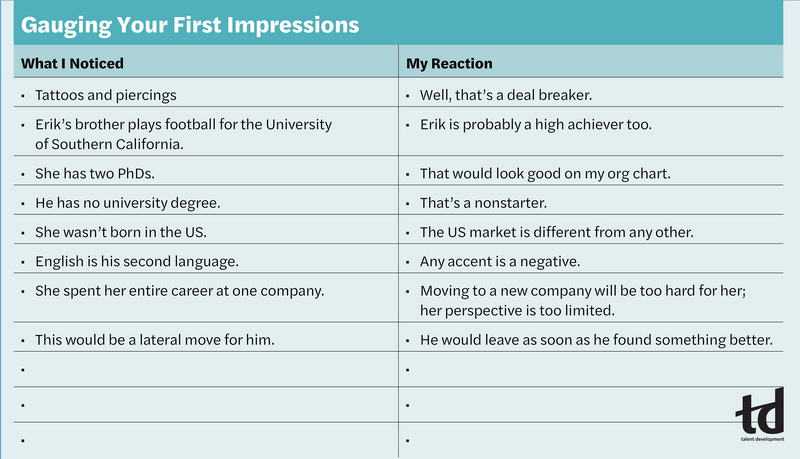
As you go about your day, pay attention to anything that stands out in your mind above others. Be aware of your first impressions and reactions—positive or negative—to certain words, smells, sounds, ideas, language, apparel, hair styles, labels, titles, and so on. See the table below for examples, and add your own observations and reactions.
As you go about your day, pay attention to anything that stands out in your mind above others. Be aware of your first impressions and reactions—positive or negative—to certain words, smells, sounds, ideas, language, apparel, hair styles, labels, titles, and so on. See the table below for examples, and add your own observations and reactions.
Content
If you are like most of our clients, you will discover a few reactions that could potentially—and faultily—affect one of your selection decisions. If so, what can you do to adjust them? One way is to use the table to record your key observations and reactions to the next candidate or resume you see, then answer these reflection questions:
If you are like most of our clients, you will discover a few reactions that could potentially—and faultily—affect one of your selection decisions. If so, what can you do to adjust them? One way is to use the table to record your key observations and reactions to the next candidate or resume you see, then answer these reflection questions:
Content
Why did I notice what I noticed or react the way I did?
Why did I notice what I noticed or react the way I did?
Content
What alternative reactions could I have?
What alternative reactions could I have?
Content
Would my colleagues react the way I did? Why or why not?
Would my colleagues react the way I did? Why or why not?
Content
Would what I noticed impair the candidate's job performance in this role?
Would what I noticed impair the candidate's job performance in this role?
Content
How valid is my reaction to what I noticed? Do I have data to support it, or is it a possibly faulty assumption?
How valid is my reaction to what I noticed? Do I have data to support it, or is it a possibly faulty assumption?
Content
Am I judging this person by a set of standards the individual does not share? If so, is it a set of standards that reflects my company's values, a set of standards that is relevant to the job requirements, or just my personal set of standards?
Am I judging this person by a set of standards the individual does not share? If so, is it a set of standards that reflects my company's values, a set of standards that is relevant to the job requirements, or just my personal set of standards?
Ask more questions and question more answers
Content
At every stage of a talent hunt, executives and managers risk looking through any number of faulty filters that could negatively influence their decision making and unnecessarily lengthen their search. As talent hunters, they are initially motivated but often in a hurry to answer key questions about the job opening. And filters, unfortunately, offer handy shortcuts.
At every stage of a talent hunt, executives and managers risk looking through any number of faulty filters that could negatively influence their decision making and unnecessarily lengthen their search. As talent hunters, they are initially motivated but often in a hurry to answer key questions about the job opening. And filters, unfortunately, offer handy shortcuts.
Content
As a result, answers to "What are the job requirements?," "What does the ideal candidate look like?," and "Where should we search?" tend to reflect those filters. And the more filters there are, the less information gets in. The less information there is, the faster managers can process it. The faster they process it, the sooner they can make a decision. And the sooner they decide, the quicker the job opening will close. Makes perfect sense, right?
As a result, answers to "What are the job requirements?," "What does the ideal candidate look like?," and "Where should we search?" tend to reflect those filters. And the more filters there are, the less information gets in. The less information there is, the faster managers can process it. The faster they process it, the sooner they can make a decision. And the sooner they decide, the quicker the job opening will close. Makes perfect sense, right?
Content
Only until you fast-forward to the point where the original questions invariably morph into tougher ones such as "Why are there so few qualified candidates?," "Why didn't somebody mention this in the beginning?," and, ultimately, "Why is this taking so long?"
Only until you fast-forward to the point where the original questions invariably morph into tougher ones such as "Why are there so few qualified candidates?," "Why didn't somebody mention this in the beginning?," and, ultimately, "Why is this taking so long?"
Content
Sound familiar? If so, try asking the following questions before or during your search.
Sound familiar? If so, try asking the following questions before or during your search.
Content
Whom should I consult before writing the job requirements and candidate profile? Inviting others to contribute to the "pre-search" could not only broaden your perception of what you need but also help clear up any unconscious filters you have in place. It also enables you to look beyond information that simply affirms what you already think.
Whom should I consult before writing the job requirements and candidate profile? Inviting others to contribute to the "pre-search" could not only broaden your perception of what you need but also help clear up any unconscious filters you have in place. It also enables you to look beyond information that simply affirms what you already think.
Content
Clearly, there are valid reasons for eliciting opinions and input from others in preparing job requirements and candidate profiles, but which others? Every situation is different, but here are some possible contributors to consider:
Clearly, there are valid reasons for eliciting opinions and input from others in preparing job requirements and candidate profiles, but which others? Every situation is different, but here are some possible contributors to consider:
Content
Team members. Ask them to describe the overarching team process the new hire will be part of and that individual's role in it.
Team members. Ask them to describe the overarching team process the new hire will be part of and that individual's role in it.
Content
Customers. If you are trying to fill a customer-facing role, who better to consult about job requirements than those who chose to be your customers?
Customers. If you are trying to fill a customer-facing role, who better to consult about job requirements than those who chose to be your customers?
Content
Job analyst. If you have people whose role is to determine a position's duties and the nature of performance evaluation, by all means consult them.
Job analyst. If you have people whose role is to determine a position's duties and the nature of performance evaluation, by all means consult them.
Content
Current job holders. These individuals may provide valuable insight into what their typical day looks like, their role relative to others in the process they're involved in, the key issues or problems they face, how to handle or avoid them, and more. You can even ask them how to revise the current job description to better reflect what's really happening in the role.
Current job holders. These individuals may provide valuable insight into what their typical day looks like, their role relative to others in the process they're involved in, the key issues or problems they face, how to handle or avoid them, and more. You can even ask them how to revise the current job description to better reflect what's really happening in the role.
Content
Your supervisor. This person provides a good reality check and a fresh set of eyes.
Your supervisor. This person provides a good reality check and a fresh set of eyes.
Content
How many of my must-haves are there? The dictionary definition of must-have is "an essential or highly desirable item." So, which is it? Must-haves are excellent ways to limit your talent options.
How many of my must-haves are there? The dictionary definition of must-have is "an essential or highly desirable item." So, which is it? Must-haves are excellent ways to limit your talent options.
Content
Hard-and-fast candidate filters almost invariably leave you upstream without an or. Plus, the trip back to dry land can add hours or even days to your talent search. To avoid that, examine and add an or to your must-haves. For example, the candidate must:
Hard-and-fast candidate filters almost invariably leave you upstream without an or. Plus, the trip back to dry land can add hours or even days to your talent search. To avoid that, examine and add an or to your must-haves. For example, the candidate must:
Content
Have experience in our industry or demonstrate how their other-industry experience can add value to our business.
Have experience in our industry or demonstrate how their other-industry experience can add value to our business.
Content
Leap tall buildings in a single bound or leap smaller buildings but more of them.
Leap tall buildings in a single bound or leap smaller buildings but more of them.
Content
Come from outside our firm or not.
Come from outside our firm or not.
Content
Live close enough to be in the office every day or be willing to \[fill in the blank\].
Live close enough to be in the office every day or be willing to \[fill in the blank\].
Content
Have worked in a startup or demonstrate an entrepreneurial mindset.
Have worked in a startup or demonstrate an entrepreneurial mindset.
Content
Have an MBA or rich business experience with demonstrated accomplishments.
Have an MBA or rich business experience with demonstrated accomplishments.
Content
Have worked in a publicly traded company or in a company that governed itself using the practices of a publicly traded company.
Have worked in a publicly traded company or in a company that governed itself using the practices of a publicly traded company.
Content
What are my assumptions about the ideal candidate and how realistic are they? Thinking that candidates can easily fit into neat classifications limits your thinking and makes it far too easy to eliminate potentially high-caliber people. It also causes the search to take longer than it should. Be honest with yourself: What more realistic requirement could you set?
What are my assumptions about the ideal candidate and how realistic are they? Thinking that candidates can easily fit into neat classifications limits your thinking and makes it far too easy to eliminate potentially high-caliber people. It also causes the search to take longer than it should. Be honest with yourself: What more realistic requirement could you set?
Content
What am I not seeing? Candidate interviews are where faulty filters most often rear their ugly heads. Open-minded people know they are not all-knowing. They realize their perception of someone is more complicated than they consciously realize, so they are more inclined to seek out and understand alternative perceptions. This effort itself expands their minds and leads them to re-examine opinions, assumptions, and filters—theirs and others'.
What am I not seeing? Candidate interviews are where faulty filters most often rear their ugly heads. Open-minded people know they are not all-knowing. They realize their perception of someone is more complicated than they consciously realize, so they are more inclined to seek out and understand alternative perceptions. This effort itself expands their minds and leads them to re-examine opinions, assumptions, and filters—theirs and others'.
Content
Remember that people and their experiences are nuanced, and this fact alone makes them worth noticing rather than dismissing. Ensure that your selection process involves more interviewers than yourself.
Remember that people and their experiences are nuanced, and this fact alone makes them worth noticing rather than dismissing. Ensure that your selection process involves more interviewers than yourself.
Content
Why did I think that last candidate (or resume) was perfect (or awful), when no one else did? That is probably one of the best questions to ask if you want to uncover unconscious filters. Did you give the candidate more points for certain experiences than other interviewers did? If so, why? Did you give the individual fewer points for certain resume features than other screeners did? If so, why?
Why did I think that last candidate (or resume) was perfect (or awful), when no one else did? That is probably one of the best questions to ask if you want to uncover unconscious filters. Did you give the candidate more points for certain experiences than other interviewers did? If so, why? Did you give the individual fewer points for certain resume features than other screeners did? If so, why?
Content
To help you avoid potential filters, try having someone remove the name, address, educational degrees, and age- and gender-indicating information from the next resume you scan. Then, after you've made a go or no-go decision, re-read it with the missing information included and see whether you discover anything interesting.
To help you avoid potential filters, try having someone remove the name, address, educational degrees, and age- and gender-indicating information from the next resume you scan. Then, after you've made a go or no-go decision, re-read it with the missing information included and see whether you discover anything interesting.
Content
How important is it? The importance you place on certain characteristics can reflect a filter you don't even know you're using. Are the requirements you set critical to doing the job, doing the job well, or doing the job perfectly? Your focus on perfect versus very good may be a filter—and it could make a difference in how long it takes to fill an open position. A question closely related to that one is next.
How important is it? The importance you place on certain characteristics can reflect a filter you don't even know you're using. Are the requirements you set critical to doing the job, doing the job well, or doing the job perfectly? Your focus on perfect versus very good may be a filter—and it could make a difference in how long it takes to fill an open position. A question closely related to that one is next.
Content
Am I in more of a hurry than I need to be? Probably. One of our favorite axioms is "Crawl to conclusions." Here are some others: "Speed is inconsequential if you're headed in the wrong direction." "Good, cheap, or fast. Pick any two." "Speed kills."
Am I in more of a hurry than I need to be? Probably. One of our favorite axioms is "Crawl to conclusions." Here are some others: "Speed is inconsequential if you're headed in the wrong direction." "Good, cheap, or fast. Pick any two." "Speed kills."
Build to suit
Content
We believe there is a must-have question to ask in any critical talent search, one that deserves to be called out separately: What would I do if I had to fill this position with a current employee?
We believe there is a must-have question to ask in any critical talent search, one that deserves to be called out separately: What would I do if I had to fill this position with a current employee?
Content
If you are like most of our clients, that question sends chills up your spine. But the exercise of answering it can be critical in overcoming what we call the NIMBY filter. NIMBY is an acronym for the phrase "Not in my backyard" and is a characterization of resistance by residents to planned developments in their local areas. In our experience, it is also an attitude that is alive, well, and causing many organizations to miss some of their most promising—and easy-to-access—talent resources. And it is a filter that is easy to avoid. How? By planning developments in your local area.
If you are like most of our clients, that question sends chills up your spine. But the exercise of answering it can be critical in overcoming what we call the NIMBY filter. NIMBY is an acronym for the phrase "Not in my backyard" and is a characterization of resistance by residents to planned developments in their local areas. In our experience, it is also an attitude that is alive, well, and causing many organizations to miss some of their most promising—and easy-to-access—talent resources. And it is a filter that is easy to avoid. How? By planning developments in your local area.
Content
Our client work suggests that too many of today's managers know more about job candidates' abilities than they do about their own workers. Therefore, start by becoming more familiar with your team members' current capabilities, potential, and career goals. Approach your employees with an open mind; discover and consider how to leverage their existing potential; and explore how each of them could be coached, trained, or provided with tools and experiences that could help them become the talent you will one day be searching for.
Our client work suggests that too many of today's managers know more about job candidates' abilities than they do about their own workers. Therefore, start by becoming more familiar with your team members' current capabilities, potential, and career goals. Approach your employees with an open mind; discover and consider how to leverage their existing potential; and explore how each of them could be coached, trained, or provided with tools and experiences that could help them become the talent you will one day be searching for.
Content
Filling open positions with current employees does not mean creating something out of nothing. It could simply mean building on property you didn't realize you had.
Filling open positions with current employees does not mean creating something out of nothing. It could simply mean building on property you didn't realize you had.
Content
As vexing as the above questions may be, they will hopefully help you to develop more informed reactions, consider more options, re-examine your assumptions, become more receptive to potentially valuable talent, and ultimately steer clear of pigs in the road. On the other hand, if you have concluded that you have no faulty filters, we'll leave you with this final question: What were your initial assumptions of Horace upon reading the first sentence of this article? Why?
As vexing as the above questions may be, they will hopefully help you to develop more informed reactions, consider more options, re-examine your assumptions, become more receptive to potentially valuable talent, and ultimately steer clear of pigs in the road. On the other hand, if you have concluded that you have no faulty filters, we'll leave you with this final question: What were your initial assumptions of Horace upon reading the first sentence of this article? Why?