TD Magazine Article
Member Benefit
Considerations After Cutbacks
Content
What strategies can help retain and engage the “survivors” of a company layoff?
What strategies can help retain and engage the “survivors” of a company layoff?
Mon Jun 03 2024

Content
What strategies can help retain and engage the survivors" of a company layoff?
What strategies can help retain and engage the survivors" of a company layoff?
Content
Recent headlines make it clear that many professionals have received—or soon will receive—pink slips. Consider these news summaries:
Recent headlines make it clear that many professionals have received—or soon will receive—pink slips. Consider these news summaries:
Content
At least 48,000 employees at US-based technology companies have lost their jobs so far in 2024, according to a Crunchbase News tally.
At least 48,000 employees at US-based technology companies have lost their jobs so far in 2024, according to a Crunchbase News tally.
Content
Companies laid off more than 305,000 US workers in 2023 in a series of mass layoffs that started, most notably, with technology companies but then spread across industries, Forbes reports.
Companies laid off more than 305,000 US workers in 2023 in a series of mass layoffs that started, most notably, with technology companies but then spread across industries, Forbes reports.
Content
Nike announced it expects to incur $400 million to $450 million in employee severance costs as it lays off more than 1,600 workers, according to Fast Company.
Nike announced it expects to incur $400 million to $450 million in employee severance costs as it lays off more than 1,600 workers, according to Fast Company.
Content
There is one group in those scenarios that employers often overlook: The staff who remain after a layoff. In many ways, of course, the kept-on workforce is in a better situation—but also one that deserves special attention from company leadership. It's time to look seriously at why those individuals require special attention and what the talent development function can do to keep them "keepin' on."
There is one group in those scenarios that employers often overlook: The staff who remain after a layoff. In many ways, of course, the kept-on workforce is in a better situation—but also one that deserves special attention from company leadership. It's time to look seriously at why those individuals require special attention and what the talent development function can do to keep them "keepin' on."
Survivor island
Content
Surviving a round of layoffs can be debilitating for the individuals who remain employed. They can suffer from survivor's guilt, low morale, concern about job security, and the burnout that comes from taking on additional tasks and responsibilities.
Surviving a round of layoffs can be debilitating for the individuals who remain employed. They can suffer from survivor's guilt, low morale, concern about job security, and the burnout that comes from taking on additional tasks and responsibilities.
Content
Within the kept-on workforce are two groups that respond differently to the same circumstance. One group comprises staff who push on despite the negativity, demonstrating resilience by staying upbeat and honing or expanding their skills. They are valuable assets to their companies but also know that there are other options out there, which makes them a flight risk.
Within the kept-on workforce are two groups that respond differently to the same circumstance. One group comprises staff who push on despite the negativity, demonstrating resilience by staying upbeat and honing or expanding their skills. They are valuable assets to their companies but also know that there are other options out there, which makes them a flight risk.
Content
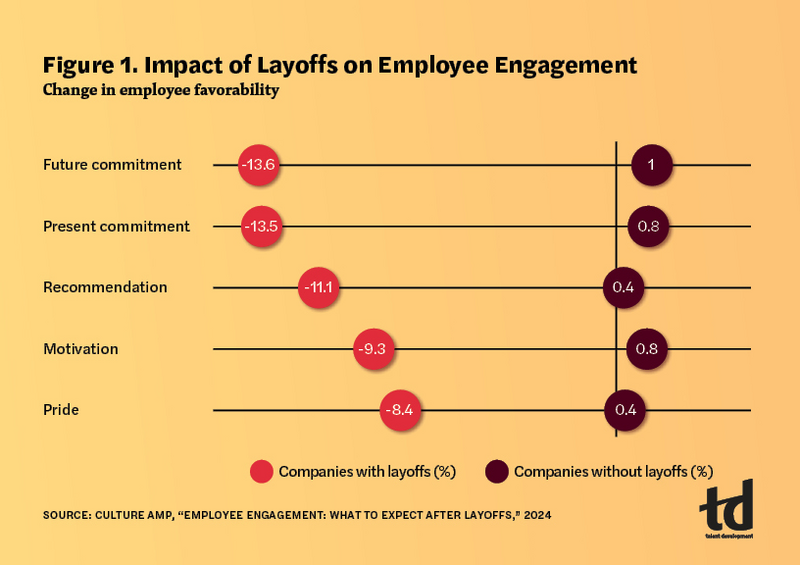
The other group comprises workers who pull back, lacking the skills or resilience to deal effectively with change. They experience an alarming drop in employee engagement (see Figure 1) and are a drag on productivity and morale.
The other group comprises workers who pull back, lacking the skills or resilience to deal effectively with change. They experience an alarming drop in employee engagement (see Figure 1) and are a drag on productivity and morale.
Content
In fact, according to Glassdoor's 2024 Workplace Trends research, "In the 30 days following a layoff, employers' overall rating drops 4 percent ... Additionally, overall ratings stay that low, even 180 days after the layoffs." Further, Glassdoor found that "ratings for Culture & Values and Work-Life balance continue to decline another 3 and 4 percent respectively during the 150 days following the initial 30-day drop. While the impact on Culture and Work-Life Balance may not be immediately felt after a layoff, there can be an ongoing impact from longer-term burnout, weaker employee culture and persistent employee disengagement that employers must be aware of."
In fact, according to Glassdoor's 2024 Workplace Trends research, "In the 30 days following a layoff, employers' overall rating drops 4 percent ... Additionally, overall ratings stay that low, even 180 days after the layoffs." Further, Glassdoor found that "ratings for Culture & Values and Work-Life balance continue to decline another 3 and 4 percent respectively during the 150 days following the initial 30-day drop. While the impact on Culture and Work-Life Balance may not be immediately felt after a layoff, there can be an ongoing impact from longer-term burnout, weaker employee culture and persistent employee disengagement that employers must be aware of."
Not your parents' job market
Content
Employees today have a different perception of their relationship with work than they had before the pandemic. People's priorities have shifted; workers now have a much stronger sense of what they want in a job. A scan of recent surveys regarding what employees want indicates that their key requirements include:
Employees today have a different perception of their relationship with work than they had before the pandemic. People's priorities have shifted; workers now have a much stronger sense of what they want in a job. A scan of recent surveys regarding what employees want indicates that their key requirements include:
Content
Flexibility in work arrangements
Flexibility in work arrangements
Content
Support for well-being, burnout prevention, and work-life balance
Support for well-being, burnout prevention, and work-life balance
Content
Opportunities for advancement
Opportunities for advancement
Content
Work that is personally fulfilling
Work that is personally fulfilling
Content
With the tremendous changes in the job market during the past few years, staff know that if their current employer won't provide at least some of their desires, then another employer will.
With the tremendous changes in the job market during the past few years, staff know that if their current employer won't provide at least some of their desires, then another employer will.
Content
Although the labor market is more stable than it was during the height of the pandemic, "it's still really clear that employees and candidates still have bargaining power," Lexi Clarke, chief people officer at compensation and data company Payscale, told HR Dive.
Although the labor market is more stable than it was during the height of the pandemic, "it's still really clear that employees and candidates still have bargaining power," Lexi Clarke, chief people officer at compensation and data company Payscale, told HR Dive.
Content
"They're looking for caring leaders who respect autonomy and flexibility. But overarchingly, I think they're also looking for workplaces that really reflect their values that fit with their personal mission," Clarke adds. "They're going to be looking for jobs that fit their lives, rather than bending their lives to fit their jobs."
"They're looking for caring leaders who respect autonomy and flexibility. But overarchingly, I think they're also looking for workplaces that really reflect their values that fit with their personal mission," Clarke adds. "They're going to be looking for jobs that fit their lives, rather than bending their lives to fit their jobs."
What it means for employers
Content
If you are a leader, manager, or TD professional whose company is going through downsizing, you are facing a double-barreled challenge. You need to give both the survivor employees who are pushing on and those who are pulling back a reason to stay.
If you are a leader, manager, or TD professional whose company is going through downsizing, you are facing a double-barreled challenge. You need to give both the survivor employees who are pushing on and those who are pulling back a reason to stay.
Content
A key to supporting those groups is to provide professional development opportunities—retrain to retain. But first, it's important to understand their differing motivations and characteristics.
A key to supporting those groups is to provide professional development opportunities—retrain to retain. But first, it's important to understand their differing motivations and characteristics.
Similarities and differences
Content
When layoffs occur, both survivor groups can experience sadness, anger, mistrust, and a psychological uncoupling from their employer. Both have also lost confidence in their organization's commitment to them. Regardless, the company depends on both groups of staff for short- and long-term organizational success.
When layoffs occur, both survivor groups can experience sadness, anger, mistrust, and a psychological uncoupling from their employer. Both have also lost confidence in their organization's commitment to them. Regardless, the company depends on both groups of staff for short- and long-term organizational success.
Content
Layoff survivors all have common concerns and complaints about their new situation, including:
Layoff survivors all have common concerns and complaints about their new situation, including:
Content
Increased workload
Increased workload
Content
Stalled salary increases
Stalled salary increases
Content
Reduced status and title
Reduced status and title
Content
Fewer chances for mobility
Fewer chances for mobility
Content
Greater organizational uncertainty
Greater organizational uncertainty
Content
Fewer career-oriented training opportunities
Fewer career-oriented training opportunities
Content
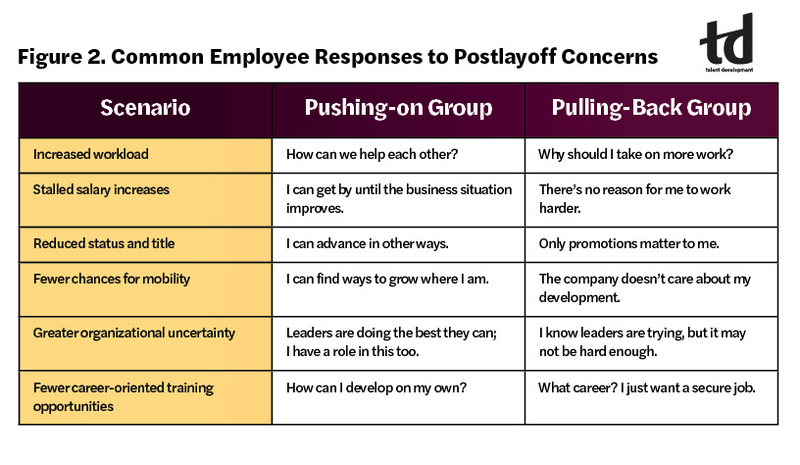
The difference between the two groups soon shows in how they respond to those feelings (see Figure 2). The individuals who are pushing on often can move past their feelings and learn from the experience. In the process, they retool their ideas about the current job and their professional future. They become valuable contributors who actively seek out a synergy between the work they are doing now and the future they are carving for themselves, whether it's with their current employer or at another company.
The difference between the two groups soon shows in how they respond to those feelings (see Figure 2). The individuals who are pushing on often can move past their feelings and learn from the experience. In the process, they retool their ideas about the current job and their professional future. They become valuable contributors who actively seek out a synergy between the work they are doing now and the future they are carving for themselves, whether it's with their current employer or at another company.
Content
Staff who pull back, however, often do not cope well with the changes. They may become stuck, unable to move past their initial emotions and feel trapped in jobs that no longer engage their full energy, interest, or talent. Employees in that group often don't see a way out, mourn the loss of what used to be, and worry that another round of layoffs is lurking around the corner. They may even become quiet quitters, doing the minimum job and withholding the discretionary effort that is the hallmark of employee engagement.
Staff who pull back, however, often do not cope well with the changes. They may become stuck, unable to move past their initial emotions and feel trapped in jobs that no longer engage their full energy, interest, or talent. Employees in that group often don't see a way out, mourn the loss of what used to be, and worry that another round of layoffs is lurking around the corner. They may even become quiet quitters, doing the minimum job and withholding the discretionary effort that is the hallmark of employee engagement.
Content
So, how can TD professionals address employees' negative mindsets and help those who are pulling back renew their productive contributions and personal satisfaction?
So, how can TD professionals address employees' negative mindsets and help those who are pulling back renew their productive contributions and personal satisfaction?
Coaching career self-reliance
Content
The TD function must assist people in the pulling-back group with renewing their productive contributions and building their self-reliance. Help the pulling-back employees reverse their mindset in two ways: Stress the basics and benefits of career self-management and engage with staff to figure out how to activate it in the workplace. The following practices can help.
The TD function must assist people in the pulling-back group with renewing their productive contributions and building their self-reliance. Help the pulling-back employees reverse their mindset in two ways: Stress the basics and benefits of career self-management and engage with staff to figure out how to activate it in the workplace. The following practices can help.
Content
Initiate conversations with staff about the changing nature of the workplace and its likely implications for their industry, organization, and career goals.
Initiate conversations with staff about the changing nature of the workplace and its likely implications for their industry, organization, and career goals.
Content
Cite specific examples of the organization's ongoing commitment to employees' skill and career development.
Cite specific examples of the organization's ongoing commitment to employees' skill and career development.
Content
Brainstorm with team members about practical ways they can take ownership of their own career development.
Brainstorm with team members about practical ways they can take ownership of their own career development.
Content
Encourage them to recognize and articulate their skills, values, competencies, and interests; and then, identify the ways those may be transferable.
Encourage them to recognize and articulate their skills, values, competencies, and interests; and then, identify the ways those may be transferable.
Content
Make it easier for individuals to consciously close gaps in skills and experience with currently available, easy-to-access learning opportunities.
Make it easier for individuals to consciously close gaps in skills and experience with currently available, easy-to-access learning opportunities.
Content
Examine the learning portfolio to determine which training topics would be especially relevant postlayoff.
Examine the learning portfolio to determine which training topics would be especially relevant postlayoff.
Content
Explore and share in-house opportunities for staff to grow in place or pursue opportunities in other parts of the company.
Explore and share in-house opportunities for staff to grow in place or pursue opportunities in other parts of the company.
Content
Promote the potential benefits of employee career self-management to the organization, such as staff autonomy, employee buy-in to reskilling, enhanced employee experience, greater engagement, and increased retention.
Promote the potential benefits of employee career self-management to the organization, such as staff autonomy, employee buy-in to reskilling, enhanced employee experience, greater engagement, and increased retention.
Content
The pulling-back group can experience a turnaround with such help, but they can also help themselves by asking tough questions, such as:
The pulling-back group can experience a turnaround with such help, but they can also help themselves by asking tough questions, such as:
Content
What skills and competencies have I used in the past that are no longer vital to my current position or my department's mission?
What skills and competencies have I used in the past that are no longer vital to my current position or my department's mission?
Content
What new skills, abilities, and competencies in my department are critical for our organization's future? Which of them can I acquire and how?
What new skills, abilities, and competencies in my department are critical for our organization's future? Which of them can I acquire and how?
Content
What can I learn from others about adjusting to the current situation?
What can I learn from others about adjusting to the current situation?
Content
If I'm caught in the next downsizing or outsourcing, what are my options inside and outside my company?
If I'm caught in the next downsizing or outsourcing, what are my options inside and outside my company?
Content
How can I begin moving in new directions before the company forces a change on me?
How can I begin moving in new directions before the company forces a change on me?
Content
What are my choices within the organization? How can I network with others to make it happen? Can my manager help?
What are my choices within the organization? How can I network with others to make it happen? Can my manager help?
Content
If I could create my own learning plan to enhance my career options within and outside of my company, would I commit to that agenda? Am I willing to invest my own time and money?
If I could create my own learning plan to enhance my career options within and outside of my company, would I commit to that agenda? Am I willing to invest my own time and money?
Content
In addition to your role in implementing other postlayoff retention tactics, you are well positioned to help employees work through those questions and determine next steps. The best TD practitioners will have the questions in front of them as they work directly with staff and their managers, encouraging them to think wider and deeper about each question. They may share their own answers with employees and their managers. But, most notably, you must ask, "How can I help?"—and then answer that question for yourself and for those employees who pull back.
In addition to your role in implementing other postlayoff retention tactics, you are well positioned to help employees work through those questions and determine next steps. The best TD practitioners will have the questions in front of them as they work directly with staff and their managers, encouraging them to think wider and deeper about each question. They may share their own answers with employees and their managers. But, most notably, you must ask, "How can I help?"—and then answer that question for yourself and for those employees who pull back.
Content
When it comes to keeping the pushing-on group, help them maintain and enhance their positive mindset by:
When it comes to keeping the pushing-on group, help them maintain and enhance their positive mindset by:
Content
Keeping in mind the importance of building trust with those employees
Keeping in mind the importance of building trust with those employees
Content
Acknowledging them for keeping their heads above water and letting them know how the company appreciates them
Acknowledging them for keeping their heads above water and letting them know how the company appreciates them
Content
Helping them learn the basics of career self-management
Helping them learn the basics of career self-management
Content
Pointing out how much they have to offer
Pointing out how much they have to offer
Content
Periodically asking them stay interview questions
Periodically asking them stay interview questions
Content
Having more in-depth development conversations with them; asking how they want to grow and what support they need (consider doubling down on career development offerings)
Having more in-depth development conversations with them; asking how they want to grow and what support they need (consider doubling down on career development offerings)
Content
Reminding them that there is life after downsizing and that the organization is not going away
Reminding them that there is life after downsizing and that the organization is not going away
Content
Demonstrate to both groups that there are possibilities for satisfying career lives within the company. Emphasize that their current organizational experience isn't the end of their career growth but the beginning of new development possibilities.
Demonstrate to both groups that there are possibilities for satisfying career lives within the company. Emphasize that their current organizational experience isn't the end of their career growth but the beginning of new development possibilities.
Content
Ultimately, the goal is to help them internalize and articulate that "My plan is no longer a static picture of what I know about myself and my organization. Instead, it's an ongoing work in progress that requires continual adjustment."
Ultimately, the goal is to help them internalize and articulate that "My plan is no longer a static picture of what I know about myself and my organization. Instead, it's an ongoing work in progress that requires continual adjustment."
Still standing
Content
Clearly, downsizing will never disappear, so TD professionals must get comfortable with it, anticipate it, and provide a range of solutions to keep the kept-on workforce. Those include one-on-one conversations in which you and managers provide career self-reliance support, and survivor employees introspect by asking themselves tough questions.
Clearly, downsizing will never disappear, so TD professionals must get comfortable with it, anticipate it, and provide a range of solutions to keep the kept-on workforce. Those include one-on-one conversations in which you and managers provide career self-reliance support, and survivor employees introspect by asking themselves tough questions.
Content
Together, those practices form a strategy for addressing the needs of layoff survivors—both employees who are pushing on and those pulling back. Involving both groups will drive necessary actions that can have long-term effects and will hopefully make the aftermath of the next round of layoffs go more smoothly for all who remain.
Together, those practices form a strategy for addressing the needs of layoff survivors—both employees who are pushing on and those pulling back. Involving both groups will drive necessary actions that can have long-term effects and will hopefully make the aftermath of the next round of layoffs go more smoothly for all who remain.