ATD, association for talent development

TD Magazine Article

Member Benefit

Go Vertical

Content

Leadership training programs often emphasize horizontal over vertical development, which thwarts leaders’ effectiveness.

Leadership training programs often emphasize horizontal over vertical development, which thwarts leaders’ effectiveness.

By

Fri Mar 01 2024

Go Vertical
Loading...

Content

Leadership training programs often emphasize horizontal over vertical development, which thwarts leaders' effectiveness.

Leadership training programs often emphasize horizontal over vertical development, which thwarts leaders' effectiveness.

Content

Take a look at the following list of notorious leaders. Although each of them has garnered praise as being a brilliant, highly talented individual, they have also exhibited character flaws.

Take a look at the following list of notorious leaders. Although each of them has garnered praise as being a brilliant, highly talented individual, they have also exhibited character flaws.

  • Content

    Sam Bankman-Fried (founder of FTX)

    Sam Bankman-Fried (founder of FTX)

  • Content

    Carly Fiorina (former CEO of Hewlett-Packard)

    Carly Fiorina (former CEO of Hewlett-Packard)

  • Content

    Elizabeth Holmes (former CEO of Theranos)

    Elizabeth Holmes (former CEO of Theranos)

  • Content

    Travis Kalanick (former CEO of Uber)

    Travis Kalanick (former CEO of Uber)

  • Content

    Bobby Knight (former coach of Indiana University's men's basketball team)

    Bobby Knight (former coach of Indiana University's men's basketball team)

  • Content

    Kenneth Lay (former CEO of Enron)

    Kenneth Lay (former CEO of Enron)

  • Content

    Elon Musk (CEO of X, formerly Twitter)

    Elon Musk (CEO of X, formerly Twitter)

Content

The key concept that those individuals help to illuminate is that leaders and people have a doing side and a being side.

The key concept that those individuals help to illuminate is that leaders and people have a doing side and a being side.

Content

The doing side is the level of someone's talent, knowledge, skills, and abilities. For example, Knight was an extremely talented basketball coach and strategist.

The doing side is the level of someone's talent, knowledge, skills, and abilities. For example, Knight was an extremely talented basketball coach and strategist.

Content

Conversely, the being side is the level or quality of someone's character and psyche. I define character as a person's capacity to prioritize their values over their instincts, while psyche is the central part of a person that consciously and unconsciously directs their thoughts, feelings, and motivation. Together, both terms refer to the quality by which someone positively and effectively responds to challenges, treats others, and navigates complex, ambiguous, and stressful situations.

Conversely, the being side is the level or quality of someone's character and psyche. I define character as a person's capacity to prioritize their values over their instincts, while psyche is the central part of a person that consciously and unconsciously directs their thoughts, feelings, and motivation. Together, both terms refer to the quality by which someone positively and effectively responds to challenges, treats others, and navigates complex, ambiguous, and stressful situations.

Content

While Knight was a talented coach, he was also someone who struggled to regulate his emotions, which led to obscene behaviors and player abuse. A similar dichotomy exists for the other listed leaders.

While Knight was a talented coach, he was also someone who struggled to regulate his emotions, which led to obscene behaviors and player abuse. A similar dichotomy exists for the other listed leaders.

Content

When talent development professionals understand those different sides, that opens the door for an underused form of development that can dramatically enhance leadership development efforts.

When talent development professionals understand those different sides, that opens the door for an underused form of development that can dramatically enhance leadership development efforts.

The power and importance of leaders' being side

Content

When leaders possess a high-quality and sophisticated being side, they operate more effectively than those with a low-quality being side in predictable ways. Specifically, leaders who fall in the former category are:

When leaders possess a high-quality and sophisticated being side, they operate more effectively than those with a low-quality being side in predictable ways. Specifically, leaders who fall in the former category are:

  • Content

    Intentional (that is to say, values driven) as opposed to reactive (emotionally driven)

    Intentional (that is to say, values driven) as opposed to reactive (emotionally driven)

  • Content

    Long-term minded as opposed to short-term minded

    Long-term minded as opposed to short-term minded

  • Content

    Purpose focused as opposed to results focused

    Purpose focused as opposed to results focused

  • Content

    Empowering as opposed to controlling

    Empowering as opposed to controlling

  • Content

    Stakeholder-centric as opposed to self-centric

    Stakeholder-centric as opposed to self-centric

  • Content

    Emotionally intelligent as opposed to emotionally unaware

    Emotionally intelligent as opposed to emotionally unaware

Content

Such characteristics and tendencies are less about a person's knowledge, skills, and abilities (their doing side) and more about their capacity to regulate themselves. Further, the higher quality someone's being side, the more effective that person is at using their aforementioned talents.

Such characteristics and tendencies are less about a person's knowledge, skills, and abilities (their doing side) and more about their capacity to regulate themselves. Further, the higher quality someone's being side, the more effective that person is at using their aforementioned talents.

Content

To be clear, companies need leaders that are highly capable in both sides. However, consider three questions.

To be clear, companies need leaders that are highly capable in both sides. However, consider three questions.

Content

On which side do more leadership development efforts focus? Almost all development programs spanning education, athletics, and organizations primarily emphasize the improvement of knowledge, skills, and abilities. There is relatively little focus related to helping people and leaders more effectively improve their character and enhance their psyches.

On which side do more leadership development efforts focus? Almost all development programs spanning education, athletics, and organizations primarily emphasize the improvement of knowledge, skills, and abilities. There is relatively little focus related to helping people and leaders more effectively improve their character and enhance their psyches.

Content

How effective are most leadership development programs? Unfortunately, there is little evidence to suggest that leadership development is working the way companies want and need them to.

How effective are most leadership development programs? Unfortunately, there is little evidence to suggest that leadership development is working the way companies want and need them to.

Content

The global leadership development program market for external service providers reached more than $60 billion in 2021, according to Future Market Insights' Leadership Development Program 2022–2032 Outlook. Despite such a huge investment, the Brandon Hall Group found that 75 percent of organizations rated their leadership development programs as not very effective, and 71 percent do not believe their leaders are able to lead their organizations into the future.

The global leadership development program market for external service providers reached more than $60 billion in 2021, according to Future Market Insights' Leadership Development Program 2022–2032 Outlook. Despite such a huge investment, the Brandon Hall Group found that 75 percent of organizations rated their leadership development programs as not very effective, and 71 percent do not believe their leaders are able to lead their organizations into the future.

Content

A reason for suboptimal leadership development efforts could be because they tend to emphasize individuals' skills and talent while neglecting character.

A reason for suboptimal leadership development efforts could be because they tend to emphasize individuals' skills and talent while neglecting character.

Content

When a leader struggles or fails, is the reason related more to a lack of skills or a lack of character? Every situation is different, and leadership difficulties can involve a lack of skills. Yet, it is clear that many struggles commonly relate to a lack of character.

When a leader struggles or fails, is the reason related more to a lack of skills or a lack of character? Every situation is different, and leadership difficulties can involve a lack of skills. Yet, it is clear that many struggles commonly relate to a lack of character.

Content

Altogether, it is apparent that leadership development initiatives do not focus enough on leaders' being side.

Altogether, it is apparent that leadership development initiatives do not focus enough on leaders' being side.

Horizontal and vertical development

Content

In my experience as a leadership development professor and consultant, a primary reason that leadership development efforts do not focus more on individuals' character and psyche is because most leadership developers do not recognize or fully appreciate the fact that there are two different forms of development: horizontal and vertical.

In my experience as a leadership development professor and consultant, a primary reason that leadership development efforts do not focus more on individuals' character and psyche is because most leadership developers do not recognize or fully appreciate the fact that there are two different forms of development: horizontal and vertical.

Content

Horizontal development, which is the most common form of development, emphasizes the improvement of leaders' knowledge, skills, and abilities. It is an approach similar to downloading an app onto an iPad. The newly downloaded app broadens the tablet's functionality, enabling the iPad to do more than it could previously. However, the new app has little influence on how effectively the device operates as a whole.

Horizontal development, which is the most common form of development, emphasizes the improvement of leaders' knowledge, skills, and abilities. It is an approach similar to downloading an app onto an iPad. The newly downloaded app broadens the tablet's functionality, enabling the iPad to do more than it could previously. However, the new app has little influence on how effectively the device operates as a whole.

Content

Vertical development involves the unique approach of focusing on refining and upgrading leaders' nervous systems. The method is similar to upgrading an iPad's operating system, which improves how effectively the device can operate. Vertical leadership development recognizes that:

Vertical development involves the unique approach of focusing on refining and upgrading leaders' nervous systems. The method is similar to upgrading an iPad's operating system, which improves how effectively the device can operate. Vertical leadership development recognizes that:

Content

The human nervous system is the body's communication and regulation network. It dictates 95 percent of a person's thinking, judgment, and operation, largely unconsciously and automatically.

The human nervous system is the body's communication and regulation network. It dictates 95 percent of a person's thinking, judgment, and operation, largely unconsciously and automatically.

Content

People differ in the quality and sophistication of their nervous systems. Some people have a more hypervigilant, sensitive, and easily triggered nervous system than others. That results in the former struggling to manage stress, pressure, change, uncertainty, and complexity. They will often operate with low character under those conditions because their body's nervous system is more attuned to self-protection.

People differ in the quality and sophistication of their nervous systems. Some people have a more hypervigilant, sensitive, and easily triggered nervous system than others. That results in the former struggling to manage stress, pressure, change, uncertainty, and complexity. They will often operate with low character under those conditions because their body's nervous system is more attuned to self-protection.

Content

Other people have a more regulated, balanced, and stress-resistant system. Because their body's nervous system is more attuned to value creation, they will have a greater capacity to effectively navigate stress, pressure, change, uncertainty, and complexity.

Other people have a more regulated, balanced, and stress-resistant system. Because their body's nervous system is more attuned to value creation, they will have a greater capacity to effectively navigate stress, pressure, change, uncertainty, and complexity.

Content

Essential to any vertical development initiative is to focus on refining and upgrading leaders' nervous systems.
Essential to any vertical development initiative is to focus on refining and upgrading leaders' nervous systems.

Go Vertical-Feature1chart1.jpg

Focus on improving leaders' mindsets

Content

A person's mental lenses—their mindset—shape how the individual makes meaning of their world. At a neurological level, a person's mindset plays a foundational and key role in the body's nervous system. A mindset automatically and unconsciously selects what information to filter into the brain for additional processing, interprets that information in specific ways, and activates the body's response to the situation based on the information the body has taken in and how it interprets that information.

A person's mental lenses—their mindset—shape how the individual makes meaning of their world. At a neurological level, a person's mindset plays a foundational and key role in the body's nervous system. A mindset automatically and unconsciously selects what information to filter into the brain for additional processing, interprets that information in specific ways, and activates the body's response to the situation based on the information the body has taken in and how it interprets that information.

Content

For example, when someone has a fixed mindset, their nervous system is hyperattuned to failure, interprets any failure as a sign that they embody failure, and directs the person away from taking on challenges that may result in further failure. However, if someone has a growth mindset, their nervous system is not as sensitive to failure; interprets failure as a valuable opportunity to learn and grow as well as an often-necessary stepping stone to advancing forward; and directs the person to take on challenges.

For example, when someone has a fixed mindset, their nervous system is hyperattuned to failure, interprets any failure as a sign that they embody failure, and directs the person away from taking on challenges that may result in further failure. However, if someone has a growth mindset, their nervous system is not as sensitive to failure; interprets failure as a valuable opportunity to learn and grow as well as an often-necessary stepping stone to advancing forward; and directs the person to take on challenges.

Content

To help leaders develop vertically through a focus on mindsets, three essential steps are necessary, each of which can take place in a group programmatic setting or in one-on-one or small-group coaching.

To help leaders develop vertically through a focus on mindsets, three essential steps are necessary, each of which can take place in a group programmatic setting or in one-on-one or small-group coaching.

Content

Leaders become aware of what mindsets are. This involves TD defining what mindsets are, the role they play in leaders' automatic processing and self-regulation, and their impact on how they show up as a leader.

Leaders become aware of what mindsets are. This involves TD defining what mindsets are, the role they play in leaders' automatic processing and self-regulation, and their impact on how they show up as a leader.

Content

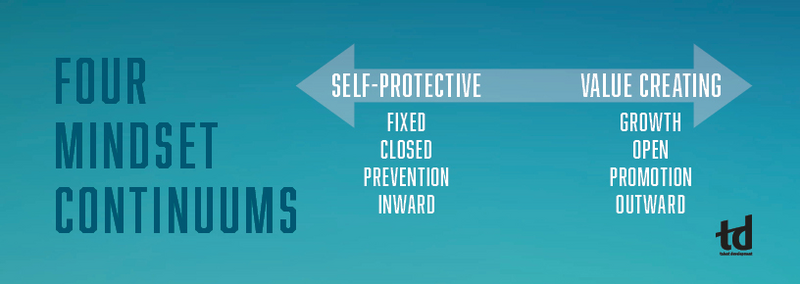
Leaders awaken to the current quality of their mindsets. Mindset researchers have identified four mindset continuums representing the degree to which someone possesses self-protective versus value-creating mindsets (see figure).

Leaders awaken to the current quality of their mindsets. Mindset researchers have identified four mindset continuums representing the degree to which someone possesses self-protective versus value-creating mindsets (see figure).

Content

Leaders must deepen their self-awareness to the degree to which they can clearly identify the current quality of their mindsets across each of the continuums. Identifying the mindset labels, providing descriptions for each of the mindsets, and using mindset assessments are all critical elements of this step.

Leaders must deepen their self-awareness to the degree to which they can clearly identify the current quality of their mindsets across each of the continuums. Identifying the mindset labels, providing descriptions for each of the mindsets, and using mindset assessments are all critical elements of this step.

Content

Leaders engage in exercises designed to activate and strengthen their value-creating mindsets. Research has found that helping people regularly engage in these activities changes and improves their neurology:

Leaders engage in exercises designed to activate and strengthen their value-creating mindsets. Research has found that helping people regularly engage in these activities changes and improves their neurology:

  • Content

    Gratitude journaling

    Gratitude journaling

  • Content

    Meditation

    Meditation

  • Content

    Engaging with material (for example, books, articles, videos, podcasts, and discussions) directly related to growth, open, promotion, and outward mindsets

    Engaging with material (for example, books, articles, videos, podcasts, and discussions) directly related to growth, open, promotion, and outward mindsets

Content

The three-step process enables leaders to better own, control, and improve the quality of their body's nervous system, thus elevating their leadership effectiveness. A disciplined program that fosters engagement and accountability is essential.

The three-step process enables leaders to better own, control, and improve the quality of their body's nervous system, thus elevating their leadership effectiveness. A disciplined program that fosters engagement and accountability is essential.

Provide coaching focused on neurological refinement

Content

All leaders have neurological processing habits. Some of the habits are helpful, such as when a leader is prone to see change both as a constant and as something that they should embrace. However, some neurological processing habits can be limiting, such as when a leader is inclined to see problems and "fires" as matters that should not occur and need immediate fixing. That processing habit generally results in micromanagement.

All leaders have neurological processing habits. Some of the habits are helpful, such as when a leader is prone to see change both as a constant and as something that they should embrace. However, some neurological processing habits can be limiting, such as when a leader is inclined to see problems and "fires" as matters that should not occur and need immediate fixing. That processing habit generally results in micromanagement.

Content

Almost all leaders possess limiting neurological processing habits (some more than others). At the root of those habits is a self-protective fear. Common fears that leaders struggle with are associated with looking bad, being wrong, having problems, and falling behind. While such concerns are justifiable because they are self-protective, they cause leaders to focus on themselves rather than on their purpose or the people they lead.

Almost all leaders possess limiting neurological processing habits (some more than others). At the root of those habits is a self-protective fear. Common fears that leaders struggle with are associated with looking bad, being wrong, having problems, and falling behind. While such concerns are justifiable because they are self-protective, they cause leaders to focus on themselves rather than on their purpose or the people they lead.

Content

The best way to help leaders surface and work through their self-protective fears and limiting neurological processing habits is through vertical development coaching. It differs from traditional horizontal development coaching in that it focuses on neurological refinement instead of on skills development. Such coaching requires a coach who possesses an expertise in neuroscience, vertical development, and crafting developmental plans for neurological refinement.

The best way to help leaders surface and work through their self-protective fears and limiting neurological processing habits is through vertical development coaching. It differs from traditional horizontal development coaching in that it focuses on neurological refinement instead of on skills development. Such coaching requires a coach who possesses an expertise in neuroscience, vertical development, and crafting developmental plans for neurological refinement.

Content

A typical vertical development coaching approach will involve a process whereby a coach helps a leader pinpoint an unmet aspiration for their leadership; identify common behaviors that are currently working against their aspiration; surface self-protective fears and commitments that are driving their limiting behaviors; and structure small, safe experiments to push against and work through their self-protective fears, inducing neurological refinement.

A typical vertical development coaching approach will involve a process whereby a coach helps a leader pinpoint an unmet aspiration for their leadership; identify common behaviors that are currently working against their aspiration; surface self-protective fears and commitments that are driving their limiting behaviors; and structure small, safe experiments to push against and work through their self-protective fears, inducing neurological refinement.

Content

As an example, consider Mike, the chief product officer of a midsize consumer products organization. Upon engaging with a vertical development coach, Mike discovers that while he aspires to be an agile leader, he is not good at taking risks and being innovative because he has a fear of failure and carries two if-then beliefs:

As an example, consider Mike, the chief product officer of a midsize consumer products organization. Upon engaging with a vertical development coach, Mike discovers that while he aspires to be an agile leader, he is not good at taking risks and being innovative because he has a fear of failure and carries two if-then beliefs:

  • Content

    If he alters the way the organization traditionally sells its products, then it may fail.

    If he alters the way the organization traditionally sells its products, then it may fail.

  • Content

    If the organization fails in its efforts, then Mike's leaders, colleagues, customers, and others will see him as a failure.

    If the organization fails in its efforts, then Mike's leaders, colleagues, customers, and others will see him as a failure.

Content

Having awakened to those neurological processing habits, Mike works with his coach to structure experiments where he can push against and tests his beliefs. For example, Mike can try making a small adjustment to how the organization sells one niche product. If that small adjustment ends up being a failure, he'll be able to assess whether people subsequently consider him a failure. It is likely that they instead consider him an innovator who is willing to push the limits for the sake of progression and improvement.

Having awakened to those neurological processing habits, Mike works with his coach to structure experiments where he can push against and tests his beliefs. For example, Mike can try making a small adjustment to how the organization sells one niche product. If that small adjustment ends up being a failure, he'll be able to assess whether people subsequently consider him a failure. It is likely that they instead consider him an innovator who is willing to push the limits for the sake of progression and improvement.

Content

Through a coaching process focused on neurological refinement, leaders can rise above the self-protective fears and commitments that limit their character and leadership effectiveness.

Through a coaching process focused on neurological refinement, leaders can rise above the self-protective fears and commitments that limit their character and leadership effectiveness.

Enhance the organization's emphasis on mental health

Content

Neuroscience has found that many factors affect the quality of someone's nervous system and, therefore, the person's ability to operate in a value-creating manner. Some of the factors include past trauma, organizational trauma, and various neurological deficiencies, such as attention deficit hyperactivity disorder (ADHD).

Neuroscience has found that many factors affect the quality of someone's nervous system and, therefore, the person's ability to operate in a value-creating manner. Some of the factors include past trauma, organizational trauma, and various neurological deficiencies, such as attention deficit hyperactivity disorder (ADHD).

Content

In my experience, at least one of those factors is playing a role in any person's significant leadership issues. Although employers cannot legally discuss a person's physical or mental health in terms of a solution for leadership development, they can provide appropriate resources for ongoing mental health of their leaders. That can take at least three forms.

In my experience, at least one of those factors is playing a role in any person's significant leadership issues. Although employers cannot legally discuss a person's physical or mental health in terms of a solution for leadership development, they can provide appropriate resources for ongoing mental health of their leaders. That can take at least three forms.

Content

Destigmatize trauma, ADHD, and mental health. Provide workshops on each of the topics, making a connection between the condition and how it can affect a person's character, psyche, mindset, and nervous system (including neural processing habits and self-protectiveness).

Destigmatize trauma, ADHD, and mental health. Provide workshops on each of the topics, making a connection between the condition and how it can affect a person's character, psyche, mindset, and nervous system (including neural processing habits and self-protectiveness).

Content

Research reveals that most people have experienced issues with at least one of those conditions. For example, the National Council for Behavioral Health reports that 70 percent of adults in the US have experienced trauma; 26 percent have a diagnosed mental disorder, per Johns Hopkins Medicine; and 32 percent experienced symptoms of anxiety or depression in 2023, according to KFF's analysis of the US Census Bureau's Household Pulse Survey.

Research reveals that most people have experienced issues with at least one of those conditions. For example, the National Council for Behavioral Health reports that 70 percent of adults in the US have experienced trauma; 26 percent have a diagnosed mental disorder, per Johns Hopkins Medicine; and 32 percent experienced symptoms of anxiety or depression in 2023, according to KFF's analysis of the US Census Bureau's Household Pulse Survey.

Content

Develop policies that support leaders' mental health. Such policies can involve encouraging and offering adequate paid time off, limiting emails outside of normal working hours, and allowing flexible working hours.

Develop policies that support leaders' mental health. Such policies can involve encouraging and offering adequate paid time off, limiting emails outside of normal working hours, and allowing flexible working hours.

Content

Provide access to medical and psychological professionals. That should be part of employers' benefits packages—and employers should encourage their employees to take advantage of such offerings.

Provide access to medical and psychological professionals. That should be part of employers' benefits packages—and employers should encourage their employees to take advantage of such offerings.

Content

As organizations prioritize mental health, they will better create the support that leaders need to operate from a place of value creation instead of from a place of self-protection.

As organizations prioritize mental health, they will better create the support that leaders need to operate from a place of value creation instead of from a place of self-protection.

Two-sided solution

Content

If a company truly wants effective leaders, it needs individuals who excel in both their doing side (that is to say, skills) and their being side (character). My experience and research demonstrate that most leadership development programs primarily emphasize the former side, yet many leadership issues are the result of matters associated with the latter.

If a company truly wants effective leaders, it needs individuals who excel in both their doing side (that is to say, skills) and their being side (character). My experience and research demonstrate that most leadership development programs primarily emphasize the former side, yet many leadership issues are the result of matters associated with the latter.

Content

Take stock of your leadership development programming:

Take stock of your leadership development programming:

  • Content

    Do your TD team members and organizational leaders know the difference between horizontal and vertical development?

    Do your TD team members and organizational leaders know the difference between horizontal and vertical development?

  • Content

    Are nervous system, internal operating system, and mindsets part of your development vocabulary and efforts?

    Are nervous system, internal operating system, and mindsets part of your development vocabulary and efforts?

  • Content

    Do initiatives go beyond skill development (that is to say, horizontal development) to focus on neural reprogramming (vertical development)?

    Do initiatives go beyond skill development (that is to say, horizontal development) to focus on neural reprogramming (vertical development)?

  • Content

    Does your organization emphasize mental health and provide access to mental health resources and professionals?

    Does your organization emphasize mental health and provide access to mental health resources and professionals?

Content

If you can answer in the affirmative to each of those questions, your company is probably already experiencing the competitive advantage of having high-functioning and effective leaders.

If you can answer in the affirmative to each of those questions, your company is probably already experiencing the competitive advantage of having high-functioning and effective leaders.

You've Reached ATD Member-only Content

Become an ATD member to continue

Already a member?Sign In

issue

ISSUE

March 2024 - TD Magazine

View Articles

Copyright © 2026 ATD

ASTD changed its name to ATD to meet the growing needs of a dynamic, global profession.

Terms of UsePrivacy NoticeCookie Policy