
TD Magazine Article
Member Benefit
Inside the Learning Brain
Cognitive neuroscience will shape the future of corporate learning practices.
Mon Apr 08 2013

Sophisticated brain-imaging tools allow researchers to study the brain and revolutionize the understanding of how we learn. As a result, today we know more about learning than ever before, which provides great opportunities for training and development professionals to harness new insights and apply this new knowledge to advance the field.
The emerging field of neuroeducation
This year, I celebrate 25 years in the field of training and development. Over the years, it always has intrigued me that during the same learning experience people learn differently, and learning outcomes for individuals can differ significantly. I have become increasingly more interested in creating training initiatives that embrace and enhance these differences in learning to gain more competitive advantage for individuals and for the organization.
In training and development until now, our field of study has had its roots in pedagogy, didactics, and instructional design focused on individual education and learning. The field of developmental psychology provides us with additional important insights on the integration of the mind and behaviors.
Cognitive neuroscience is the study of mental brain processes and its underlying neural systems. This includes thinking and behavior and is underpinned by the learning brain. Therefore, cognitive neuroscience looks at how the brain learns, stores, and uses the information it acquires. It is through learning that the brain enables us to adapt to our ever-changing environment.
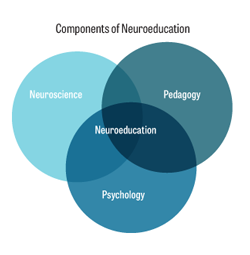
The area of overlap between different disciplines, including cognitive neuroscience and education, has been identified as a transdisciplinary field of study called educational neuroscience or neuroeducation (see figure below). According to The Royal Society February 2011 report, The Brain Waves Module 2: Neuroscience: Implications for Education and Lifelong Learning, this field investigates basic biological processes involved in becoming literate and numerate, and explores learning to learn, cognitive control, flexibility, and motivation, as well as social and emotional experiences.
Our brain and learning
Learning is a physical process in which new knowledge is represented by new brain cell connections. The strength and formation of these connections are facilitated by chemicals in the brain called growth factors.
We now know from neuroscience that the availability of these growth factors can be enhanced. For example, specific exercise routines, optimal sleep structure, and silencing the mind can all enhance the availability of these growth factors. Nature and nurture affect the learning brain. People have different genetic predispositions, but experience continuously shapes our brain structure and modifies behavior.
During the past decade numerous peer-reviewed publications have connected the fields of neuroscience with education and learning. Several studies report structural and functional changes in the brain related to training. A working understanding of how the brain learns and performs is an invaluable new skill. It is essential for the future success of individual employees and their organizations.
What follows are evidence-based results that have an impact on how companies should design and deploy training initiatives.
Increasing knowledge of people is key to innovation
We intuitively understand the knowledge worker's need to acquire new knowledge that optimizes the value of his unique contribution to the business. What is less obvious, but of great importance, is that creative and innovative thinking processes in our brains are built on the foundation of knowledge.
Our brains continuously draw on this knowledge base to create simple solutions to complex problems. Knowledge provides the building blocks for innovation, which is the number one priority for many enterprises.
For this reason alone, employees wanting to be more innovative (and, thereby, increasing the value of their contribution to the business) should explore every opportunity to add to their knowledge base. And since we live in a fast-paced world with ever increasing sensory overload, we need well-designed and structured learning opportunities to make best use of the limited time available to us to build new knowledge.
Active engagement is necessary for learning
Changes in neural connections, which are fundamental for learning to take place in the brain, do not seem to occur when learning experiences are not active. Many research studies suggest that active engagement is a prerequisite for changes in the brain.
Not surprisingly, just listening to a presentation or lecture will not lead to learning. Powerful training initiatives that stimulate active engagement include facilitation, simulation, games, and role play.
All learning has an emotional base
Neuroscientists believe that emotions are fundamental to learning. One of the earlier advocates of this was Plato, who mentioned more than 2,000 years ago that "All learning has an emotional base."
Motivation in the brain is driven by emotion. Individuals are motivated to engage in situations with an emotionally positive valence and avoid those with an emotionally negative valence. Research findings indicate that different aspects of memory are activated in different emotional contexts, and that demonstrates there are links between emotion and cognition.
Training professionals can design learning sessions that tap into the emotions. For example, ask learners to share work experiences that have been difficult for them.
Focused attention is fundamental to acquiring new knowledge
We now have learned from neuroscience that sustained focus is largely an unconscious process but essential for learning and creative thinking. Actively silencing the mind through a process of focused attention (focusing on the major senses while breathing deeply) or open monitoring (actively allowing incoming stimuli without reacting or responding to it) for 20 minutes per day will go a long way toward enhancing the ability for focused and sustained attention.
Therefore, it is a powerful imperative to include time for meditation and breathing in the design of classroom programs.
Deployment of short learning sessions will increase knowledge retention
The brain remembers the first part and the last part of a training initiative best. This is called the primacy-recency effect.
The middle period of learning should be filled with the least important information, and shorter learning sessions will reduce the middle "down" period. This is why training sessions ideally should be no more than 20 minutes, with planned "brain breaks" separating sessions.
Use learning techniques that enhance memory formation
Learning techniques that have shown to enhance memory formation include elaborating, verbalizing, writing and drawing, and sharing learned information during and at the end of a learning session. Interweaving different subject matter categories during a training event enhances the learning process.
Simply, this means that three different subjects can be learned by studying them simultaneously, moving from one subject to the next in an open-ended interweaving fashion. That is because the brain learns and packages new knowledge even while we are not aware of it; it's a continuous and vastly unconscious process. The brain continues to learn and consolidate new knowledge unconsciously, even as we consciously start to focus on new material.
Use it or lose it
The adult brain changes following the acquisition of new skills. However, the changes in the brain reverse when people do not have the opportunity to use the skills they have developed.
Unfortunately, many training initiatives are less effective because people can't apply their learning in the workplace after completion of training. This is one of the benefits of digital learning. It provides on-demand learning and knowledge that can be reviewed at any time and any place.
Multitasking slows down learning
Multitasking has become a way of living and working for many people. Unfortunately, our brains are not wired for multitasking because most of us can only apply our full conscious attention to one stimulus at a time. (A small proportion of the population, called "super-taskers," can pay attention to two stimuli at one time.)
Our working memory—this is the part of the brain that allows us to focus our attention on a task such as reading—continues to interact with our long-term memory where we retrieve and store specific information. If we try to conduct two tasks at the same time, we must switch between the different tasks and an overload results between our working memory and long-term memory, which causes us to lose time.
Multitasking is not effective and costs an estimate of $650 billion because employees spend one-third of their time interrupting existing tasks to continue later with the same tasks. Therefore, it is important during training programs to limit multitasking such as simultaneously reading or writing email during a class.
Enhancing brain performance capacity supports learning
Etienne van der Walt, an experienced neurologist and expert in cognitive neuroscience, has developed diagnostics to assess the extent to which an individual complies with current neuroscientific applications that are proved to enhance brain performance capacity. According to him, human brain performance is continuously affected by identifiable brain performance drivers.
Guided by current evidence from the best neuroscience research available, van der Walt has identified 12 drivers that can be individually and collectively enhanced for optimum brain performance. These include the foundational drivers of exercise, sleep, nutrition, and rhythms; emotional drivers such as belonging and identity; higher order drivers that include the executive planning functions of the prefrontal cortex; and sensory drivers.
By using a program called BrainCoach, an individual's compliance levels and current level and mix of each brain performance driver can be measured. According to van der Walt, all these individual brain performance drivers can be enhanced and fine-tuned to improve the performance capacity of brain performance. In other words, we can develop skills that may allow us to manage these drivers for optimum brain performance.
Challenges and opportunities
There is plenty of research that provides clear and accurate summaries of progress in the cognitive neuroscience of learning. However, there are at the same time questionable media reports and claims about brain-based learning that, according to some scientists, often oversimplify, misrepresent, and allow for "neuromyths" to flourish. Training professionals should only use research that provides sufficient evidence and that can be put into practice.
Cognitive neuroscience is a promising field of study and has exciting potential discoveries ahead. Medical professionals often are trained in molecular biology and organic chemistry, knowledge that indirectly affects the future practice of physicians.
Similarly, training professionals should have a fundamental knowledge about the brain and apply cognitive neuroscience evidence to their practice of developing people. In the 21st century, companies will put much more emphasis on individual and organizational learning to innovate and compete successfully in a global knowledge economy.
The Application of Brain-Based Learning at Deloitte\*
Deloitte’s learning and leadership curriculums are dynamic and go through ongoing stages of refreshment and redesign to make sure they are aligned with business needs. The learning design principles increasingly use evidence brain-based learning practices. For example:
Classroom programs are designed to support a high level of engagement and intentionally touch on emotions. Learners are expected to participate actively by collaborating, elaborating, verbalizing, drawing, and sharing what has been learned. Lecture-driven experiences are kept to a minimum.
Learning sessions are reduced to smaller bytes and chunks and provide a high level of personalization.
Learners are strongly encouraged to use valuable offsite classroom time to reflect on their development and are discouraged to look at emails and texts during classroom time. This ensures that people stay focused on learning.
A large inventory of digital learning provides learners with an opportunity to acquire knowledge and develop skills as needed. As a result they can apply and practice new skills directly on the job, making the learning stick.
Health and well-being are supported by providing fitness, yoga, and meditation classes at Deloitte University in Dallas. Participants can take advantage of healthy food choices to stimulate body and brain.
\*Deloitte refers to one or more of Deloitte Touche Tohmatsu Limited and its network of member firms, each of which is a legally separate and independent entity.
Recommended Reading
Julie Dirksen, Design for How People Learn. New Riders, 2012.
Mariale Hardiman, Neuroeducation: Learning, Arts, and the Brain. Dana Foundation, 2009.
Christina Hinton, Kurt W. Fischer, and Catherine Glennon, Mind, Brain, and Education. Jobs for the Future, 2012.
Mary Helen Immordino-Yang and Antonio Damasio, "We Feel, Therefore We Learn: The Relevance of Affective and Social Neuroscience to Education." Mind, Brain, and Education, March 2007.
Organization for Economic Corporation and Development, Understanding the Brain: The Birth of a Learning Science. OECD Publishing, 2007.
View Courses Recommended for You