TD Magazine Article
Member Benefit
Personalization Matters
Use personas as the foundation of learning experience design to customize learning journeys.
Fri Aug 01 2025

Employees must learn and adapt quickly to keep pace with technological advancements, frequent industry disruptions, and shifting business strategies. Ranging from adopting new technology and adjusting to a new work model to developing must-have leadership skills, organizations rely on continuous learning to remain relevant and competitive. However, despite significant investments in training and development, many learning experiences fail to deliver meaningful impact.
That's because they overlook a critical factor: the learners. L&D often develops programs around content rather than around learner engagement and impact, resulting in a disconnect between the training course and real-world application. Companies often assume that one course or program can serve all employees equally, disregarding the fact that individuals:
Come from diverse backgrounds
Have different roles and responsibilities
Possess varying levels of prior knowledge
Prefer different learning modalities
Face different workplace challenges
Not considering those nuances often leads to generic, one-size-fits-all training programs that don't resonate with learners. Employees lose interest, struggle to see the relevance of the content, and ultimately don't apply their learning in meaningful ways. That both wastes valuable training resources and prevents businesses from achieving their workforce development goals.
Therefore, shift from a content-first to a learner-first approach to ensure that learning journeys engage staff, address real workplace challenges, and drive long-term performance improvement. In other words, design programs that personalize, contextualize, and tailor the learning experience. That is where learner personas come into play.
The principal tool for personalization
Learner personas provide a structured way to design training programs based on real learner needs and account for the nuances in role, background, and preferences. They are fictional, data-driven profiles that represent different segments of a learner population. Personas acknowledge that every learner is unique and attempt to quantify those different experiences, skills, and motivations. By focusing on who the learners are rather than just what you think they need to learn, you can design highly engaging, custom, and results-driven learning experiences.
Without personas, learning journeys run the risk of feeling generic and impersonal. And with personas, learning becomes relevant, meaningful, and effective. Personas ensure that learning reflects the way people naturally absorb and apply knowledge.
Why traditional training falls short
L&D teams design most corporate training programs around the what(content), not the who(learners). On the surface, that approach makes sense. Organizations invest heavily in content development: They purchase off-the-shelf programs, license learning management systems that include libraries of assets and e-learning courses, and hire instructional designers and developers to build structured learning experiences. Companies often measure success by how much content the L&D team produces, how many courses staff complete, or how many training hours employees log.
However, focusing solely on content creation and delivery misses the mark. It assumes that training success ties to the volume of learning materials available rather than the effectiveness of the learning experience itself. A content-first approach can lead to numerous consequences.
Low engagement. Learners feel disconnected from the material because it doesn't speak to their experiences, challenges, or interests. A technical employee who prefers hands-on learning will likely disengage from a long, talking-head e-learning module. Similarly, a senior leader new to a company may find first-time-manager training irrelevant, causing frustration and disengagement.
High dropout rates. Employees either abandon the course early or complete it without genuine participation, often because it is too difficult (overwhelms learners with unfamiliar concepts), too basic (fails to challenge experienced employees), or irrelevant (doesn't connect to their daily work responsibilities).
Poor skills application. Even if staff complete the training program, they often struggle to apply what they've learned because the material lacks real-world relevance to their job or role. Training content that is too theoretical without practical application leaves learners unsure of how to transfer their knowledge to the workplace. It becomes a nice-to-have versus a need-to-have.
Missed business goals. Ultimately, ineffective training leads to wasted time and resources as well as lost productivity. Companies invest millions of dollars in L&D each year, yet without a learner-first approach, those efforts don't translate into meaningful performance improvements, innovation, or employee retention.
A content-first approach assumes that knowledge alone is enough to drive behavior change. It follows an "If you build it, they will come" philosophy: If an organization provides employees with enough information, they will naturally absorb and apply it. But learning doesn't work that way. People don't engage with a training program simply because it exists. They engage because:
It resonates with their personal and professional needs.
It connects to their real-world challenges.
The content delivery matches their learning preferences.
When you design learning experiences without considering who the learners are, how they learn best, and what motivates them, programs become compliance-driven checklist items rather than opportunities for real growth. Using personas to begin the design process results in training initiatives that feel more relevant, engaging, and actionable.
Step 1. Conduct learner research
Before building learner personas, it's essential to gather real insights about your workforce. Without accurate data, you risk the personas being generic or assumptive rather than true reflections of learner needs. To develop personas that accurately reflect your workforce, consider using a combination of the following research techniques.
Surveys and polls. These methods are a quick and scalable way to gather information about learner preferences, motivations, and challenges.
Ask employees about their learning preferences (such as instructor-led training, self-paced e-learning, or blended learning) and the formats they find most engaging (such as videos, quizzes, case studies, or podcasts). Gather information about career goals and challenges by identifying the skills they want to develop and the obstacles hindering their progress. Assess training effectiveness by asking which past programs have been most useful and where they see gaps in their current learning opportunities.
Interviews and focus groups. While surveys provide broad, quantitative data, one-on-one interviews and focus groups help uncover qualitative insights that reveal:
What learners struggle with daily
How they approach learning
What motivates or discourages them
Speak with high-performing employees to understand what contributed to their success, recent hires to uncover onboarding challenges, and managers to identify team training gaps. Ensure meaningful insights by using open-ended prompts that encourage detailed responses, such as "Tell me about a time you struggled with a workplace challenge." Avoid leading questions. Focus on eliciting real stories and specific examples, which enables employees to share their experiences and provide deeper context for their learning needs.
LMS and performance data. Identify learning gaps and patterns. Your organization's LMS and HR performance data provide powerful insights into how staff interact with training programs. Don't ignore the analytics and assume what you build is going to be better. Key data to analyze includes:
Course completion rates
Engagement metrics
Assessment scores
Promotion and turnover data
Productivity and error rates
Observations. See how employees apply learning in real work settings. While surveys and interviews provide self-reported insights, workplace observations help verify how individuals learn and apply knowledge. For example, during the next classroom training course, rather than participate, observe how attendees interact with training materials.
Although some L&D professionals have direct access to their learners, many do not. In such cases, conduct as much research as you can. For instance, use corporate website information and open job descriptions. Speak with those with whom you have contact, even if it's not frequent, to help confirm where you may have made some high-level assumptions so that you can validate or revise later.
Step 2. Identify key learner segments
Once you've gathered data, categorize learners into distinct audience segments based on various factors.
Role and job function. This category determines skills gaps and learning needs relevant to job success and affects the level of technicality necessary in a training program. It also influences whether learning should focus on soft skills (such as leadership and communication) or hard skills (technical expertise and industry-specific knowledge).
Career stage. Define learning depth and complexity based on learners' career progression. For example, new employees may need onboarding and foundational skills, and executives may need leadership and strategy training. Career stage also influences motivation and engagement strategies. Early-career professionals may seek skill-building, while senior employees may focus on career growth.
Learning preferences. Establish the content format and delivery based on what learners favor. Some people prefer interactive, hands-on experiences and others prefer self-paced courses or mentorship. Such choices can also inform which technologies to use in a learning experience as well as their complexity.
Work environment. Employees' work setting determines accessibility and delivery methods. The environment affects learning engagement strategies. Hybrid workers may benefit from a mix of virtual and in-person training while on-site employees may prefer live, in-person learning.
If you're building onboarding training, the categories may include all the above if the program is for people across those segments. But if you're designing a more specific form of training, such as sales training, all learners may work in the same job function and in a similar work environment, so focus on the outlier segments (for example, career stage and learning preferences) that create differentiation across the learner population.
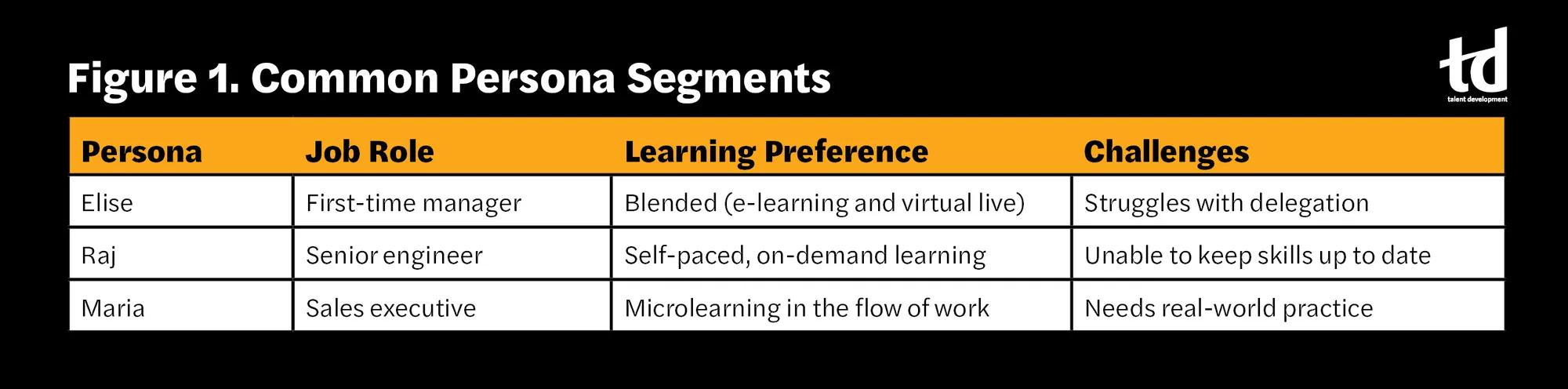
The key elements from someone's confirmed personas directly influence how you design, structure, and deliver their learning journey. When building learning experiences, create several personas that represent different segments (see Figure 1). Then, when you overlay the personas, trends in environment, technology aptitude, and learning preferences will emerge, guiding you to a solution that will meet the needs of all your learners most directly and effectively. By aligning experience design with personas, you enhance engagement, retention, and knowledge application.
That said, there may be cases where the overlay won't cleanly drive all solutioning, and part of the solution may create learner challenges for some of the audience. A simple example is integrating a chatbot into an initiative for knowledge retention. Some learners may not be technically savvy, so a chatbot will create engagement barriers. In such cases, apply change management strategies (for instance, in the program launch and communications) to help ease those barriers and enable individuals to engage with the learning content and experience.
Step 3. Create detailed persona profiles
An instructive learner persona should include specifics that will result in designing targeted learning solutions that resonate with the persona's challenges and learning preferences characteristics (see Figure 2).
Name and role. Understanding the learner's position, responsibilities, and perspective on their work helps align learning objectives with job performance. What's their position, key responsibilities, and thinking on their role and the work they do?
Professional background and career goals. A learner's industry experience and career aspirations determine their training needs and the depth of necessary knowledge. For example, do they work in technology, healthcare, or finance? Are they entry level, midcareer, or senior level? What goals are they trying to achieve?
Pain points. Identifying roadblocks that hinder professional growth helps create learning strategies that address accessibility, flexibility, and engagement.
Motivations and triggers. Understanding what drives someone to learn helps create relevant and engaging training experiences that keep them invested.
Learning preferences. A learner's favored training format, engagement style, and technological comfort level influence how they consume and retain information. That helps determine the most effective training format and ensures learning engagement and retention.
![Figure 2. Sample Persona [person's headshot] Meet Elise
Frontline Leader
I love my job in finance at ACME Healthcare. I have led several large project teams and have been managing two teams for about one year. I haven’t had many good instincts. That said, sometimes I feel like I’m guessing the best route forward to address for some leadership challenges (and hoping I guess right). When it comes to more efficient leadership, performance conversations, and leading change, I know I could do better. Role: Lead, financial analysis
Location: Duluth, Minnesota
Tenure: Four years
Education: Bachelor’s degree, finance
Personal: Single DiSC Personality Profile: C
• Analytical
• Reserved
• Precise
• Cautious Goals: Gain a reputation as a reliable leader. Ensure a strong work-life balance. Build a strong network across ACME Healthcare. Lead a highly effective team that always delivers.
Technology Usage: IT and internet; Mobile apps; Social networks Preferred Learning Methods: [A computer monitor with a video-play button] Self-paced learning. [A video with a hand about to push the play button.] Self-serve videos. [A person icon with a presentation icon (a square with lines) next to it; beneath are three people icons that slightly overlap so they appear as an audience.] Hands-on classroom. [Three people icons connected in a circle.] Peer network. [Two people icons with talk bubbles that overlap.] One-on-one meetings with manager.](https://assets.td.org/transform/86e6f05e-fd33-4724-aaa0-db731c9891e7/feature1figure2)
Applying personas to learning journeys
The learner personas you develop serve as a foundation for designing structured and engaging learning experiences that align with employees' characteristics.
Pre-assessment. Use personas to tailor assessments to specific job functions and career stages, determine baseline skills and gaps to address, and choose assessment methods based on learning preferences (for example, quizzes for self-paced learners and manager evaluations for coached learners).
Custom learning paths. Match learning content to each persona's job function, career stage, and learning preference; develop tiered learning paths (beginner, intermediate, and advanced) to align with career progression; and offer personalized coaching for those who prefer guided learning.
Hands-on application. Use personas to design realistic scenarios that mimic workplace challenges; select the right format (such as virtual reality simulations for frontline workers and case studies for executives); and provide real-world projects to reinforce learning through practical experience.
Support networks. Leverage personas to determine which staff benefit from mentorship or peer learning. Foster a culture of continuous learning by creating discussion groups based on personas (such as a New Managers Circle). Encourage cross-functional collaboration to build knowledge-sharing networks.
Based on details about Elise in Figure 2, her learning journey may break down as follows.
Week 1-3: Virtual onboarding and leadership fundamentals
Week 4-6: Microlearning on delegation and communication
Week 7-10: Coaching and real-world leadership challenges
Week 11+: Continuous mentorship and upskilling opportunities
Elise may be leveraging content that is from a large library of assets or programs that are general in nature but L&D has designed her experience so that she gets the right material in the right format at the right time, all while offering opportunities to make it real within her job role.
If you already have training programs in place and receive feedback that some elements aren't working, that is the perfect opportunity to retroactively apply persona work to reshape the learning experience. Instead of starting from scratch, analyze learner feedback, completion rates, and engagement data to identify patterns that align with different learner segments. Are certain groups disengaged? Do some individuals struggle with applying the material? Use the insights to refine content, adjust delivery methods, and tailor learning paths to better meet learners' unique needs. Doing so ensures that existing programs become more effective, relevant, and learner centric.
Understand your learners
Personas provide a powerful framework for making training more relevant, engaging, and effective by aligning it with real-world challenges, motivations, and learning preferences. By identifying distinct learner segments and designing personalized learning journeys, L&D teams can improve engagement, retention, and skills application.
Different learners require different approaches. Customizing development experiences to meet each learner's unique needs leads to better outcomes for both people and organizations. Whether you're designing new programs or refining existing ones, learner personas serve as a foundation for meaningful, results-driven learning.
View Courses Recommended for You