TD Magazine Article
Member Benefit
Presenter, Know Thyself
By understanding the type of presenter you are, you can focus on the necessary strategies to enhance your practice.
Thu Jul 01 2021

What kind of presenter are you? Are you more of a subject matter expert, able to captivate the masses with your deep knowledge of a topic? Or are you more skilled in the art of facilitation, with the ability to engage people in discussion and navigate any topic by finding ways for your learners to grow through dialogue? At the end of the day, does it really matter whether you know what kind of presenter you are?
As someone immersed in the world of facilitation and adult learning theory, I thought I knew why it was important to be aware of the type of presenter you are and the reason it mattered. However, when I began to look at the research, I found out I was wrong.
A traditional presenter skill set continuum
One traditional way of looking at the type of presenter you (or others with whom you work) are, is to see it as a continuum, with pure subject matter experts (people with deep expertise in a given area) on the left end and pure facilitators (people who may not know anything about a specific subject but who can engage groups in discussion, activities, and dialogue) on the right end.
With my bias toward adult learning and the importance of being able to engage people in learning, I assumed that it was more important to find yourself somewhere to the right of center on the continuum if you wanted to be effective and gain learners' confidence. After all, who wants to sit through a didactic session when there are almost always opportunities to engage participants through dialogue, activities, and content exploration? When I began to look for some data to confirm what I thought I already knew, I was a little surprised by what I found.
In his 2017 article "The Trainer as SME," Mohamed El Kholy describes a small study in which 116 trainers were asked to deliver a half-hour session on a topic of their choice and then researchers evaluated them on different variables, including facilitation abilities and content mastery (subject matter expertise).
The researchers concluded that if trainers did not "master the content they are delivering, that weakness could overshadow their delivery skills." Other studies have come to similar conclusions. Contrary to what I had long hypothesized, it seems that finding yourself to the left of center of the continuum, where you skew toward more expertise and fewer engagement strategies, would inspire more credibility in your learners' eyes.
Where do you think someone like Neil deGrasse Tyson would fall on this continuum? He has deep expertise in science topics, so he could fall in the most far left part of the continuum. However, he's also quite engaging and can facilitate dialogue as part of his delivery as well—so perhaps he could mark himself on the continuum twice?
The more I thought about that concept, the more I found a two-dimensional continuum to be too limited. It was time to add a dimension.
A multidimensional view of presenter skill sets
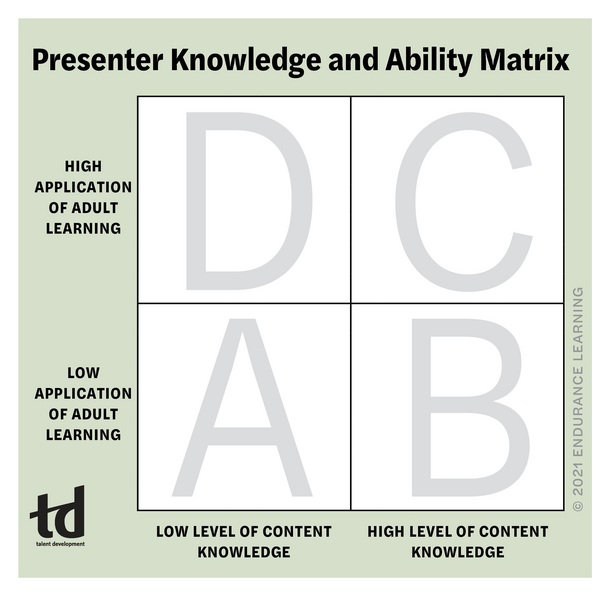
Instead of using the two-dimensional continuum, I developed the Presenter Knowledge and Ability Matrix to help individuals to better characterize their style. It offers a sort of road map for professional development that any presenter may want to use to hone their craft.
Taking a closer look at the two-by-two matrix, you'll see a presenter's level of content knowledge (traditionally known as subject matter expertise) along the bottom and along the left side a presenter's use of adult learning strategies to engage their learners and make the learning meaningful. What does a presenter look like in each of the quadrants?
Quadrant A
This presenter is someone with both a low level of content knowledge and a low tendency to use adult learning principles in presentation design and delivery. This is often someone who has been asked to present at the last minute or as an afterthought on top of all their other duties.
Perhaps another name for this quadrant could be messenger, because the presenter is tasked with sharing information regardless of how comfortable they may be with the content. Think of the last time your supervisor needed to review a new organizational policy with you during a team meeting. It's not a policy your manager came up with, it's probably not a policy they're an expert in, and they probably didn't do much to engage you in your understanding of the policy.
You may also find yourself in this quadrant if someone asks you to cover for a colleague who's running late or fell ill and can't make it to work that day. This is not an ideal quadrant in which to find yourself. In fact, it can be quite an uncomfortable experience, but sometimes it's necessary.
Quadrant B
This is a presenter who would be considered a subject matter expert—someone with high levels of content knowledge on the one hand and a low tendency to incorporate adult learning principles in their delivery on the other hand (because they know a lot about a topic but not necessarily about how adults learn).
Examples of presenters who fall into this category are often (but not limited to) technical experts such as doctors who are sharing information about medical procedures and the efficacy of new treatments, HR attorneys who are presenting on the types of questions managers can and cannot ask in an interview, and IT professionals and software developers who display screens of information and features about the new database system you need to adopt at your company. Attempts at engagement between presenters in this quadrant and their learners are typically limited to Q&A.
Quadrant C
This quadrant comprises people who have a deep understanding of the topic at hand and who also deliver participant-centered presentations intended to engage their audience via sound adult learning principles.
Someone like Tyson would likely fall into this quadrant. So too would technical experts around your organization who are not only passionate about their topics but also passionate about finding ways for other people to experience the joy of their subject by truly experiencing the learning through case studies, dialogue, and simulations.
Quadrant D
This is where you'll likely find pure facilitators. As an internal L&D resource as well as an external contractor who designs programs for clients, I've spent the majority of my time in this quadrant.
Presenters here have a deep understanding of adult learning and can facilitate conversations on a range of topics from simple to complex. Presenters in this quadrant, even more so than those found in Quadrant C, will also feel comfortable facilitating debates and discussions, leading debriefs that guide and deepen the learning process, and delivering effective activity instructions.
The situational nature of this matrix
Any time you use a model, it's important to keep in mind the adage that "all models are wrong, but some models are useful." That means models (and labels associated with those models) can never be 100 percent accurate when you apply them to people, because models are static while people are dynamic beings capable of change.
Although I don't know of many presenters who would be purely in one quadrant or another 100 percent of the time, I find the Presenter Knowledge and Ability Matrix useful when looking at where you stand as a presenter in various contexts.
For example, when I'm facilitating a presentation skills or instructional design workshop, I'd place myself solidly in Quadrant C. My whole career has been built around studying and then finding ways to apply solid instructional design strategies and principles of adult learning into every learning experience I create. However, when I'm facilitating a train-the-trainer workshop for a tire sales training program, I'd move to Quadrant D. In that situation, I may be continuously applying adult learning principles, but my technical knowledge of tires or even sales processes is quite limited.
Of course, if a colleague asked me to fill in for her at the last minute, I may find myself entering the extreme discomfort of Quadrant A. That could be a situation where, even if my colleague gave me her slide deck, I would still be trying to talk about a topic I know little about. Likewise, I would probably be so anxious in front of the group expecting me to know something about the topic that all my training and experience with adult learning would go out the window. In such scenarios, I am simply in survival model, trying to make it through the next hour of my life.
Even though the matrix is situational, each of us will probably find that on a normal day we will spend more time in one quadrant than any other. That doesn't mean that we're doomed to stay in one quadrant forever. Quadrant mobility is possible.
Getting to Quadrant C
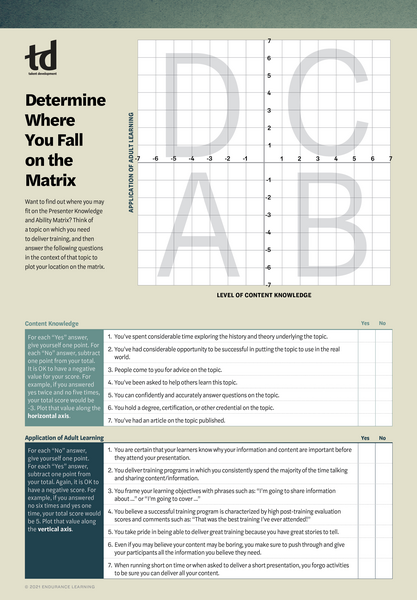
Someone with an MBA will probably tell you that in business school they learned that the best (usually ideal) place to be on any two-by-two matrix is in the upper right quadrant. I don't think that holds true in this matrix.
Quadrant C inherently assumes that you have deep technical or subject matter expertise that you probably earned through years of study and experience. It also assumes that you have refined your facilitation skills in accordance with adult learning principles through years of experience, presentation delivery, feedback, and improvement. While not impossible, especially for more-experienced professionals, getting to Quadrant C is a tall order for most people who present here or there.
In fact, many organizations may not want many (or any) Quadrant C-level presenters. Companies hire people for their expertise—being an expert coder, an expert researcher, or an expert salesperson is how a business makes money. When those expert coders, researchers, and salespeople are spending time developing presentation skills and learning to integrate adult learning theory principles, they aren't usually making money for the company.
The good news is that you don't need a Quadrant C presenter on your team to be successful. If you're able to bring two presenters into your next workshop—one from Quadrant B (someone with deep subject matter expertise) and one from Quadrant D (someone skilled in applying adult learning principles)—then you have an opportunity to provide a Quadrant C-level presentation for your learners.
If you're the only presenter and you find that you're more of a SME who needs help thinking of activities that would engage learners, technology can help fill the adult learning gap. Tools such as SessionLab or Soapbox enable presenters to organize their thoughts and come up with engagement strategies. If you find that you're more of a pure facilitator, then making sure you have access to job aids and on-demand resources from your organization's intranet may prove most useful—as will familiarity and comfort with the phrase "I'm not sure, but I can find out for you."
Moving out of Quadrant A
Of course, everyone finds themselves beginning in Quadrant A at some point—whether you're early in your career, you're starting a new job in a new field or new company, or someone has suddenly asked you to deliver a presentation. The question becomes: Which way do you want to grow? It's ill-advised and usually unrealistic to go straight from Quadrant A to C, so generally your choices will be to work on your subject matter expertise or your ability to integrate adult learning principles into your design and delivery.
Making the move into Quadrant B by increasing your technical expertise brings both benefits and pitfalls. Proven strategies to take you from Quadrant A to B include:
Spending time immersed in your technical area through on-the-job experiences, articles, the organization's intranet, podcasts, or the internet
Researching industry trends and best practices
Setting specific goals and milestones to grow your understanding of the industry from your co-workers, supervisor, and mentors
Finding ways to apply your knowledge in real-world contexts
The danger with building your knowledge is that you can become too close to your content, fall into the "curse of knowledge" trap, and begin to load your presentations with details that you believe are important but that your learners don't need to be effective in their jobs.
Another option is to move toward Quadrant D. You may do so in several ways, such as:
Reading L&D industry publications from cover to cover each month (that is literally how I learned about the world of L&D)
Reading books such as The Adult Learner or Learning to Listen, Learning to Teach to gain a fundamental grasp on the theory and strategies behind adult learning
Video recording your presentation delivery (whether during an actual presentation or simply practicing) and watching yourself to identify what you do well and what you can do better
Having a supervisor, colleague, or mentor who is skilled in adult learning observe you and share feedback
Seeking opportunities to present and gaining confidence in applying strategies that ensure your content is relevant for learners and that learners can understand how your content can help solve their problems
The importance of knowing thyself
Ultimately, are you going to list "Quadrant D-style presenter" on your LinkedIn profile? Probably not. However, you may want to be able to write phrases such as "Consistently receive 5 out of 5 on my presentation evaluation forms" or "Able to present highly technical content in a way that is easily digestible to my audience" on your LinkedIn profile or resume.
One key to getting there is having greater awareness around the degree to which you instill (or don't instill) confidence in learners (through your subject matter expertise) and your self-awareness around the way in which you engage (or don't engage) learners through presentation strategies that keep your content relevant and interesting.
View Courses Recommended for You