TD Magazine Article
Member Benefit
Soak It Up
Content
Create a culture of learning using the SPONGE model.
Fri Jun 30 2023

Content
Create a culture of learning using the SPONGE model.
Content
Rising inflation, talent shortages, increased costs to retain talent, fears of recession, wars, and rapid changes in the economy are all putting a lot of pressure on businesses. As Eric Hoffer observes in Reflections on the Human Condition, "In times of change learners inherit the earth; while the learned find themselves beautifully equipped to deal with a world that no longer exists." For organizations to survive and innovate, the L&D function's role is even more critical as it enables talent to perform and continually create business value.
Content
A strategic question for L&D leaders is: How can we create an ecosystem where a culture of learning thrives?
Continuous learning
Content
When someone is learning, important changes take place in their brain, including the creation of new connections between neurons. The expression "Soak up information like a sponge" refers to a person's ability to be highly curious about absorbing new information and building new connections.
Content
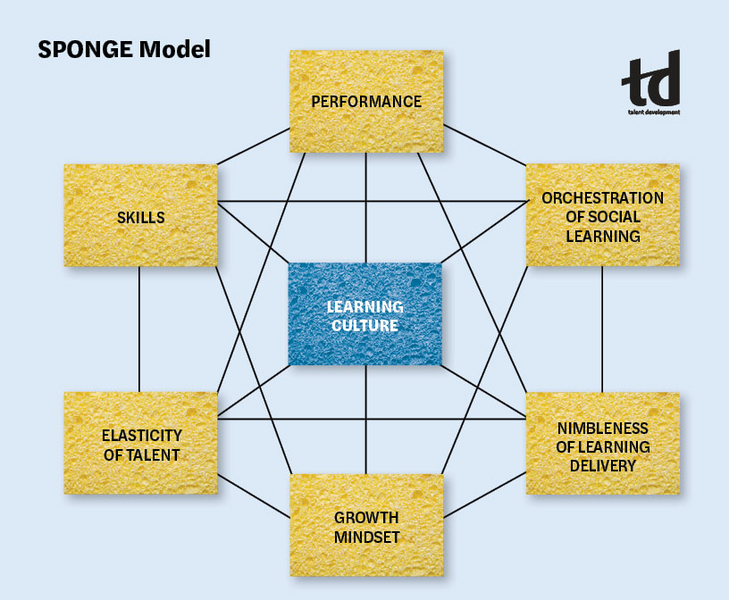
The SPONGE model for building a learning culture provides a framework that learning leaders can use to inspire and incite career growth. The acronym stands for:
Content
Skills
Skills
Content
Performance
Performance
Content
Orchestration of social learning
Content
Nimbleness of learning delivery
Content
Growth mindset
Growth mindset
Content
Elasticity of talent
Content
The framework offers critical questions in each of the categories, which have bolstered performance analysis conversations, yielding identification of root causes of performance gaps and building thriving talent ecosystems. In prior roles and in our current roles leading L&D innovation, we have used several of the questions during consulting engagements with Fortune 500 companies.
Content
Why is it so important to promote a culture of learning? Gartner reports that employees are applying only 54 percent of the new skills they learn despite the number of skills required for a single job increasing by 10 percent year over year. Although it's critical that companies hire people who are quick and eager learners, an organization's work isn't done once a new employee walks through the door.
Content
In fact, the onus is on companies—and most often on the L&D function and hiring managers—to ensure that workers have everything they need to continue to develop their skill sets, use the skills on the job, and increase organizational performance.
Skills
Content
In these disruptive economic times, hiring for skills enables employers to bring in capabilities that match their current needs and creates an avenue that then qualifies talent with transferable skills to fill open roles or project-specific needs. Transferability within an organization is a key avenue for career growth, which improves employee job satisfaction and reduces time to fill talent needs.
Content
In terms of skills, L&D leaders should ask:
Content
What are the top five to 10 skills the organization needs now?
Content
What are key skills the company will need in two to five years?
Content
Which high-performing and innovative leaders in the organization can help identify relevant skills?
Content
What is the business impact of talent with those skills?
Content
How long will those skills help the company sustain, evolve, and stay relevant?
Content
How can staff and their respective skills differentiate the company from the competition and sustain innovation?
Content
Responses to those questions will help L&D identify solutions for whichever problems will get the organization the biggest returns. Nailing down top skills as well as creating learning and skills development programs focused on current and future skills needs will ensure talent is always ready to help the company succeed.
Performance
Content
When L&D starts taking a performance-orientation approach versus focusing on creation and delivery of requested content, the results engender trust among employees and business leaders. In the pursuit of increasing departmental, vertical, and business performance, the L&D function's role becomes that of an enabler and problem solver that creates, curates, buys, or borrows content; motivates employees; delivers and tracks learning; provides opportunities for learners to practice; removes technological impediments; and creates community connections that foster social learning.
Content
Adopting a performance-orientation approach involves L&D partnering with internal teams responsible for organizational design, talent consulting, people analytics, transformation and innovation, and change management.
Content
To shift to a performance-oriented approach, L&D leaders should ask:
Content
What are the organization's goals and objectives as well as key requirements, and how is the organization faring against them?
Content
What are the performance gaps? Which systems, processes, tools, and policies are necessary to build collective team performance?
Content
What is the difference between a high- and low-performing employee in the company?
Content
What are the limitations to building team capabilities? Are employees motivated to perform?
Content
Are systems and processes well documented?
Content
What are the performance objectives? Do we need learning courses to meet those performance objectives? If so, what would the learning objectives entail and what learning journey would work effectively in the hybrid-flexible workplace? How will we measure the performance improvements?
Content
What technologies, such as employee performance support systems, can we leverage and host to leapfrog into the future?
Content
Will the performance challenge at hand require a learning solution? Is there a need to create content? Is content searchability a challenge? Do learners have the time to learn?
Content
Responses to those questions will help learning leaders identify real performance problems, determine causes of the performance gaps, as well as present learning solutions and changes required to close the gaps.
Orchestration of social learning
Content
Humans are constantly absorbing different and new things from their environments, colleagues, books, TV, and any social sources, which causes the brain to act like a sponge. That results in a huge source of wisdom that aids humans in learning socially by sharing information, discussing it with others, and teaching it back to peers.
Content
In "Social Presence as a Predictor of Satisfaction Within a Computer-Mediated Conferencing Environment," Charlotte Gunawardena and Frank Zittle found that social presence is indeed a predictor of overall learner satisfaction and contributed to about 60 percent of the variance. Further, in "Examining Social Presence in Online Courses in Relation to Students' Perceived Learning and Satisfaction," Jennifer Richardson and Karen Swan conclude that learners with high overall perceptions of social presence scored high in perceived learning and perceived satisfaction.
Content
L&D plays a key role in orchestrating social learning. The L&D function cannot be a center of all knowledge and intellectual property that exist within a company, but creating an ecosystem that enables social connection in tandem with finding resources and experts who can answer business questions is well within L&D limits.
Content
Some questions for L&D leaders to think about:
Content
Where do our employees connect socially in the hybrid environment? How can we embed L&D solutions in existing social channels such as all-staff meetings, watercooler conversations, and social media platforms?
Content
What technology currently exists within the organization for social connection (for example, Yammer, Slack, Facebook Workplace, the intranet, or the learning management system)?
Content
Are coaches or social change agents necessary to influence learning adoption and support reinforcement after facilitated sessions?
Content
What are the rewards and incentives the company can provide to recognize success?
Content
What policy considerations and updates to existing procedures must the company make to create an environment where employees can learn and connect socially?
Content
What motivational swag or rewards can the organization provide to market learning opportunities and subtly motivate employees to invest in their development?
Content
By answering those questions, L&D can strategize its ability to effectively connect learners in a cohort model, create social communities of practice, and build a marketing plan.
Nimbleness of learning delivery
Content
Strategic plans used to be stable and last three to five years. However, responding to change and being able to pivot quickly are now highly valued skills. Nimbleness of learning delivery to learners—collecting and responding quickly to feedback as well as iterative delivery to customers to enable business performance results—is a metric for L&D success and essential to evolving a culture of learning.
Content
L&D leaders should consider these questions:
Content
What modalities are we using for content creation?
Content
How long does it take to create content? Does the effort have good return on investment?
Content
Are we incorporating build, buy, borrow, and curate options during performance consulting?
Content
What new processes must we set up to incorporate learner feedback into course revisions?
Content
What processes must we convert to Agile versus waterfall delivery?
Content
What considerations are there to delivering learning to a hybrid workforce?
Content
Where do our learners consume content (for example, the LMS, learning experience platform, SharePoint, team meetings, or internet searches)?
Content
Responses to those questions help determine where L&D needs to spend the effort to deliver as quickly as possible and iterate on what is deliverable to continually make it more effective. Agile learning links L&D skills development to the business strategy rather than to knowledge gained. For example, according to the Gartner report An Executive Leader's Guide to Agile Learning, if a business strategy is to increase revenue through technology, then L&D should deem critical the skills that will create, implement, and maintain those technologies. Likewise, L&D should link the skills to the business strategy.

Growth mindset
Content
Growth mindset is the belief that an individual can grow and develop through dedication, hard work, and purposeful practice—rather than relying on given talent. Purposefully deploying growth mindset language and techniques can establish new cultures, change current working norms, and help unlock hidden potential. Identify real and unconscious barriers to growth and provide a language for employees to use to overcome those barriers and stay energized.
Content
Language has the power to influence behaviors and change business outcomes. It shapes the way people think and creates perspectives that can unlock potential. Coupling with techniques from several problem-solving methodologies such as Lean, Agile, and design thinking, a growth mindset can create a powerhouse that collaborates to deliver on solutions and minimizes the need for formal learning solutions.
Content
Creating a growth mindset goes hand in hand with cre-ating a learning culture. As such, L&D leaders should ask:
Content
Do leaders show curiosity, demonstrate risk-taking capabilities, and learn from failures? Do they exhibit use of growth mindset vocabulary?
Content
Is the organization curious? Does it have grit and agility?
Content
Do employees trust that leaders listen to employee voices?
Content
Are managers including career development in their conversations and performance feedback with direct reports?
Content
Does the company reward innovation and recognize failures as learning opportunities?
Content
Is innovation and growth differentiating the organization from its competitors?
Content
Responding to those questions can help L&D leaders identify the behaviors the organization values, which growth mindset behaviors it may need to teach, and whether the company rewards and recognizes employees for innovation. A curious organization will always be learning from its successes and failures in addition to exploring new solutions.
Elasticity of talent
Content
McKinsey reports that employers have acknowledged the need to build skills, with a focus on developing social and emotional skills such as empathy, leadership, and adaptability. Soft skills are hard to buy. Reskilling—for both soft and technical skills—and redeploying talent is more cost-effective; it can cost up to six times more to hire externally versus hiring (or building) internally.
Content
As L&D gets into the business of prioritizing skills development, retaining curious talent will be foundational. In terms of talent elasticity, L&D leaders should ask:
Content
With the speed of technological advancements, how elastic or fungible is the company's workforce?
Content
How powerful and relevant are soft skills, such as critical thinking, to the organization?
Content
What is the average tenure of talent in the company and in a role?
Content
What is the internal mobility rate?
Content
Has the company adopted practices that promote internal mobility?
Content
What formal or informal coaching mechanisms exist in the organization that enable employees to hear about and try new projects outside of their current department?
Content
Responding to some of those questions can help identify and build mechanisms to reskill for current and future needs, prepare talent to face technological advancements head-on, and increase employment longevity. While there are fears of technological advancements taking jobs away, there will also always be new technology to learn and build solutions.
Future ready
Content
An L&D professional's role is not to sit in silos and deliver on intake requests but instead make an impact on collective team performance that enables business growth. The SPONGE model can help L&D functions create a culture of learning, growth, curiosity, adaptability, critical thinking, and agile delivery that are essential to sustainability in the future.