
TD Magazine Article
Member Benefit
The Enduring Talent Trial
Content
Business challenges related to talent development remain some of the top concerns for CEOs worldwide.
Business challenges related to talent development remain some of the top concerns for CEOs worldwide.
Mon Jul 09 2012

Content
Addressing workplace talent challenges is on the forefront of CEOs' minds this year, according to the PricewaterhouseCoopers 15th Annual Global CEO Survey 2012. The survey finds that chief executives are nearly three times as confident in their companies' growth as they are in the global economy's growth, and their strategies to achieve such change revolve around balancing global capabilities and local opportunities; resilience to global disruptions and local risks; and the talent challenge.
Addressing workplace talent challenges is on the forefront of CEOs' minds this year, according to the PricewaterhouseCoopers 15th Annual Global CEO Survey 2012. The survey finds that chief executives are nearly three times as confident in their companies' growth as they are in the global economy's growth, and their strategies to achieve such change revolve around balancing global capabilities and local opportunities; resilience to global disruptions and local risks; and the talent challenge.
Content
"It's quite notable how high on executives' agenda talent issues are considering the other economic challenges that exist," says Suzanne Snowden, head of global thought leadership at PricewaterhouseCoopers. Snowden explains that 2012 is the first year that this survey deeply examines the talent challenge. During the past several years, CEOs reported that talent was important, but when asked what they were actually doing to deliver change, talent dropped out of their priorities.
"It's quite notable how high on executives' agenda talent issues are considering the other economic challenges that exist," says Suzanne Snowden, head of global thought leadership at PricewaterhouseCoopers. Snowden explains that 2012 is the first year that this survey deeply examines the talent challenge. During the past several years, CEOs reported that talent was important, but when asked what they were actually doing to deliver change, talent dropped out of their priorities.
Content
"We noticed a gap between CEOs' proclaimed interest in talent issues and their actions to address them, so we decided to explore the topic in more depth this year," Snowden says.
"We noticed a gap between CEOs' proclaimed interest in talent issues and their actions to address them, so we decided to explore the topic in more depth this year," Snowden says.
Content
The 2012 report shows that executives still value talent, with 84 percent claiming that business in general has a role in workforce development . And when pressed about their current commitment to talent, CEOs claim that developing the workforce tops their investment goals.
The 2012 report shows that executives still value talent, with 84 percent claiming that business in general has a role in workforce development. And when pressed about their current commitment to talent, CEOs claim that developing the workforce tops their investment goals.
Content
Seventy-one percent of respondents say they would devote a "significant increase" or "some increase" to their investment to create and foster a skilled workforce during the next three years. Additionally, 68 percent of respondents wish they could personally spend more time developing their leadership and talent pipeline, second only to meeting with customers (69 percent).
Seventy-one percent of respondents say they would devote a "significant increase" or "some increase" to their investment to create and foster a skilled workforce during the next three years. Additionally, 68 percent of respondents wish they could personally spend more time developing their leadership and talent pipeline, second only to meeting with customers (69 percent).
Content
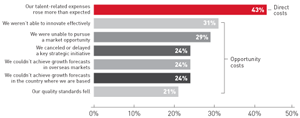
Despite their zeal for workforce development, CEOs admit their shortcomings when it comes to securing the right people for the right jobs to drive growth. Because of talent constraints during the past 12 months, 31 percent could not innovate effectively, 29 percent were unable to pursue a market opportunity, and 24 percent canceled or delayed a key strategic initiative (see table on page 23).
Despite their zeal for workforce development, CEOs admit their shortcomings when it comes to securing the right people for the right jobs to drive growth. Because of talent constraints during the past 12 months, 31 percent could not innovate effectively, 29 percent were unable to pursue a market opportunity, and 24 percent canceled or delayed a key strategic initiative (see table on page 23).
Content
Furthermore, 43 percent of executives say it has become more difficult to hire workers in their industry. A "surplus or deficit in supply of skilled candidates" is the primary reason for such difficulties, according to 47 percent.
Furthermore, 43 percent of executives say it has become more difficult to hire workers in their industry. A "surplus or deficit in supply of skilled candidates" is the primary reason for such difficulties, according to 47 percent.
Content
So what does the future hold? While 47 percent of respondents are confident in their three-year revenue growth prospects, only 30 percent are assured that they'll have access to the talent needed to execute the company's strategy.
So what does the future hold? While 47 percent of respondents are confident in their three-year revenue growth prospects, only 30 percent are assured that they'll have access to the talent needed to execute the company's strategy.
Content
Organizations are investing heavily in talent development: Leaders say during the next three years they are closely integrating human resources with business planning, and they expect the majority of promotions to come from within the existing workforce.
Organizations are investing heavily in talent development: Leaders say during the next three years they are closely integrating human resources with business planning, and they expect the majority of promotions to come from within the existing workforce.
Talent Constraints Are Now Affecting Growth and Profitability
Content
Have talent constraints impacted your company's growth and profitability during the past 12 months in the following ways?
Have talent constraints impacted your company's growth and profitability during the past 12 months in the following ways?
Content
[
[
Content
Business challenges related to talent development remain some of the top concerns for CEOs worldwide.
Business challenges related to talent development remain some of the top concerns for CEOs worldwide.
Content
]( http://files.astd.org/TD-Article-Images/2012/07/Intelligence6-L.png )
](http://files.astd.org/TD-Article-Images/2012/07/Intelligence6-L.png)