TD Magazine Article
Member Benefit
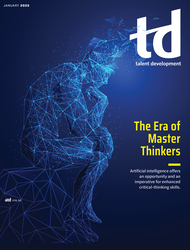
The Era of Master Thinkers
Artificial intelligence offers an opportunity and an imperative for enhanced critical-thinking skills.
Wed Jan 01 2025

The emergence of artificial intelligence in the workplace is revolutionizing how businesses operate and is poised to reshape the future job market. The 2024 AI Skills Report by online education company Pluralsight states that 81 percent of executives have formally deployed or plan to formally deploy AI tools and technologies, while 95 percent of executives believe AI initiatives will fail without staff who can effectively use those tools.
In their Stanford Social Innovation Review article, "Choosing AI's Impact on the Future of Work,” Massachusetts Institute of Technology professors Daron Acemoglu and Simon Johnson predict that the technological shift will likely follow one of two paths. One focuses on automation, where technology companies design AI systems to execute tasks as effectively as, or even better than, human employees. Such an approach, while potentially increasing efficiency, carries the risk of society getting "more of the same—a gap between capital and labor, more inequality between the professional class and the rest of the workers, and fewer good jobs in the economy,” Acemoglu and Johnson explain.
A more optimistic path, they continue, emphasizes augmenting human capabilities by leveraging AI to equip workers with enhanced tools and data-driven insights. That approach has the potential to unlock new levels of productivity and create opportunities for individuals to engage in more intricate and fulfilling work.
However, regardless of which path becomes dominant, AI will necessitate a transformation in how people approach work. Instead of being primarily producers of work, employees will increasingly take on the roles of verifiers, ensuring the accuracy and reliability of AI-generated output.
In his 2024 SHRM Talent Conference keynote address, futurist Elliott Masie stated that "in 18 months, we won't use the term AI.” The implication was that AI is a computing language, and declaring its value 18 months from now would be akin to purporting the amazing use of HTML or JavaScript today. AI will intertwine with the applications people use, and people won't talk about it explicitly because it will be an everyday tool.
The need for critical thinking
Prior industrial revolutions focused on creating efficiency whereas the modern era entails humans operating alongside completely autonomous machines and computers. Klaus Schwab, founder and executive chairman of the World Economic Forum, describes in The Fourth Industrial Revolution that this current period is one where "we are facing a range of new technologies that combine the physical, digital and biological worlds. These new technologies will impact all disciplines, economies and industries, and even challenge our ideas about what it means to be human.”
Therefore, it's up to humans to ensure that the autonomous work that computers execute is accurate and productive. That shift in responsibilities underscores the growing importance of critical-thinking skills within organizations.
The ability to discern factual information from AI-generated content, which can sometimes be inaccurate or misleading, is paramount in an era where AI tools are becoming ubiquitous. Concerns surrounding AI hallucinations—where AI systems generate outputs that are factually incorrect or lack a basis in reality—further amplify the need.
Six stages of critical thinking
To effectively navigate the evolving landscape, employers must cultivate critical thinking as a core competency. That involves fostering a work environment that values analytical thinking, embraces evidence-based decision making, and encourages the continuous development of critical-thinking skills.
Educational psychologists Linda Elder and Richard Paul developed a framework that outlines six stages of critical thinking, from unreflective to master thinkers.
Unreflective. People in this stage have a tendency to accept information at face value without delving deeper or questioning assumptions. Unreflective thinkers often rely on preconceived notions and may be influenced by unexamined prejudices.
Challenged. Individuals in this stage begin to acknowledge the importance of questioning their beliefs and reflecting on information. However, they may not yet consistently engage in critical-thinking practices.
Beginning. This stage marks the start of active engagement with critical thinking. Beginning thinkers make a conscious effort to examine their assumptions and evaluate the credibility of information sources.
Practicing. Practicing thinkers demonstrate a growing ability to analyze information, identify biases, and consider alternative viewpoints. They are increasingly comfortable with questioning their own thought processes.
Advanced. Thinkers in this stage consistently apply critical-thinking principles and strive for intellectual integrity. They demonstrate a strong commitment to seeking truth and are adept at updating their beliefs in light of new evidence.
Master. Master thinkers represent the pinnacle of critical thinking, possessing a deep understanding of their own thought processes and a relentless pursuit of accurate information. They are highly skilled at identifying and challenging biases, both in their own thinking and in the information they encounter.
One of the hallmarks of a master thinker is that they value accurate information and examine the sources of that information. One popular acronym used to evaluate source validity is called the CRAAP test.
Currency considers the timeliness of the information. When did the information publish or post, and is its timeliness relevant for your context?
Relevance considers whether the information is important in your particular context. Does it relate to your topic, and have you considered several sources?
Accuracy considers the correctness of the information. Have other reputable sources confirmed it?
Authority considers the author of the information. Do they have credibility relevant to this type of information?
Purpose considers why the information exists. Is it factual, or is it opinion or propaganda?
Critical thinking is more of a practice than a single skill. Any one individual can be at various levels of the critical-thinking stages depending on the subject and the context.
For the practice of critical thinking to thrive, cultural beliefs must exist in organizations, whether they are part of the company's values or mission. If such beliefs don't exist, developing skills for critical thinking will be difficult. Another necessity is for companies to teach employees the skills to conduct critical thinking.
![Figure 1. AI Priorities [blue triangles float around]
What should organizations do to use artificial intelligence technology effectively?
Invest in talent, training, and culture. IT professionals: 38% Executives: 32%
Develop a clear strategy. IT professionals: 12% Executives: 12%
Evaluate partners and solutions. IT professionals: 5% Executives: 8%
Establish clear objectives and measures of success. IT professionals: 16% Executives: 14%
Evaluate risks and compliance. IT professionals: 10% Executives: 12%
Secure funding and resources. IT professionals: 10% Executives: 8%
Stay up to date on AI trends. IT professionals: 3% Executives: 4%
Perform test or pilot projects. IT professionals: 3% Executives: 7%
Other. Executives: 3%
Source: AI Skills Report, Pluralsight, 2024](https://assets.td.org/transform/ecba90e1-ce37-4093-a814-c4de04c5d4a3/feature1chart1)
Cultural beliefs
A set of cultural beliefs is a foundation that helps critical thinking in businesses thrive. Talent development professionals and organization development practitioners play a major role in instilling such beliefs in a company.
Psychological safety. Individuals must feel safe taking risks, admitting mistakes, and asking questions without fear of negative repercussions in their workplace.
Openness to new ideas. Employees must feel comfortable sharing diverse perspectives and be receptive to changing their minds in the face of compelling evidence.
Intellectual humility. Recognizing that no one has all the answers and that everyone can learn from others encourages a culture of inquiry and continuous improvement.
Questioning mindset. Encourage curiosity and empower staff to question assumptions, challenge existing processes, and seek deeper understanding.
Embracing ambiguity. Equip employees to navigate complex situations where clear-cut solutions may not be readily apparent. Foster comfort with uncertainty and encourage exploration of multiple possibilities.
Valuing evidence. Emphasize data-driven decision making and encourage staff to base their conclusions on sound evidence and logical reasoning.
Respect for diverse opinions. Create an inclusive environment where individuals feel safe expressing their ideas, even if they differ from the majority. Encourage respectful dialogue and constructive criticism.
Commitment to learning. Support continuous learning by providing opportunities for professional development and encouraging employees to expand their knowledge base.
To instill those beliefs, TD and OD professionals need to first receive confirmation from senior leaders that they value the beliefs and that the beliefs align with the organization's strategy. Without executive support, there is risk in the beliefs falling flat.
A second step is to identify ways to raise awareness and create experiences that reinforce the beliefs as existing within the company. In the case of psychological safety, for example, one activity may be to deliver training company-wide to help employees understand what it is and how it thrives. TD and OD can then support the workforce by recognizing when they see behaviors that reinforce positive elements of psychological safety.
In the case of commitment to learning, TD professionals can demonstrate their own commitment to learning as well as ensure all staff are aware of the learning opportunities that exist.
Skills for critical thinking
To develop employees' critical-thinking skills, incorporate the following five competencies into TD programs.
Observation. Use scenario planning, competitive intelligence teams, and mindfulness training to enable staff to improve their ability to notice and predict opportunities, problems, and solutions.
For instance, scenario planning involves exploring key uncertainties and trends that could affect the business. Therefore, facilitators of scenario planning should encourage open dialogue to envision multiple scenarios and then collaboratively assess potential strategies that address risks and opportunities within each scenario.
Analysis. Data analysis training, data interpretation workshops, data reviews, and evaluating sources for validity and fallacies are methods to teach employees to gather, understand, and interpret data and other information.
As an example, a data interpretation workshop tailored to the organizational context could focus on building participants' skills in analyzing data and making informed decisions using existing tools within the company. The facilitator could begin by familiarizing participants with all the data sources that are available internally and then work through real-life exercises to interpret and apply data insights to real business challenges.
Inference. This skill entails drawing conclusions based on relevant data, information, and personal knowledge and experience. TD can develop this skill in employees via case study analysis, critical reading and discussion, and mind mapping.
A mind mapping session typically starts by introducing a central theme or problem, then guiding participants to brainstorm related ideas and concepts, encouraging free association and creativity. As ideas flow, the facilitator helps structure them visually—branching out from the core theme and ensuring the map captures connections and patterns between thoughts—which fosters deeper understanding and collaboration.
Communication. Sharing and receiving information with others verbally, nonverbally, and in writing are skills staff can hone through role-playing scenarios, public speaking, and feedback sessions.
TD can teach workers the skills to give peer-to-peer feedback. Using models such as the Situation-Behavior-Impact method can be helpful in giving structure for providing feedback.
Problem solving. To enhance employees' process of gathering, analyzing, and communicating information to identify and troubleshoot solutions, TD can use training programs that incorporate root-cause analysis, decision-making matrices, and simulation exercises.
People often can be quick to rush to judgment, so providing frameworks for root-cause analysis can be valuable in slowing such gut-based judgments and helping to find the true causes of issues. Some ways to go about that include helping employees clearly define the problem, collect available data, identify possible causal factors, analyze those factors, and determine the root cause.
![Figure 2. Top Organizational Benefits
of Using Artificial Intelligence [Rodin's statue, the Thinker, is drawn with interconnected technological lines. The pixels and lines break apart at the crown of his head, with fractals suspended in the air.] Increased productivity and efficiency [cogs]
Improved customer service [headset]
Reduced repetitive tasks and human error [checklist]
Reduced business costs [three coins with $]
Improved data analytics and management [an upward-trending graph]
Improved employee experience [5 rating stars over an office building]
Source: AI Skills Report, Pluralsight, 2024](https://assets.td.org/transform/3595b9dd-0245-480e-9ad8-4d5f5603cefa/feature1chart2)
Case study: Competitor assignment
One program in a sales organization created a great example in developing each of the critical-thinking skills for its sales force. The program objective was to help new sales representatives become familiar with their competitive landscape. Considering that the reps operated in a highly dynamic market where the competition was constantly shifting, it was important to provide the salespeople with the ability to quickly research and find valid information about their competitors as opposed to memorizing static facts about them.
The primary artifact around which the exercise revolved was a battle card that outlined a quick hit of information for each of the company's competitors. It contained information that any salesperson could access to understand a particular competitor. One knowledge management issue that existed was that the battle cards needed constant updating. The critical-thinking exercise provided an opportunity to refresh the cards on a regular basis.
The activity began by assigning new sales reps a single competitor and asking them to first review the battle card along with prior presentations about their assigned competitor (observation).
The second assignment involved salespeople researching data in the customer relationship management system to understand how often the organization had won or lost against the particular competitor. There were often rich notes about the deal that provided the new rep with anecdotal data and information that they could use to continue learning about the competitor as well as the number of deals where the competitor appeared (analysis).
Next, the sellers conducted self-guided research via the internet and other reports they could source to find information about their assigned competitor (inference).
Once they compiled all that information, the reps needed to create and give a presentation to their leader and other senior leaders in the sales organization (communication).
As a final assignment, the sellers updated the battle cards they initially received as part of the assigned project. The sales organization then put the updated battle card into rotation for other field reps to use.
Consider the advantage
The use of AI in the workplace is only going to continue to become more prevalent. TD and OD professionals who stay ahead of the curve and keep up with new technology will have a definitive advantage. Companies that will find success in adopting AI tools and mitigating potential risks will instill cultural beliefs and skills that complement the ethical and effective use of AI.
View Courses Recommended for You