TD Magazine Article
Member Benefit
The Fine Art of Conversation
Content
Let’s talk about how to improve your communication and conversational skills.
Tue Jan 02 2024

Content
Let's talk about how to improve your communication and conversational skills.
Content
Having conversations sounds simple. It's something everyone does every day. You talk with friends, colleagues, and clients—yet conversing is something most people pay far too little attention to, especially when they are at work.
Content
What you choose to talk about and how you go about your conversations, especially as a leader and as a designer of learning solutions, carries huge potential to affect your organization's success—both positively and negatively.
Content
Your ability to have good conversations with other human beings is essential to creating common understanding, goodwill, and agreements. Underpinning that is the ability to have an honest conversation with yourself about your motivations and drivers when conversing.
Content
When you consider how much time you spend in dialogue with others at work, you'll start to recognize that conversations are a key tool for creating change. Dialogue at work comes in the form of performance reviews, appraisals, career conversations, and honest chats. You converse when giving and receiving feedback, sharing organizational vision, and bringing it to life every day. Such communication relies on your ability to connect through your conversations with awareness, skill, and empathy.
The risk
Content
Right now, the world's complexity is overwhelming, and society is at risk of losing the art of conversation. Technology begets a growing flood of daily information and distractions. Individuals can order food, fall in love, and connect with friends, all without opening their mouths. Disparate workforces have led to new challenges in how to hold truly engaging and meaningful conversations when most meetings are virtual.
Content
Such disruptions profoundly test a person's ability to hold face-to-face interactions, especially those that happen incidentally—the smaller, unexpected, watercooler conversations when you learn something that speeds up your work or you make a new connection. Those interactions are where serendipity has the chance to emerge.
Content
Improving the quality of conversations in the workplace can foster a better company culture with greater loyalty, create stronger human connections, and deepen trust—all of which contribute to enhanced business performance.
A framework for better dialogue
Content
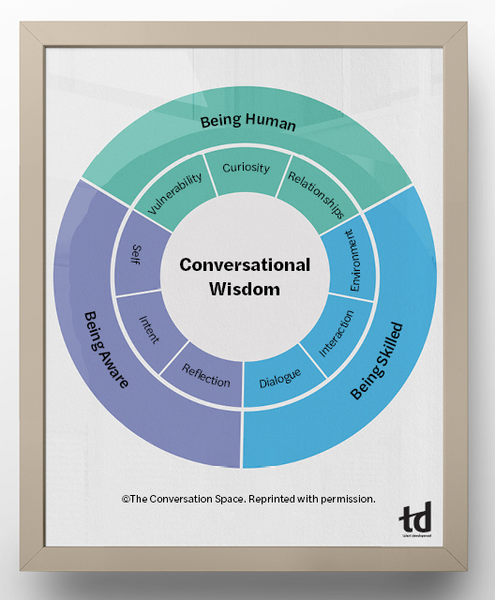
Conversational Wisdom is a philosophy and framework that has grown from our research published in Mastering Conversation: The Key Ingredient to Successful Leadership. The framework is not a definitive guide to having better conversations; rather, it is a map to help people navigate the landscape of conversations. It can guide your thinking on how you talk with others to demonstrate a sense of connection, care, and commitment as well as how to use conversation to create a more empathic, inclusive, and engaging culture at work.
Content
Based on three essential pillars—being aware, being human, and being skilled—the framework is for anyone who wants to engage in more meaningful conversations. By becoming more conversationally wise, you will equip yourself with a core leadership skill.
Content
Becoming more conversationally wise is primarily about both how people connect and relationships. After all, it is through networks of connections and human relationships that organizations function. The framework invites you to be more human, to use your experience, knowledge, and intuition to make choices about what to say and how to say it. It reminds you to stay with your feelings of vulnerability and share uncomfortable truths with others. That may feel risky, but it serves the dual purpose of washing away the distractions of status and creating a more open and trusting environment.
Content
The Conversational Wisdom framework highlights the skills required to listen to all voices, step into difficult conversations, as well as create brave and psychologically safe environments. That will enable deeper and more meaningful connections with whomever you speak with.
Content
Growing the wisdom and understanding in how to use your conversations to greatest effect and sustain deeper behavioral change takes practice and effort. Here are some practical things you can do to become a better conversationalist.
Being aware
Content
Awareness in conversations is where it all starts. When you start paying attention to what's going on in and around your spoken conversation—for example, noticing your assumptions about others—you can choose how to respond.
Content
Being aware lays the foundation for having conversations with more empathy and helps you work effectively with people who have different perspectives. Three elements of Conversational Wisdom help you become more aware.
Content
Self. Working on your self-awareness in your conversations is crucial. The saying "You cannot serve from an empty vessel" highlights the importance of paying attention to those aspects in yourself. Ensuring that you access the support and challenge to develop yourself, along with time to digest, reflect, and embed that learning, is critical.
Content
Deepening your awareness of how you show up in conversations means you have a choice about how you respond in the moment. For example, by noticing your shortcomings (talking over people, for instance), or how you do (or don't) challenge people who are more senior, you give yourself room to try a different approach.
Content
You can become more self-aware through continued professional development, peer networks, or diagnostics. Don't forget to ask for feedback from friends, family, or colleagues about your conversational skills. Constructive feedback can help you identify areas for improvement and refine your approach.
Content
Intent. Knowing your intent for any conversation—why you are having it and what you hope to get out of it—provides a compass to help you stay on track. Sharing your intent with others also gives them clarity and helps to set expectations. The more you can speak about your intent, and listen to others' intent, the more aware you will be of any conversation's purpose.
Content
Before you go into a conversation, especially an important one, think about:
Content
What the purpose is
What the purpose is
Content
What you want to get out of it
Content
How you want people to experience you during the conversation
Content
Start by making a list of key points you want to make and how you will share them with any others involved.
Content
Reflection. As your days become squeezed, you may not have time to reflect. Yet, reflecting on your conversations gives you access to a rich opportunity to learn and grow your Conversational Wisdom. That practice is fundamental to being aware of how you show up.
Content
Taking just a few minutes to reflect on a conversation helps to raise your awareness as an individual—and as a team. For example, next time your team comes out of a meeting with a key stakeholder, ask yourselves:
Content
On a scale of 1 to 10, how well did the meeting go?
Content
What was the balance between our focus on building a relationship versus completing a task?
Content
How well did we listen?
Content
Record your reflections and come back to them before the next meeting with the same stakeholder. Doing so can help raise your awareness of what may be important to remember.

Being human
Content
In the context of the Conversational Wisdom framework, being human means recognizing that each one of us is unique. Each person enters every conversation and meeting bringing a rich tapestry of experiences, beliefs, assumptions, and emotions.
Content
As social beings, humans are hardwired to connect with others, and that does not disappear at work. Organizations are now giving greater attention to creating environments where people can bring more of their whole selves to work. As a result, a shift is happening toward more personal, inclusive conversations.
Content
For your conversations to be more human, focus on the following elements.
Content
Vulnerability. Having more human conversations requires courage and vulnerability. Author and professor Brené Brown describes vulnerability as the feeling individuals get during times of "uncertainty, risk, or emotional exposure." For example, you may need to share difficult feedback and be afraid of hurting the other person or damaging your relationship with them. In that instance, your natural response could be to not have the conversation altogether. However, by being willing to feel vulnerable and step courageously into conversations that you find difficult, you are actively taking steps that deepen trust and build psychological safety.
Content
During your next team meeting, rather than getting straight into the task, invite each person to share an object that says a little bit more about them outside of work. Such conversations help create greater human connection and bring a sprinkle of joy into meetings. People love to talk about themselves and their passions, and when you show that you value them as a person, they are more likely to open up and engage in a deeper conversation.
Content
Curiosity. As people develop in their careers, they may come to a stage where they stop asking questions and think they know everything. They take on the role of being an expert and become unaware of what impact that can have. They lose their curiosity to search for solutions.
Content
When you stop becoming curious and asking questions, you risk missing out on diverse thoughts and perspectives that are essential for innovating and thriving in a complex world.
Content
Therefore, it is important to enable other people to bring their unique thinking, letting different ideas flourish. Do that by asking more questions, staying quiet for a moment after someone has spoken, and showing genuine interest in the other person's experiences and opinions.
Content
Relationships. Trust is the foundation to any successful relationship, and you have the opportunity to build trust during your everyday conversations. One of the most effective ways to do so is during those brief chats before a meeting really gets going—the ones about the weather or what you did over the weekend. Such conversations can boost the brain's executive function and make people happier. If you feel better, you are more likely to be engaged and productive.
Content
Don't underestimate the power of your conversations in strengthening relationships. Build in time to catch up with your team about everyone's weekend. During your next Zoom call, chat about the latest Netflix hit you've watched. Make a point of incorporating small talk into your day and notice the impact it has on your relationships.
Being skilled
Content
Growing conversational skill takes time and practice. By honing your listening skills, practicing empathy, improving your body language, and paying attention to the conversational environment, you can become a better conversationalist as well as build more meaningful connections in your personal and professional lives.
Content
Dialogue. The word dialogue in the context of Conversational Wisdom refers to the words, language, and meaning spoken in any conversation. Words have the power to help people influence, provide insights, and evoke feelings. Words also can have significant and unintended consequences.
Content
There is a shifting awareness of the imperative to use more inclusive language at work, which means giving more thought to the words that you choose to speak and how you form questions and statements. For example, simply changing your use of the word and rather than but in conversations can help those with whom you speak to stay open to ideas and steer clear of defensiveness.
Content
The meaning each person attributes to their words can be different, depending on the individual's unique perception or culture. By checking in, you help catch potential misunderstandings and challenge negative, limiting, or biased beliefs.
Content
Interactions. If dialogue is the transcript of your conversation, interaction is everything else that surrounds it—the unspoken conversation.
Content
The quality of your conversation is affected by your tone of voice and body language, both of which can often have a far greater impact than the words you speak. Maintaining an open posture, smiling genuinely, and using hand gestures naturally encourages a more comfortable and fruitful conversation.
Content
The quality of your listening has the greatest impact of all. When someone you're speaking with is not giving their full attention to the conversation, that often disrupts your ability to engage in the discussion and do your best thinking. Listening is a skill to practice and hone. Here are three simple tips to help:
Content
Be as present as possible. Put down your phone and close your laptop—remove as many distractions as you can.
Content
Ask more open and probing questions. That allows for further and deeper listening.
Content
Listen with empathy and understanding. Take the time to let the other person tell their story.
Content
Environment. Giving attention to where and how you hold your conversations matters. It only takes a little thought and preparation to create a conversational environment grounded in empathy and support.
Content
The physical environment can create the conditions for best thinking and ultimately higher quality outcomes from your conversations. For example, when holding a confidential conversation in person, find somewhere where you won't be disturbed, away from distractions, and where you feel comfortable. Try removing tables or going for a walk-and-talk to add a different dynamic to any conversation. Talking side by side rather than across a table or on a screen, provides a natural way to have less eye contact and lowers intimidation or distraction factors.
Content
If holding the conversation virtually, confirm whether the environment you are in enables you and the other person to be comfortable to speak openly.
Talk it out
Content
Conversational Wisdom is a valuable asset everyone holds. It requires focused awareness in addition to attention and investment from a time perspective. Like any skill, becoming a better conversationalist requires practice. Engage in conversations regularly, whether with friends, colleagues, or strangers.
Content
To be able to challenge and disagree, and to show that you care; to bring more humanity and empathy; to make work more meaningful and joyful; and to radically change how you talk to other people in virtual meetings, in person, and online, foster your development of being aware, skilled, and human in your conversations.
The Research Behind Good Conversations
Content
Mastering Conversation: The Key Ingredient to Successful Leadership is the result of research we conducted to examine how organizations support leaders in becoming better conversationalists. We held 40 in-depth interviews with people at all levels, from graduates to CEOs, across a wide range of sectors, from professional services to not-for-profit to retail, with the aim of gaining a deeper understanding of good conversations.
Content
We explored four key areas:
Content
What makes a great leadership conversation?
Content
How great conversations affect individuals, teams, and the wider organization
Content
How organizations support and develop the capacity for leaders to be more skillful in their conversations
Content
How those in the learning profession can support future leaders to grow their conversational muscles
Content
The research highlighted many interesting findings and illuminated the sheer scale and complexity of embedding conversational change. Download the report at tinyurl.com/yckj6t26.