ATD, association for talent development

TD Magazine Article

Member Benefit

The Intentional Decision Maker

Content

Your approach to making decisions is crucial to building a more inclusive, agile, and high-performing organization.

Your approach to making decisions is crucial to building a more inclusive, agile, and high-performing organization.

By

Thu Feb 01 2024

The Intentional Decision Maker
Loading...

Content

Your approach to making decisions is crucial to building a more inclusive, agile, and high-performing organization.

Your approach to making decisions is crucial to building a more inclusive, agile, and high-performing organization.

Content

People make tens of thousands of decisions per day—in fact, a Cornell University study found that up to 300 of those are about food alone. To stay functional and keep moving through life, individuals make most daily decisions automatically, without thinking too much about them.

People make tens of thousands of decisions per day—in fact, a Cornell University study found that up to 300 of those are about food alone. To stay functional and keep moving through life, individuals make most daily decisions automatically, without thinking too much about them.

Content

But when people come together in a business context to make decisions, the process often becomes sticky and dysfunctional. Such dysfunction may take the form of teams stuck in an endless loop, trying to achieve perfect consensus. It may look like over-relying on structural authority (such as rank, title, or tenure) as a proxy for decision-making capability when determining who should lead those activities. Back-channeling, forgetfulness, urgency, miscommunication—there are myriad ways a decision-making process can get stuck, lost, or headed in the wrong direction.

But when people come together in a business context to make decisions, the process often becomes sticky and dysfunctional. Such dysfunction may take the form of teams stuck in an endless loop, trying to achieve perfect consensus. It may look like over-relying on structural authority (such as rank, title, or tenure) as a proxy for decision-making capability when determining who should lead those activities. Back-channeling, forgetfulness, urgency, miscommunication—there are myriad ways a decision-making process can get stuck, lost, or headed in the wrong direction.

Content

Organizations and teams can't rely on the same default decision-making habits that make individuals more efficient and effective. Doing so only reinforces structural inequities and dysfunction, even if a company is vocally committed to collective transformation (in other words, big ideas such as innovation, trust, agility, and empowerment).

Organizations and teams can't rely on the same default decision-making habits that make individuals more efficient and effective. Doing so only reinforces structural inequities and dysfunction, even if a company is vocally committed to collective transformation (in other words, big ideas such as innovation, trust, agility, and empowerment).

Content

But if you, your team, and your company adopt a more intentional decision-making methodology, you can change how those big ideas manifest within everyday moments throughout the organization. Change how you make decisions, and you'll change the company culture.

But if you, your team, and your company adopt a more intentional decision-making methodology, you can change how those big ideas manifest within everyday moments throughout the organization. Change how you make decisions, and you'll change the company culture.

The impact of decision making

Content

Research from Bain & Company reveals that companies that excel at decision making "generated average total shareholder returns nearly six percentage points higher than those of other firms," according to the Harvard Business Review article "The Decision-Driven Organization." Six percent can equate to millions or billions of dollars.

Research from Bain & Company reveals that companies that excel at decision making "generated average total shareholder returns nearly six percentage points higher than those of other firms," according to the Harvard Business Review article "The Decision-Driven Organization." Six percent can equate to millions or billions of dollars.

Content

Further, a Cloverpop study notes that teams that follow an inclusive process make decisions two times faster, with half the meetings, and the decisions diverse teams make and execute deliver 60 percent better results.

Further, a Cloverpop study notes that teams that follow an inclusive process make decisions two times faster, with half the meetings, and the decisions diverse teams make and execute deliver 60 percent better results.

Content

Clearly, decision making can be a powerful lever for building a more inclusive, agile, high-performing organization.

Clearly, decision making can be a powerful lever for building a more inclusive, agile, high-performing organization.

Drawbacks of RACI charts

Content

Inevitably, when I talk about decision making with clients, one of the first questions that comes up is: "What about RACI?"

Inevitably, when I talk about decision making with clients, one of the first questions that comes up is: "What about RACI?"

Content

After eight years of consulting with hundreds of large, complex organizations that use the RACI (responsible, accountable, consulted, informed) model in their decision making, my colleagues at consulting firm August Public and I have concluded that a RACI chart, which is a type of responsibility assignment matrix, is not a useful decision-making tool. We have found that it lends the illusion of clarity and efficiency to decision making, and it instead serves to document existing organizational dysfunction.

After eight years of consulting with hundreds of large, complex organizations that use the RACI (responsible, accountable, consulted, informed) model in their decision making, my colleagues at consulting firm August Public and I have concluded that a RACI chart, which is a type of responsibility assignment matrix, is not a useful decision-making tool. We have found that it lends the illusion of clarity and efficiency to decision making, and it instead serves to document existing organizational dysfunction.

Content

Our experience is that a RACI chart rarely moves decision-making authority to the right level. A team typically creates a chart once for a project without accounting for the dozens or hundreds of decisions that will drive that project forward. Further, the chart gives no guidance for how decision making will occur; it's only a template for whom to blame when things go wrong.

Our experience is that a RACI chart rarely moves decision-making authority to the right level. A team typically creates a chart once for a project without accounting for the dozens or hundreds of decisions that will drive that project forward. Further, the chart gives no guidance for how decision making will occur; it's only a template for whom to blame when things go wrong.

Content

A more effective decision-making method is to designate an empowered decision owner, supported by a robust stakeholder map.

A more effective decision-making method is to designate an empowered decision owner, supported by a robust stakeholder map.

Empowered decision ownership

Content

A decision owner is the person who makes final decisions even if others (even those more senior) disagree. The individual should have expertise in the decision at hand, reliable access to data to make an informed choice, time for the process, and the skill to solicit and integrate diverse perspectives.

A decision owner is the person who makes final decisions even if others (even those more senior) disagree. The individual should have expertise in the decision at hand, reliable access to data to make an informed choice, time for the process, and the skill to solicit and integrate diverse perspectives.

Content

The ideal decision owner is usually not at the top of the organizational chart, and they work in close contact with the people who will be most affected by the decision. The decision owner must have a nuanced perspective on how large-scale decisions from the top translate into outcomes on the ground and be best positioned to spot unintended consequences and risks before they balloon.

The ideal decision owner is usually not at the top of the organizational chart, and they work in close contact with the people who will be most affected by the decision. The decision owner must have a nuanced perspective on how large-scale decisions from the top translate into outcomes on the ground and be best positioned to spot unintended consequences and risks before they balloon.

Content

One example demonstrating the benefit of distributing decision ownership away from the top leader is the story of how Netflix CEO Reed Hastings initially passed on the pilot script for the TV show Stranger Things. In his opinion, it didn't seem like a runaway global hit. Fortunately for the streaming service, Hastings wasn't the only one with decision-making power. A manager several rungs lower on the organizational chart greenlit the pilot after Hastings declined, thereby launching one of the biggest hits in streaming history and delivering outstanding results for the company's bottom line.

One example demonstrating the benefit of distributing decision ownership away from the top leader is the story of how Netflix CEO Reed Hastings initially passed on the pilot script for the TV show Stranger Things. In his opinion, it didn't seem like a runaway global hit. Fortunately for the streaming service, Hastings wasn't the only one with decision-making power. A manager several rungs lower on the organizational chart greenlit the pilot after Hastings declined, thereby launching one of the biggest hits in streaming history and delivering outstanding results for the company's bottom line.

Content

Hastings's near-miss is a stark illustration of how critical it is to have the right person—instead of defaulting to the highest-ranking person—at the helm of each decision.

Hastings's near-miss is a stark illustration of how critical it is to have the right person—instead of defaulting to the highest-ranking person—at the helm of each decision.

Content

I saw distributed decision ownership in effect in 2022, when August Public consulted with a software company on its transition to a hybrid workplace. While other large organizations mandated a return to the office, driven by leadership agendas and preferences, the software company empowered managers to make the call for their respective teams.

I saw distributed decision ownership in effect in 2022, when August Public consulted with a software company on its transition to a hybrid workplace. While other large organizations mandated a return to the office, driven by leadership agendas and preferences, the software company empowered managers to make the call for their respective teams.

Content

Within the guardrails of the software company's hybrid-centric initiative called Flex Forward, each manager can now decide when—or whether—their employees come into the office. That shift recognizes that managers are best equipped not only with expertise, time, and data, but with the skill to incorporate diverse perspectives into an inclusive and empowering plan for their teams.

Within the guardrails of the software company's hybrid-centric initiative called Flex Forward, each manager can now decide when—or whether—their employees come into the office. That shift recognizes that managers are best equipped not only with expertise, time, and data, but with the skill to incorporate diverse perspectives into an inclusive and empowering plan for their teams.

The support system

Content

To be inclusive, many organizations default to a consensus model of decision making. However, in practice, consensus isn't inclusive. Mandatory agreement silences relevant and dissenting perspectives because people will self-censor just to keep the process moving.

To be inclusive, many organizations default to a consensus model of decision making. However, in practice, consensus isn't inclusive. Mandatory agreement silences relevant and dissenting perspectives because people will self-censor just to keep the process moving.

Content

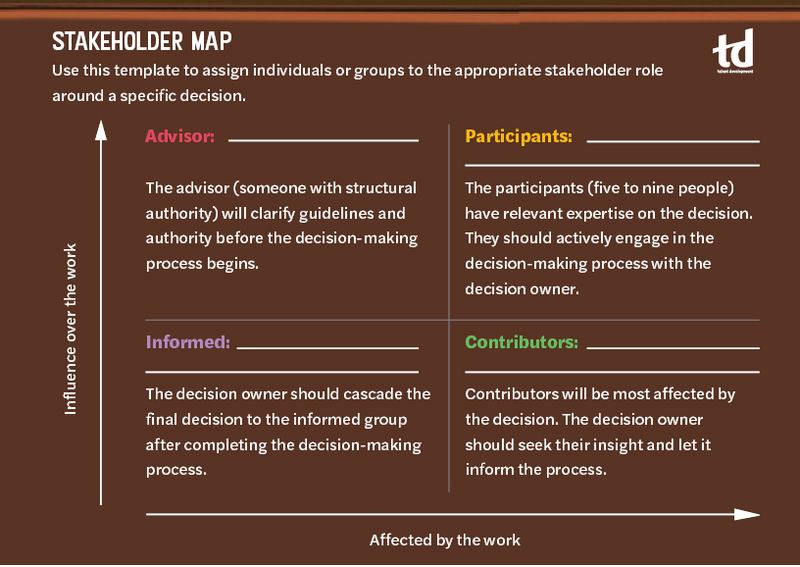
A stakeholder map, on the other hand, is a method for building meaningful inclusion without requiring unanimous agreement. It is a way to deliberately choose whose voices should influence the decision owner's process as well as a means of finding creative ways for soliciting input and insight from the wider community. The map consists of four groups: advisors, participants, contributors, and informed stakeholders (see figure).

A stakeholder map, on the other hand, is a method for building meaningful inclusion without requiring unanimous agreement. It is a way to deliberately choose whose voices should influence the decision owner's process as well as a means of finding creative ways for soliciting input and insight from the wider community. The map consists of four groups: advisors, participants, contributors, and informed stakeholders (see figure).

Content

Within the Flex Forward program, advisors were mainly the company's C-suite leaders (the CEO, chief HR officer, chief media officer, and chief technology officer), who each provided insight on the resources and limitations for taking the company hybrid. Participants were key leaders from affected areas (facilities, finance, and sales). Contributors were all employees; their managers surfaced and represented their opinions and preferences. Informed people were those who already worked remotely as well as certain other groups (contractors, service organizations, and the general public who followed the story).

Within the Flex Forward program, advisors were mainly the company's C-suite leaders (the CEO, chief HR officer, chief media officer, and chief technology officer), who each provided insight on the resources and limitations for taking the company hybrid. Participants were key leaders from affected areas (facilities, finance, and sales). Contributors were all employees; their managers surfaced and represented their opinions and preferences. Informed people were those who already worked remotely as well as certain other groups (contractors, service organizations, and the general public who followed the story).

The emergency brake

Content

Because so many people conflate inclusion with the slow grind of consensus, there's a big misconception that inclusive decision making will slow things down. The distinction, however, is that consensus slows down a process, while inclusive decision making speeds things up.

Because so many people conflate inclusion with the slow grind of consensus, there's a big misconception that inclusive decision making will slow things down. The distinction, however, is that consensus slows down a process, while inclusive decision making speeds things up.

Content

The decision owner and stakeholder map model are built on a bias toward action: With one person tasked with making the final decision, universal agreement is not a prerequisite for moving forward. In place of consensus, stakeholders have an emergency brake to keep the organization safe from the fallout of a faulty decision. That fail-safe tool is called safe to try.

The decision owner and stakeholder map model are built on a bias toward action: With one person tasked with making the final decision, universal agreement is not a prerequisite for moving forward. In place of consensus, stakeholders have an emergency brake to keep the organization safe from the fallout of a faulty decision. That fail-safe tool is called safe to try.

Content

After the decision owner has integrated the perspectives of the stakeholder map and proposed a final decision to the participants, the decision owner will ask, "Is this decision safe to try?" The participants must say yes—unless someone voices a valid objection that proves the decision is not safe to try. A valid objection is not:

After the decision owner has integrated the perspectives of the stakeholder map and proposed a final decision to the participants, the decision owner will ask, "Is this decision safe to try?" The participants must say yes—unless someone voices a valid objection that proves the decision is not safe to try. A valid objection is not:

  • Content

    A gut feeling or vague concern

    A gut feeling or vague concern

  • Content

    A preference for a different decision

    A preference for a different decision

  • Content

    A concern about the decision's failure to address other unrelated problems

    A concern about the decision's failure to address other unrelated problems

Content

Those objections can be important considerations, but they don't make a decision unsafe to try.

Those objections can be important considerations, but they don't make a decision unsafe to try.

Content

A valid objection provides hard data that the decision will cause immediate and irreparable harm, such as:

A valid objection provides hard data that the decision will cause immediate and irreparable harm, such as:

  • Content

    Badly undermining another team's project

    Badly undermining another team's project

  • Content

    Damaging a critical relationship

    Damaging a critical relationship

  • Content

    Repeating a mistake the team has made in the past

    Repeating a mistake the team has made in the past

Content

When participants raise those types of objections, the decision owner then works with them to adapt the decision in a way that will make it safe to try.

When participants raise those types of objections, the decision owner then works with them to adapt the decision in a way that will make it safe to try.

Content

The safe-to-try approach frees everyone to voice their concerns while keeping the process moving forward. That makes it possible to make inclusive decisions quickly, with minimal risk. In addition, the approach shifts the decision goal toward learning and discovery, which empowers faster decisions and quicker adoption of successful strategies. That in turn leads to better business outcomes on a shorter timetable, all while building inclusion and empowerment. Proceeding and learning become the default option so that individuals try new ideas and learn from them.
The safe-to-try approach frees everyone to voice their concerns while keeping the process moving forward. That makes it possible to make inclusive decisions quickly, with minimal risk. In addition, the approach shifts the decision goal toward learning and discovery, which empowers faster decisions and quicker adoption of successful strategies. That in turn leads to better business outcomes on a shorter timetable, all while building inclusion and empowerment. Proceeding and learning become the default option so that individuals try new ideas and learn from them.

The Intentional Decision Maker-feature5chart1.jpg

Capture and communicate

Content

How many times have you found yourself experiencing decision déjà vu in a meeting? You know your team already made a decision about the topic at hand, but no one can remember what it was.

How many times have you found yourself experiencing decision déjà vu in a meeting? You know your team already made a decision about the topic at hand, but no one can remember what it was.

Content

To avoid such a scenario, after the decision owner makes a decision, it's essential to communicate it widely and clearly. Skipping that step will result in revisiting the same decision down the line.

To avoid such a scenario, after the decision owner makes a decision, it's essential to communicate it widely and clearly. Skipping that step will result in revisiting the same decision down the line.

Content

The key role in decision capture is the scribe, a rotating role fulfilled by one of the participants. Every time a decision maker comes to a decision, the scribe writes it down in an open, shared digital document. The file should include the decision method, the stakeholders, the rationale and context that influenced the decision, in addition to the decision's anticipated impact and trade-offs. The scribe next circulates the decision to everyone on the stakeholder map.

The key role in decision capture is the scribe, a rotating role fulfilled by one of the participants. Every time a decision maker comes to a decision, the scribe writes it down in an open, shared digital document. The file should include the decision method, the stakeholders, the rationale and context that influenced the decision, in addition to the decision's anticipated impact and trade-offs. The scribe next circulates the decision to everyone on the stakeholder map.

Content

The final decision-making step is to set a schedule for implementing, evaluating, and recalibrating, if necessary, to maximize the learning value of the decision as well as get the best return on the time and energy invested in the decision-making process.

The final decision-making step is to set a schedule for implementing, evaluating, and recalibrating, if necessary, to maximize the learning value of the decision as well as get the best return on the time and energy invested in the decision-making process.

Rethink decision making

Content

The outlined methods are built on three fundamental mindset shifts:

The outlined methods are built on three fundamental mindset shifts:

  • Content

    A shift from implicit authority to explicit authority will enable you and your team to practice empowered decision ownership, resulting in better outcomes and faster processes as well as galvanizing more diverse voices to have a tangible impact.

    A shift from implicit authority to explicit authority will enable you and your team to practice empowered decision ownership, resulting in better outcomes and faster processes as well as galvanizing more diverse voices to have a tangible impact.

  • Content

    A shift from "Is it right?" to "Is it safe to try?" will free your organization from perfectionism, making space for dissenting perspectives and enabling the team to learn faster by defaulting to action.

    A shift from "Is it right?" to "Is it safe to try?" will free your organization from perfectionism, making space for dissenting perspectives and enabling the team to learn faster by defaulting to action.

  • Content

    A shift from decision secrecy to decision visibility will maximize the learning value of the decision and minimize any inefficiencies or miscommunications in its wake.

    A shift from decision secrecy to decision visibility will maximize the learning value of the decision and minimize any inefficiencies or miscommunications in its wake.

Content

Those shifts have the power to bring an organization's biggest ideas into the daily reality of its workforce. A business shifting its decision-making process from default habits to intentional practices that align with company values will drive culture change faster than ever before. Redesign how you, your team, and your company make decisions, and you'll change the entire organization from the inside out.

Those shifts have the power to bring an organization's biggest ideas into the daily reality of its workforce. A business shifting its decision-making process from default habits to intentional practices that align with company values will drive culture change faster than ever before. Redesign how you, your team, and your company make decisions, and you'll change the entire organization from the inside out.

You've Reached ATD Member-only Content

Become an ATD member to continue

Already a member?Sign In

issue

ISSUE

February 2024 - TD Magazine

View Articles

Copyright © 2026 ATD

ASTD changed its name to ATD to meet the growing needs of a dynamic, global profession.

Terms of UsePrivacy NoticeCookie Policy