ATD, association for talent development

TD Magazine Article

Member Benefit

The Long and Short of Video Content Creation

Content

Microlearning may be popular, but long-form videos also have a place in your training arsenal.

Microlearning may be popular, but long-form videos also have a place in your training arsenal.

By

Thu Dec 30 2021

The Long and Short of Video Content Creation
Loading...

Content

During the past decade, the trend in L&D has been to create short educational videos, but is that a superior instructional solution to longer videos? Has the training industry's move to a shorter video length obscured the focus on creating effective long-form instructional videos?

During the past decade, the trend in L&D has been to create short educational videos, but is that a superior instructional solution to longer videos? Has the training industry's move to a shorter video length obscured the focus on creating effective long-form instructional videos?

Content

Research points to using shorter training content segments to optimize knowledge transfer, and the industry followed suit by beating the drum that all training content should be concise and by using terms such as snackable, bite-size, and microvideo. However, there are moments along the learning journey when an information-rich video is a proper media selection for transferring knowledge.

Research points to using shorter training content segments to optimize knowledge transfer, and the industry followed suit by beating the drum that all training content should be concise and by using terms such as snackable, bite-size, and microvideo. However, there are moments along the learning journey when an information-rich video is a proper media selection for transferring knowledge.

Instructional strategies

Content

The instructional strategy described in this article supports adult learners who are part of a prescribed education program (andragogy) and are independent learners (heutagogy). That audience will consume a large amount of information throughout the learning journey that includes video and other supporting content.

The instructional strategy described in this article supports adult learners who are part of a prescribed education program (andragogy) and are independent learners (heutagogy). That audience will consume a large amount of information throughout the learning journey that includes video and other supporting content.

Content

Before mapping a long video in the learning journey, let's establish what constitutes a long training video.

Before mapping a long video in the learning journey, let's establish what constitutes a long training video.

Content

The video contains more than one learning objective. This criterion is easy to identify. If you have multiple learning objectives represented in a video, you will want to pay attention to its structure to alleviate viewer cognitive load issues.

The video contains more than one learning objective. This criterion is easy to identify. If you have multiple learning objectives represented in a video, you will want to pay attention to its structure to alleviate viewer cognitive load issues.

Content

The learning objective within the video has more than four concepts or ideas. It's shortsighted to say one learning objective constitutes a short video, because it's relatively easy to go deep into a single learning objective depending upon the topic. If a learning objective goes beyond four concepts or steps, as the video continues, viewers will experience issues related to content retention in working memory—another factor to consider when developing content for long-form videos.

The learning objective within the video has more than four concepts or ideas. It's shortsighted to say one learning objective constitutes a short video, because it's relatively easy to go deep into a single learning objective depending upon the topic. If a learning objective goes beyond four concepts or steps, as the video continues, viewers will experience issues related to content retention in working memory—another factor to consider when developing content for long-form videos.

Content

The video length is longer than one minute. Sixty seconds is the line I've drawn in the sand when describing either a short or long training video. There's evidence audience retention begins to significantly drop around the six-minute mark; thus, some professionals consider six minutes the benchmark for a long training video. However, odds are you are filling up viewers' working memory within one minute if you mention four or more concepts within that time. That means there's a lot of information viewers are potentially ignoring after 60 seconds.

The video length is longer than one minute. Sixty seconds is the line I've drawn in the sand when describing either a short or long training video. There's evidence audience retention begins to significantly drop around the six-minute mark; thus, some professionals consider six minutes the benchmark for a long training video. However, odds are you are filling up viewers' working memory within one minute if you mention four or more concepts within that time. That means there's a lot of information viewers are potentially ignoring after 60 seconds.

Content

Topics best suited for a long-form training video in terms of knowledge and skills transfer include:

Topics best suited for a long-form training video in terms of knowledge and skills transfer include:

  • Content

    Employee onboarding

    Employee onboarding

  • Content

    Health and safety issues

    Health and safety issues

  • Content

    Operating machinery and vehicles

    Operating machinery and vehicles

  • Content

    Software, mobile, and web application workflows

    Software, mobile, and web application workflows

  • Content

    Sales selling techniques

    Sales selling techniques

  • Content

    Financial, insurance, and government compliance
    Financial, insurance, and government compliance

The Long and Short of Video Content Creation-feature1_January2022_TD_figure1.jpg

Mapping video in the learning journey

Content

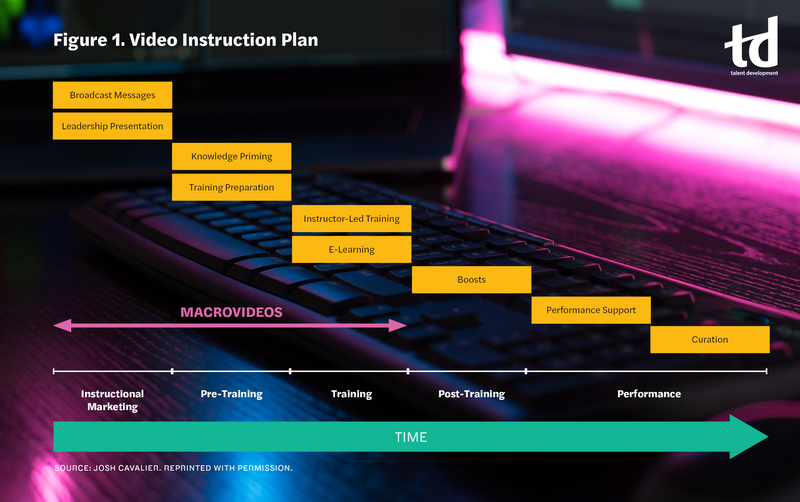
Where in the learning journey do learners consume a macrovideo? Learning professionals primarily focus on video content for training and performance support, but the learning journey comprises additional moments where L&D can leverage video. Viewers' progression as they gain knowledge, learn a new skill, or modify a behavior typically follows these steps:

Where in the learning journey do learners consume a macrovideo? Learning professionals primarily focus on video content for training and performance support, but the learning journey comprises additional moments where L&D can leverage video. Viewers' progression as they gain knowledge, learn a new skill, or modify a behavior typically follows these steps:

Content

1. Instructional marketing builds audience awareness and excitement for the topic.

1. Instructional marketing builds audience awareness and excitement for the topic.

Content

2. Pre-training primes the audience with an overview of the content and any preparation before the training.

2. Pre-training primes the audience with an overview of the content and any preparation before the training.

Content

3. Training comprises the core knowledge transfer events.

3. Training comprises the core knowledge transfer events.

Content

4. Post-training reinforces concepts immediately following the training.

4. Post-training reinforces concepts immediately following the training.

Content

5. Performance support occurs when learners seek information to complete a task or answer a question.

5. Performance support occurs when learners seek information to complete a task or answer a question.

Content

Use long-form training videos in the learning journey's first three steps. Post-training and performance support videos are typically short and contain one instructional element or learning objective with fewer than seven information elements.

Use long-form training videos in the learning journey's first three steps. Post-training and performance support videos are typically short and contain one instructional element or learning objective with fewer than seven information elements.

Content

Instructional marketing videos help build an emotional attachment to the training content—for instance, a video featuring company leaders enthusiastically describing a new software platform that affects the entire organization or a promotional video with an online course author who informs the viewer of the course benefits and content. Typically, to tell a story properly about a training initiative, multiple information points will easily take longer than one minute to describe correctly.

Instructional marketing videos help build an emotional attachment to the training content—for instance, a video featuring company leaders enthusiastically describing a new software platform that affects the entire organization or a promotional video with an online course author who informs the viewer of the course benefits and content. Typically, to tell a story properly about a training initiative, multiple information points will easily take longer than one minute to describe correctly.

Content

Pre-training videos prepare the audience for the upcoming training content. They enable viewers to understand training length, any pre-training preparation, and housekeeping items to ensure a successful training experience. You can use both macro- and microvideos during this phase. Use macrovideos if you want to reduce the number of audience touchpoints or your learning ecosystem doesn't lend itself to delivering spaced, interval videos. If you have a method for delivering videos in a timed sequence, consider a series of microvideos leading up to the training event.

Pre-training videos prepare the audience for the upcoming training content. They enable viewers to understand training length, any pre-training preparation, and housekeeping items to ensure a successful training experience. You can use both macro- and microvideos during this phase. Use macrovideos if you want to reduce the number of audience touchpoints or your learning ecosystem doesn't lend itself to delivering spaced, interval videos. If you have a method for delivering videos in a timed sequence, consider a series of microvideos leading up to the training event.

Content

Training videos are going to be the sweet spot for macrovideos. This is where you will use most of your time producing content, and it will have the highest impact on the learning journey—only second to short-form videos used for post-training reinforcement.

Training videos are going to be the sweet spot for macrovideos. This is where you will use most of your time producing content, and it will have the highest impact on the learning journey—only second to short-form videos used for post-training reinforcement.

Audience considerations

Content

Throughout the day, people make thousands of decisions that entail a constant dialogue in individuals' minds about what actions they will or will not take. That thought pattern—decision, path, outcome—likewise repeats in a viewer's mind regarding your video.

Throughout the day, people make thousands of decisions that entail a constant dialogue in individuals' minds about what actions they will or will not take. That thought pattern—decision, path, outcome—likewise repeats in a viewer's mind regarding your video.

  • Content

    Decision: Should I perform an action (for example, click the video's play button)?

    Decision: Should I perform an action (for example, click the video's play button)?

  • Content

    Path: As the video plays, is the content putting me in the right direction?

    Path: As the video plays, is the content putting me in the right direction?

  • Content

    Outcome: Is the information I'm gathering going to give me the desired result?

    Outcome: Is the information I'm gathering going to give me the desired result?

Content

When a viewer's path is not clear or they don't desire the perceived outcome, then the learner may stop paying attention to the video or stop playing it altogether. Therefore, when developing video content, ensure there is a clear path to the result and that the information transferred represents the perceived outcome. As an example, for a video that instructs on how to change a tire, the pattern may look like the following.

When a viewer's path is not clear or they don't desire the perceived outcome, then the learner may stop paying attention to the video or stop playing it altogether. Therefore, when developing video content, ensure there is a clear path to the result and that the information transferred represents the perceived outcome. As an example, for a video that instructs on how to change a tire, the pattern may look like the following.

  • Content

    Decision: Viewers confirm it is the correct training video by reviewing the thumbnail, video description, and length and then begin to play the video.

    Decision: Viewers confirm it is the correct training video by reviewing the thumbnail, video description, and length and then begin to play the video.

  • Content

    Path: As the video plays, the narrator states, "In this video, I'm going to show you how to properly change a car tire in six easy steps." That confirms to viewers the path to the knowledge outcome.

    Path: As the video plays, the narrator states, "In this video, I'm going to show you how to properly change a car tire in six easy steps." That confirms to viewers the path to the knowledge outcome.

  • Content

    Outcome: As learners continue watching, does the video go through the six steps, and are those steps in fact easy? Are viewers engaged? If not, then viewers will decide to skip ahead or stop watching.

    Outcome: As learners continue watching, does the video go through the six steps, and are those steps in fact easy? Are viewers engaged? If not, then viewers will decide to skip ahead or stop watching.

The Long and Short of Video Content Creation-feature1_January2022_TD_figure2.jpg

Video structures

Content

To maintain viewers' interest in long-form skill-based videos, strategically use short emotion segments as illustrated in Figure 2.

To maintain viewers' interest in long-form skill-based videos, strategically use short emotion segments as illustrated in Figure 2.

Content

The core video structure comprises five segments.

The core video structure comprises five segments.

Content

Emotional pull. Gain the viewer's attention with awe, excitement, and even humor. Viewers usually take between five and eight seconds to decide whether to continue a video.

Emotional pull. Gain the viewer's attention with awe, excitement, and even humor. Viewers usually take between five and eight seconds to decide whether to continue a video.

Content

Priming. Relay the video's learning objective. It could be a simple statement such as the narrator's message mentioned earlier about how to change a tire. By priming viewers, you are validating that learners are going down the correct path and mentally ready to take in information specific to the learning objective you shared.

Priming. Relay the video's learning objective. It could be a simple statement such as the narrator's message mentioned earlier about how to change a tire. By priming viewers, you are validating that learners are going down the correct path and mentally ready to take in information specific to the learning objective you shared.

Content

Content. This is where knowledge transfer takes place. Methods to maintain viewer focus during knowledge transfer include:

Content. This is where knowledge transfer takes place. Methods to maintain viewer focus during knowledge transfer include:

  • Content

    Encouraging active viewing—ask a question or tell the viewer to focus on an item on the screen.

    Encouraging active viewing—ask a question or tell the viewer to focus on an item on the screen.

  • Content

    Using strategic emotion—inject a brief emotional moment during the video's knowledge transfer portion, such as the host briefly coming back on screen to emphasize a critical moment in the video.

    Using strategic emotion—inject a brief emotional moment during the video's knowledge transfer portion, such as the host briefly coming back on screen to emphasize a critical moment in the video.

  • Content

    Empowering independent construction of knowledge—give viewers time to synthesize the information they currently have in working memory. For example, ask them to pause the video and take a note or screenshot the moment, such as a list of tools required to change a tire, so they can use it later.

    Empowering independent construction of knowledge—give viewers time to synthesize the information they currently have in working memory. For example, ask them to pause the video and take a note or screenshot the moment, such as a list of tools required to change a tire, so they can use it later.

  • Content

    Reducing cognitive load—less is more, so use symbols, white space on the screen, and exceptional audio quality to help minimize learners' cognitive load.

    Reducing cognitive load—less is more, so use symbols, white space on the screen, and exceptional audio quality to help minimize learners' cognitive load.

  • Content

    Incorporating microreinforcement—repeat a step, show a technique from a different angle, or challenge viewers to perform the action and then return to the video.

    Incorporating microreinforcement—repeat a step, show a technique from a different angle, or challenge viewers to perform the action and then return to the video.

Content

Reflection. Repeat the learning objective or summarize the steps covered in the content section—for example: "Let's review what we covered. When you change a tire, make sure you find a safe place, use your hazard lights, check your materials, loosen the lug nuts, lift your vehicle off the ground, change the tire, drop the vehicle, and replace the lug nuts."

Reflection. Repeat the learning objective or summarize the steps covered in the content section—for example: "Let's review what we covered. When you change a tire, make sure you find a safe place, use your hazard lights, check your materials, loosen the lug nuts, lift your vehicle off the ground, change the tire, drop the vehicle, and replace the lug nuts."

Content

The visual to support that statement could be a montage of all the steps reviewed in the content section. By summarizing what was covered, you present an opportunity to transfer information from viewers' working memory to longterm memory.

The visual to support that statement could be a montage of all the steps reviewed in the content section. By summarizing what was covered, you present an opportunity to transfer information from viewers' working memory to longterm memory.

Content

Emotional push. Learners have reached the end of the video. The moment could be nothing more than an end card with music, or it could be more elaborate with a subject matter expert or video host describing a call to action or a challenge based upon the video content. For instance, the final statement could be: "Now you understand the steps to safely changing a car tire. Go out to your car today and make sure you have a good spare tire, a car jack, and a tool to remove the lug nuts. That will ensure your safety and others' if you get a flat tire."

Emotional push. Learners have reached the end of the video. The moment could be nothing more than an end card with music, or it could be more elaborate with a subject matter expert or video host describing a call to action or a challenge based upon the video content. For instance, the final statement could be: "Now you understand the steps to safely changing a car tire. Go out to your car today and make sure you have a good spare tire, a car jack, and a tool to remove the lug nuts. That will ensure your safety and others' if you get a flat tire."

Content

That five-segment base structure is the core format for short-form training videos between 30 and 60 seconds in length. When extending the length of a training video beyond the 60-second mark, repeat the structure.

That five-segment base structure is the core format for short-form training videos between 30 and 60 seconds in length. When extending the length of a training video beyond the 60-second mark, repeat the structure.

Content

Each content section should be an influential knowledge transfer segment focusing on maintaining viewer attention, reducing cognitive load, and placing knowledge in working memory. As you progress to the end of the first content section, there is a reflection, and then viewers move to a critical transition called the emotional pull/push. That transition is an essential fencepost in your long-form video—it is where you emotionally re-engage learners before moving onto the next content section. In addition, the viewers will need to unload information from working memory before moving on in the video.

Each content section should be an influential knowledge transfer segment focusing on maintaining viewer attention, reducing cognitive load, and placing knowledge in working memory. As you progress to the end of the first content section, there is a reflection, and then viewers move to a critical transition called the emotional pull/push. That transition is an essential fencepost in your long-form video—it is where you emotionally re-engage learners before moving onto the next content section. In addition, the viewers will need to unload information from working memory before moving on in the video.

Content

Here are some examples for developing an emotional push/pull:

Here are some examples for developing an emotional push/pull:

  • Content

    Bring the host or subject matter expert on the screen to reinforce the importance of transferring the knowledge.

    Bring the host or subject matter expert on the screen to reinforce the importance of transferring the knowledge.

  • Content

    Use an animation or title card with music as a bumper between the content sections.

    Use an animation or title card with music as a bumper between the content sections.

  • Content

    Illustrate where on the knowledge journey viewers are (if there's more than one learning objective).

    Illustrate where on the knowledge journey viewers are (if there's more than one learning objective).

  • Content

    Ask viewers to stop the video and perform an action—such as practicing an exercise, taking notes, or writing in a journal—to reinforce what they just learned.

    Ask viewers to stop the video and perform an action—such as practicing an exercise, taking notes, or writing in a journal—to reinforce what they just learned.

  • Content

    Present related content that leads to a "wow" reaction but is not necessary to retain information. For example, show an animated graphic that states: "1.5 billion tires are used in the world each year, and there are many uses for tire waste including asphalt for roads." That information is related to changing a tire but is not part of the required skills.

    Present related content that leads to a "wow" reaction but is not necessary to retain information. For example, show an animated graphic that states: "1.5 billion tires are used in the world each year, and there are many uses for tire waste including asphalt for roads." That information is related to changing a tire but is not part of the required skills.

  • Content

    Ask questions. You can verbally ask questions covering prior information or prime viewers before moving to the following content.

    Ask questions. You can verbally ask questions covering prior information or prime viewers before moving to the following content.

  • Content

    Offer viewers complementary content based on the information covered that enables them to take a deep dive into a related topic. The information should be supplemental and not essential to the knowledge transfer. Content could include a job aid or related training videos.

    Offer viewers complementary content based on the information covered that enables them to take a deep dive into a related topic. The information should be supplemental and not essential to the knowledge transfer. Content could include a job aid or related training videos.

Short isn't always sweet

Content

As you plan your next training initiative, consider the advantages of a macrovideo as part of your content strategy. If executed properly, a long-form video will effectively impart skills and knowledge to your audience members, allow for multiple learning objectives, and reduce the overall number of videos to maintain for the learning journey.

As you plan your next training initiative, consider the advantages of a macrovideo as part of your content strategy. If executed properly, a long-form video will effectively impart skills and knowledge to your audience members, allow for multiple learning objectives, and reduce the overall number of videos to maintain for the learning journey.

Content

When you deploy the macrovideos, be prepared to review the video analytics at predetermined time intervals such as daily, weekly, or monthly. The data you collect will provide insights regarding viewer engagement and the audience's preferred video lengths and will point to sections of the macrovideo you could use for boosts and performance support.

When you deploy the macrovideos, be prepared to review the video analytics at predetermined time intervals such as daily, weekly, or monthly. The data you collect will provide insights regarding viewer engagement and the audience's preferred video lengths and will point to sections of the macrovideo you could use for boosts and performance support.

Content

Finally, the measurement of audience's knowledge retention and positive changes to business key performance indicators will be your true North Star to determine whether your macrovideos are having an impact on your learning program goals.

Finally, the measurement of audience's knowledge retention and positive changes to business key performance indicators will be your true North Star to determine whether your macrovideos are having an impact on your learning program goals.


Long-Form Training Video Ideas

Content

Educational video topics come in three categories, each of which has different ways you can creatively present information. Keep in mind that these techniques are not exclusive; mix them to generate an engaging macrovideo.

Educational video topics come in three categories, each of which has different ways you can creatively present information. Keep in mind that these techniques are not exclusive; mix them to generate an engaging macrovideo.

Content

Skills development (visually or auditorily assist learning)

Skills development (visually or auditorily assist learning)

  • Content

    Give an expert demonstration—for example, a step-by-step activity such as a safety procedure; a verbal performance such as a foreign language; or an interpersonal demonstration such as selling, teaching, coaching, or counseling.

    Give an expert demonstration—for example, a step-by-step activity such as a safety procedure; a verbal performance such as a foreign language; or an interpersonal demonstration such as selling, teaching, coaching, or counseling.

  • Content

    Use symbols—doing so reduces cognitive load by removing extraneous information.

    Use symbols—doing so reduces cognitive load by removing extraneous information.

  • Content

    Present contrasting situations—visually show the correct and incorrect steps.

    Present contrasting situations—visually show the correct and incorrect steps.

  • Content

    Illustrate concepts with real-world examples.

    Illustrate concepts with real-world examples.

  • Content

    Simplify a process with visual overlays.

    Simplify a process with visual overlays.

  • Content

    Vary picture layouts—for instance, picture in picture or side by side (split screen).

    Vary picture layouts—for instance, picture in picture or side by side (split screen).

Content

Vicarious experiences (inaccessible locations or time modifications)

Vicarious experiences (inaccessible locations or time modifications)

  • Content

    Present staged experiments or reenactments.

    Present staged experiments or reenactments.

  • Content

    Show dangerous or inaccessible locations.

    Show dangerous or inaccessible locations.

  • Content

    Display chronological sequence and time duration—for example, show an image of a forest from 100 years ago and then contrast the foliage coverage of the forest with a recent picture.

    Display chronological sequence and time duration—for example, show an image of a forest from 100 years ago and then contrast the foliage coverage of the forest with a recent picture.

  • Content

    Incorporate historical or rare events—this could be a speech by a historical figure or old footage of a pivotal moment in time that has an impact on the video's topic.

    Incorporate historical or rare events—this could be a speech by a historical figure or old footage of a pivotal moment in time that has an impact on the video's topic.

  • Content

    Present technical equipment or a technical process.

    Present technical equipment or a technical process.

  • Content

    Leverage slow and fast motion.

    Leverage slow and fast motion.

Content

Motivation and feelings (foster emotions for action or behavior change)

Motivation and feelings (foster emotions for action or behavior change)

  • Content

    Build motivation by illustrating success—for example, closing a sale using a consultative selling technique.

    Build motivation by illustrating success—for example, closing a sale using a consultative selling technique.

  • Content

    Move to action—emotionally charge viewers to performing a physical action.

    Move to action—emotionally charge viewers to performing a physical action.

  • Content

    Change attitudes through appreciation and empathy.

    Change attitudes through appreciation and empathy.

  • Content

    Encourage viewers—build self-confidence.

    Encourage viewers—build self-confidence.

  • Content

    Validate abstract concepts—show real-world examples solving problems.

    Validate abstract concepts—show real-world examples solving problems.

SOURCE: DESIGNING VIDEO AND MULTIMEDIA FOR OPEN AND FLEXIBLE LEARNING BY JACK KOUMI

You've Reached ATD Member-only Content

Become an ATD member to continue

Already a member?Sign In

issue

ISSUE

January 2022 - TD Magazine

View Articles

Copyright © 2026 ATD

ASTD changed its name to ATD to meet the growing needs of a dynamic, global profession.

Terms of UsePrivacy NoticeCookie Policy