TD Magazine Article
Member Benefit
Trainers Need Training Too
Establish a sustainable instructor development program and a feedback culture to transform your training programs.
Thu May 01 2025

Are your trainers struggling to captivate and engage their audiences? Despite subject matter experts' vast knowledge, do they have insufficient formal training expertise to convey their insights effectively? Do you lack a structured instructor development program to nurture and elevate the skill set of your trainers?
If you answered yes to any of those questions, it's time to build a sustainable training team. Ignite transformation in your training approach by creating a replicable and effective instructor development program that encompasses dynamic train-the-trainer sessions and robust evaluation criteria.
Consistency leads to effectiveness
Instructor development stands as a cornerstone of organizational effectiveness. While training initiatives for other teams often attract talent development leaders' focus, it's imperative to prioritize the professional growth of the TD team.
The cultivation of talent among instructors is essential for enhancing overall performance within training programs. By investing in trainer development, TD functions can achieve greater uniformity and standardization in course delivery, resulting in stronger compliance and improved retention rates among the workforce.
Consistency is critical for the efficacy of training programs. During my tenure at the Federal Law Enforcement Training Center, we adopted the analogy of the Big Mac hamburger: Similar to how a Big Mac retains its signature qualities—sesame bun, two all-beef patties, cheese, lettuce, pickles, onions, and secret sauce—no matter the location, our training sessions should also exhibit uniformity across deliveries.
What does that look like in practice? When multiple cohorts participate in the same course concurrently, both class A and class B receive identical content, activities, and resources. Variations in delivery style or instructor engagement may occur, allowing instructors to incorporate their unique perspectives or flair; however, the core structure and key elements of the training program must remain consistent. Such standardization enhances overall program success and strengthens the learning experience for all participants.
Assess training program health
A robust assessment of your team's capabilities will enable you to implement a sustainable development framework that enhances skill sets and effectively nurtures talent from within. By channeling resources into internal development first, TD functions can optimize their return on investment and foster a more competent workforce. Such an inward focus transforms TD teams into powerhouses of innovation and performance.
Pinpoint gaps in instructor skills by first establishing a performance baseline via active participation in daily operations. Firsthand observations will reveal valuable insights such as trainers' strengths and areas of opportunity. In addition, implement Kirkpatrick Level 1 (reaction) surveys to gauge engagement levels, which will help highlight any deficiencies in training methodologies. If you identify specific training gaps or weaknesses, that indicates a critical need for a strategic overhaul of your training team, emphasizing a targeted approach to instructor development.
Designing a train-the-trainer program
Sustainability should be the foundational principle of any training program, whether it's for your trainers or any other group of learners. In addition, ensuring that development initiatives are effective and that you can maintain them over time is essential for long-term success. A framework for instructor development has four phases: participant observation, train the trainer, instructor observation, and qualification. That approach allows for continuous improvement and adaptation, aligning with the evolving needs of the organization and its staff.
Regardless of the duration of the instructor training program— whether it spans three weeks, one week, two days, or two hours—adhere to all four phases of development. Although the time you will allocate for the phases may vary based on the training course's length, they are interdependent and build upon one another to support a holistic approach to instructor preparation.
The framework is a replicable process. In fact, various entities in the US federal government, including the Department of Homeland Security, the Department of Defense, and government contractors, have successfully adopted it. The model effectively applies to both instructor-led training and virtual instructor-led training. Implementing the approach demonstrates a commitment to the professional growth of team members while aligning with the organization's business objective to gain a positive return on investment from training initiatives.
Participant observation
This initial phase is critical for a new instructor before delivering a course for the first time. The instructor immerses themselves in the course content by attending the class, enabling them to gain a comprehensive understanding from the learner's perspective. Identify and document areas of confusion or difficulty to inform the subsequent training phases.
Train the trainer
During phase 2, the new instructor engages with the curriculum, reviewing the course instructor guide and accompanying presentation. The novice trainer conducts at least two teach-backs to a live cohort of fellow instructors comprising the other new trainers as well as the train-the-trainer session's facilitators. The purpose is to give the novice instructor opportunities to deliver the material in a safe setting. Typically, they present an area of content, predetermined by the facilitators, that is more difficult to deliver—for instance, a section where there tends to be many learner questions or an activity.
The teach-back demonstrates their comprehension of the material and serves as an opportunity to receive developmental feedback on their delivery techniques. The goal is to cultivate the new instructor's confidence and proficiency in a supportive environment.
Instructor observation
In this stage, the novice trainer observes a live class through the lens of the facilitator. That involves a detailed, concurrent review of the instructional materials while leveraging the instructor guide to refine content delivery. The individual should use the instructor guide to document insights and reflections on various elements of the facilitator's material.
Qualification
The final phase involves having a trained evaluator observe the new instructor as they facilitate the course in a live environment. After the course, the instructor meets with their evaluator for 15–30 minutes to go over questions or seek clarification on the content they presented.
To assess the new instructor's performance, the evaluator uses a comprehensive rubric and evaluation checklist with clear pass or fail criteria. The evaluator provides feedback postsession to facilitate the new instructor's growth and enhance their teaching efficacy.
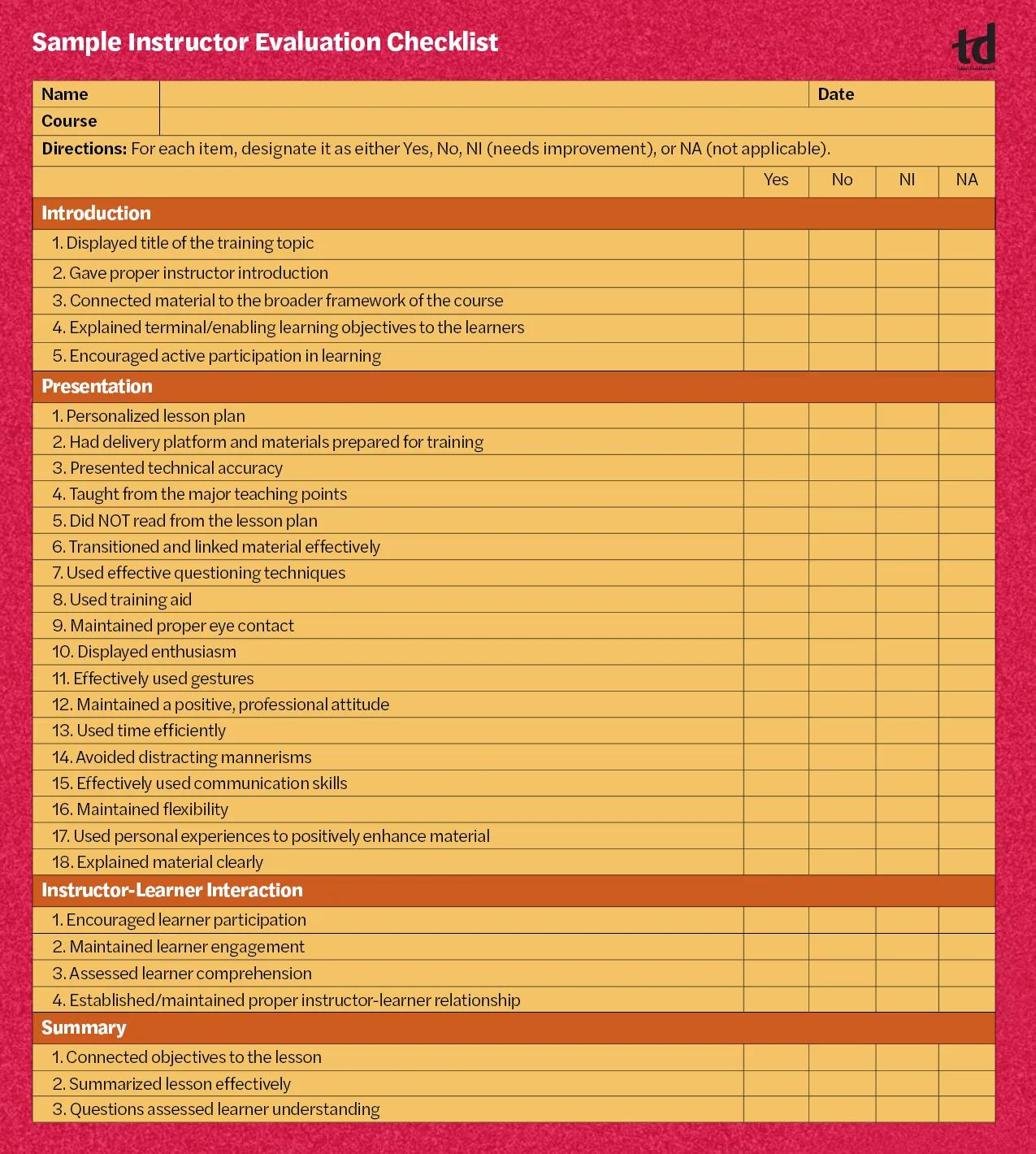
The checklist inventories behaviors in different categories, such as introduction, presentation, instructor-learner interaction, and summary (see figure). The behaviors should encompass a diverse set of competencies, including motivating participants, transitioning and linking material to past or future training content, technical accuracy, time management, using personal examples to illustrate material, and encouraging active participation. Each of the behaviors must align with a rubric entry that includes an ample definition.
Establish clear evaluation standards. Given that the criteria are based on a pass or fail outcome, outline the consequences of failing an evaluation. That includes detailing the process itself and the subsequent steps for both the evaluator and the novice instructor once they determine a result—whether a successful or unsuccessful one. For instance, if a new instructor does not meet the necessary standards, the evaluator should implement an improvement plan for them. The plan may encompass mentoring, targeted professional development, and a subsequent re-evaluation to assess progress and competency.
Foster a feedback culture
Feedback throughout the process is significant, primarily due to its role in enhancing the efficacy of your training programs.
Collect and assess feedback. A notable framework is the Kirkpatrick model, which leverages external feedback to assess training effectiveness. The input will initially come from participants in the form of immediate reactions to training programs, the level of learning they achieved, any resultant behavior changes, and the application of learned skills. Additionally, it evaluates whether the training program achieved its intended results.
Shifting focus to internal feedback is equally vital. Promote a transparent culture for your team that encourages open communication and psychological safety. Such an environment enables individuals to be open and comfortable when providing honest feedback to their colleagues.
By continually gathering and analyzing feedback, organizations can ensure that learning initiatives remain relevant and engaging and align with both learner needs and business objectives.
In the context of instructor development, there are two types of feedback: positive and developmental. Positive feedback serves as a motivating tool and informs individuals how they contribute to the team's success. In contrast, developmental feedback focuses on developing areas of improvement and growth.
When delivering feedback, there are several important considerations to keep in mind. The first priority is to be timely. It's essential to provide input as close to the observed behavior as possible, whether after an instructor observes a novice trainer or any other scenario. That ensures the information is relevant and memorable and allows for immediate correction of the behavior, if necessary.
The next consideration is being clear and specific. The person giving input should clearly articulate the strengths and areas of opportunities in the individual's performance. Instead of saying "You did a great job," an observer could say: "The way you gave that personal example in lesson four on key performance indicators enhanced the material and made it easier to understand for participants." As such, the individual gets a better understanding of what they did well versus what they can improve.
Lastly, balance the feedback. By integrating both positive and developmental feedback, observers can effectively underscore an individual's strengths while identifying areas in need of enhancement. That approach maintains an equal weighting of both types of feedback, fostering greater engagement and improved productivity.
Foster a culture of continuous improvement within the team. Clearly set expectations and communicate that you expect everyone to give and receive feedback and lead by example by soliciting feedback to show a commitment to personal growth. Transform feedback into a natural, habitual, and consistent part of the TD team's culture.
Conduct scheduled evaluations for growth. For the instructor development program, conduct an annual quality assurance evaluation on all instructors. Training managers should observe their director reports teaching a specific piece of material rather than the entire course. They managers use an evaluation checklist and the same pass/fail criteria that evaluators use during the instructor development program. (Note that managers can integrate the annual evaluations into the instructors' annual performance reviews.)
Quality assurance evaluations will establish and clarify performance expectations, enhance skill sets, foster a coaching and mentoring atmosphere between training managers and their direct reports, and promote a continuous growth mindset for the organization.
Institute postfacilitation debriefing sessions. They entail an instructor convening with the SMEs involved in program development to solicit feedback on their instructional techniques. The exchange of constructive feedback will result in ongoing improvements.
Elevate instruction
The instructor development program is a replicable framework that can transform training into a vibrant ecosystem that nurtures charismatic and sustainable instructors. It will enable you to lay a solid foundation for growth, while a culture of developmental feedback will empower instructors and enrich the learning environment. Get ready to ignite passion and drive success in your learning endeavors.
Program Facilitator Preparation
Critical to ensuring consistency in instructional delivery is identifying and properly training the individuals who will serve as train-the-trainer facilitators and qualification evaluators. The facilitators/evaluators are subject matter experts in both the content that new instructors will deliver and in the delivery process itself.
The facilitators/evaluators undergo comprehensive training during a one-day workshop to learn how to facilitate the train-the-trainer session in phase 2, conduct qualifications in phase 4, and effectively use the evaluation checklist in phase 4. During the workshop, participants receive the train-the-trainer instructor guide and lesson plan, the evaluation checklist, and the evaluation rubric. It is imperative that they understand the importance of standardization to uphold the integrity of the replicable process.
Feedback is also a training topic for the facilitators/evaluators. They learn the situation-behavior-impact (SBI) model to ensure they provide individuals with clear, actionable feedback that promotes positive change.
Situation: Include specific information about when and where the behavior occurred.
Behavior: Keep the focus on observable behavior, which needs to be objective. Do not include any assumptions about the other person such as what they were thinking or why they did it.
Impact: Detail the results of the behavior, including how it affected you, the team, or the organization.
View Courses Recommended for You