TD Magazine Article
Member Benefit
You Had Me at Hello
Content
Chatbots can keep learners engaged and reinforce training.
Thu Dec 31 2020
Content
Most of us work hard to protect ourselves against the onslaught of incoming messages. We unsubscribe from automated emails, turn off push notification settings, and only share our phone number on a need-to-know basis. But with this technological fortress that we build, how do the messages that matter make their way to us?
Content
During the past few years, many organizations have become enamored with the promise of chatbots and how they can support L&D. Chatbots that help with training reinforcement and sustainment, new-hire onboarding, and safety and compliance training—and even offer an alternative to e-learning courses altogether—have fueled the adoption of this technology across enterprises all over the world.
Content
They are a compelling communication medium, because exchanging messages with a chatbot is as easy as texting with a friend, and users feel in control of each interaction and conversation. In addition, having a virtual team member that never tires or goes to sleep and is always friendly and accessible sounds like a dream for many L&D executives.
Content
Chatbots come in different forms, from a web-based widget that helps individuals find information to an SMS-based coach that pushes people to improve their skills and knowledge. But as with any technological innovation, implementation success hinges on thoughtful design, excellent project planning, and outstanding writing. While many L&D teams likely do not have the luxury of having dedicated software engineers to help build custom software to support their learning programs, a growing number of chatbot authoring platforms seek to make design and deployment as easy as possible. Here is what you need to consider when designing a chatbot that supports learning.
Make the purpose clear
Content
Hollywood's depiction of artificial intelligence personas (think JARVIS of Iron Man or HAL from A Space Odyssey as two of dozens of examples) has done the emerging chatbot community a disservice because those personas portray AI as being able to have a deep, emotionally intelligent conversation with humans. In fact, AI is far from being able to do that. Instead, AI technologies, like chatbots, can be programmed to automate simple tasks such as sending reminders and answering commonly asked questions.
Content
However, simple does not mean worthless. On the contrary, designing chatbots that deliver clear, contextual information to a target user can offer tremendous value to an organization.
Content
To ensure that users do not become disappointed with unrealistic expectations from an interaction with a chatbot, make sure to clearly convey to users the chatbot's purpose. State what the chatbot will and won't do. For example, when your chatbot first introduces itself to a new learner, it could say something like: "Hi there! I'm Coach Bot, and I will be sending you some friendly reminders about the course you just completed on listening skills. I'll limit my messages to twice a week for the next 30 days. You can text STOP at any time to opt out!"
Content
In that example, the chatbot clearly states what its content expertise is, how often it will engage with users, how long the experience will last, and instructions on how to opt out. By setting clear expectations, you can eliminate any confusion and apprehension that users may feel.

Nail your use case
Content
The best learning chatbots enjoy the strongest return on investment and user participation when there is a clear business case and learners perceive the messages as a real benefit. When evaluating whether a chatbot for learning is the right tool, ask:
Content
What problem does this solve for the organization?
Content
How will learners benefit from the experience?
Content
Use cases that have a good balance of benefiting both the company and learners include new-hire onboarding, training reinforcement, and performance support.
Content
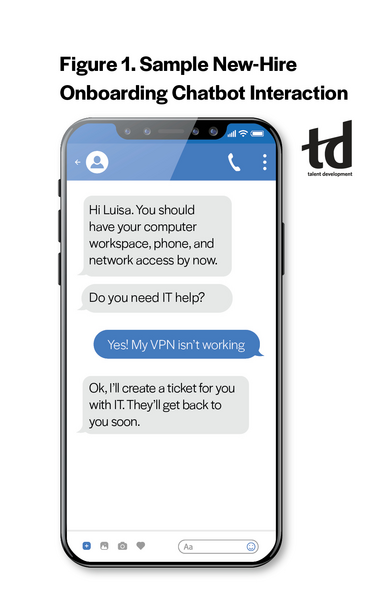
New-hire onboarding. This is a compelling use case because the onboarding process can be overwhelming for a new hire as well as the team working to help the individual get acclimated and functional as quickly as possible. A chatbot can help new hires keep track of important deadlines, learn cultural norms, and answer questions. The business result is clear: It reduces manager and HR workloads and, more importantly, can reduce employee turnover.
Content
Training reinforcement. "Learning is a journey, not an event" is a common rallying cry from L&D professionals taking an industry from old norms of event-driven classroom training to blended and spaced learning journeys that better mirror the way people learn a skill or complex topic. The COVID-19 pandemic has done more for organizations adopting digital-based, alternative learning platforms than years of persuasion from the industry's top experts.
Content
However, the difficulty with embracing a learning journey is the logistical challenge of gaining learner attention and engagement on a consistent basis. Asking learners to consistently log in to a learning management system or e-learning platform has been frustratingly ineffective. In contrast, chatbots are a seamless way for learners to interact with learning content. You can program chatbots to push relevant reminders, microlessons, and quizzes via common messaging platforms so that learners have easy access to the content. That kind of user experience translates into better reinforcement and sustainment over time.
Content
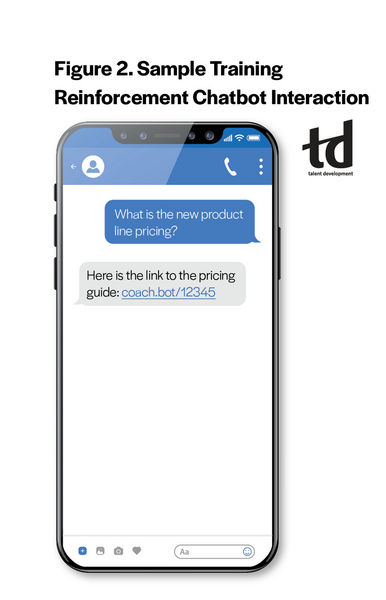
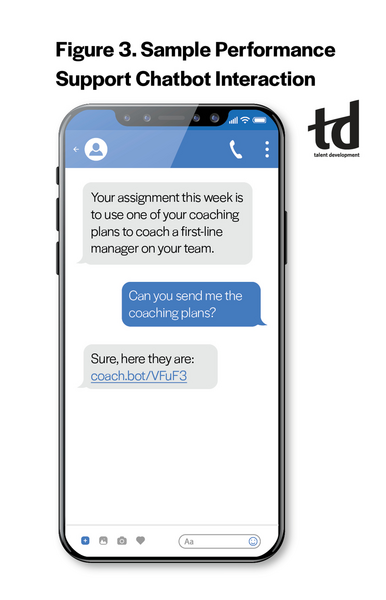
Performance support. Wouldn't it be great if all employees could go through an apprenticeship with a master watching over their every move to provide answers and support until they too become masters? Because that is not possible or practical for the vast majority of people, organizations work hard to provide job aids and other moment-of-need support for their workforce. But such tools are often too many clicks away. Chatbots provide a more direct path to the help and answers someone may need.

Choose the right channel
Content
When you picture a chatbot, you may think of a little box popping up on a webpage. The chatbot window opens, asks whether it can answer questions, and directs the users to a clickable menu to get help. Or maybe you picture a chatbot on an app, such as to assist in filing an insurance claim.
Content
Those aren't the only—or best—places a chatbot for learning could live. Learning chatbots are best suited to a messaging platform like SMS, Microsoft Teams, or WhatsApp, because they enable proactive and sustained conversations.
Content
To fully leverage a chatbot, it should be on a channel your learners are already using. That means there is no new app to download or web address to remember. Instead, the chatbot sits right next to your users' conversations with colleagues and friends. You can even choose different channels for different audiences, ensuring everyone has the best experience. For example, to reach your on-the-go sales team, set up a chatbot on SMS. Then, for your managers who live on Microsoft Teams, set up a chatbot there.
Content
Chatbot functionality can vary by the authoring platform's style, features, and—most importantly—channels, so start by identifying which chatbot channel is best for your organization and the most-prized functionality. Choosing the right channel could mean the difference between success and an unused resource (see sidebar).
Content
It's likely that the channel you decide is best for your audience will be a common one for chatbots. That's good news, because that means services and documentation already exist to help you set up and maintain your chatbot, which will reduce the project's complexity. In fact, you'll find the most complex part of chatbot creation is writing the script and its accompanying logic.
Personalize the messaging
Content
Chatbot technology today is tested enough to ensure that messages are delivered when you want and to whom you intend. However, whether a message is well-received is dependent on its quality.
Content
The more personalized the messages are, the more contextual and valuable they will feel to learners. Personalization can be as simple as including the user's name and as complex as designing different adaptive learning paths based on learner performance and preference.
Content
There are two ways to capture information to personalize the experience: Base it on information the user provides or pull it from an external system. User-based personalization can include items such as choosing a goal to work on, a preferred topic, or a preset time of day to receive a reminder. Consider this chatbot dialogue example:
Content
Chatbot: Hi there, how many sales leads will you contact this week as a goal?
Content
Sales rep: 100
Sales rep: 100
Content
Chatbot (three days later): Hi! You had a goal to contact 100 leads this week. How is that going?
Content
Integrating via application programming interface with an LMS, learning record store, customer relationship management system, or HR information system makes your chatbot smarter. Imagine learners are going through an LMS course that shares information with a chatbot. That chatbot can proactively remind learners of deadlines, help them apply the content they recently finished, or otherwise personalize their experience based on their interaction with the LMS. For example: "I noticed you started Safety 101 in the LMS last Wednesday, October 21 at 10:35 a.m. but didn't finish. I encourage you to find the time to complete it this week. Here is the link to the course in our LMS: coach.bot/SafE1."

Balance push vs. pull
Content
Push versus pull terminology comes from the marketing world. Push marketing refers to promoting products proactively to the consumer, while pull marketing means drawing consumers into content that they want to peruse at their choice.
Content
You can program a chatbot to push content to learners, such as reminders, nudges, challenges, and new training material. You can also program chatbots to be accessible at a moment's notice when a learner needs help (for example, for performance support). The pull scenario leverages the idea that chatbots never sleep, never tire, and are always available.
Content
Of course, to optimize a learning journey via a chatbot, you can design chatbots to leverage both push and pull. For example, in an onboarding scenario, the scripted chatbot conversation could be a 70–30 split between push and pull. The push component could include scheduled messages to remind users of deadlines, check-in questions, and tips about the organization. And the script's pull portion could comprise questions you anticipate new hires asking (Where do I find out more about my health benefits? What is our paid time off policy?) and their associated answers.
Have a content management strategy
Content
One obvious advantage of a chatbot is that once you set it up, it runs automatically, thus saving time. However, over time, the content can become outdated. As with any content, you'll need a plan for version control. You don't want your onboarding chatbot to give new hires the wrong benefits information, for example.
Content
The content management strategy should include a plan to revisit the script regularly, or you could have the chatbot connect to the original content stores so you're only updating information once. Early on, make sure to determine which method works best for your organization and incorporate the updating process into the normal workflow.
Content
Because chatbots are much easier to test and iterate than traditional software, once you've launched one, you'll get valuable data and user feedback to incorporate into it for future users. Functional design elements such as feedback questions, A/B testing, and notifications can all help facilitate iteration. You can use each of those throughout the design to indicate how and when to improve the chatbot script. Plan to iterate the script at least once after the first cohort.
Identify success metrics in advance
Content
Decide what metrics you will use to measure success—but do so before you begin designing the script. Ask yourself and key stakeholders what would constitute success. Maybe converting manual tasks into an automated system is all you are looking to accomplish. Or perhaps you want to increase learner satisfaction with the company's training programs. More quantitative metrics could include the percentage of participants engaging with learning content over time or measuring a business metric such as employee turnover rates.
Content
By choosing metrics in advance, you'll be better able to prioritize and refine what the chatbot should be saying. That will be helpful because a major challenge with chatbot writing is facing the temptation to make the chatbot script all-encompassing. If you know how you'll measure success in advance, you can prioritize what features and content are most important and should be the focal point of the user experience.
Content
Agreeing on success metrics in advance also enables you to be a more effective champion for the chatbot within your organization. Every employee needs an internal advocate, and your virtual team member—the chatbot—is no exception. Because chatbots will likely be a relatively new innovation for your organization, there will be skeptics at worst and uninformed stakeholders at best. Therefore, consistently provide visibility on how the chatbot is making a contribution.
A compelling solution
Content
Chatbots may not yet live up to the promises of Hollywood, but they can make a real difference in your company right now. By following these tips and having an intentional, focused design, your chatbot can reduce information friction, increase learning, and achieve real business results. With the right approach, a chatbot could become an incredibly valuable and long-term member of your team.
Chatbot Considerations and Best Practices
Content
Determine the best channel, frequency of messages, and length of user experience based on the most common use cases.
Content
Employee onboarding
Employee onboarding
Content
Channel: SMS or mobile messaging app
Content
Frequency: Daily
Frequency: Daily
Content
Length of user experience: 30–60 days
Content
Soft skills training reinforcement
Content
Channel: SMS or mobile messaging app
Content
Frequency: Once or twice per week
Content
Length of user experience: 60–90 days
Content
Performance support
Performance support
Content
Channel: Desktop app such as Microsoft Teams or Slack
Content
Frequency: Any time learners have a question
Content
Length of user experience: Indefinite