
ATD Blog
How to Use Animations for Learning
Tue Jul 12 2016

Moving pictures are hard to resist. But research shows when compared to static graphics, animations get mixed reviews as an effective learning medium. Fortunately there are ways to make animations more effective.
Types of Animation for Learning
There are many types of animation that can be used for instructional purposes, including:
2-D animation: Creating the illusion of motion by the rapid display of a sequence of static images or frames that minimally differ from one another.
3-D animation: Creating the illusion of moving objects rendered from 3-D wireframes. Based on mathematical algorithms, the objects can be rotated and moved over time.
Motion graphics: Moving graphical elements and text across the screen. This is what we create with certain authoring and presentation tools.
Transformations: Animations that depict changes without movement, such as color transformations (a person blushing) or lines changing from thin to thick (clogged arteries maybe?).
Stop-motion animation: Photographs of an object shown in a quick sequence to create the illusion of movement.
Reasons for Using Animation
Educational psychologist Richard Lowe (2004) writes that there are basically two main reasons for using instructional animations: affective and cognitive.
Affective Purpose
Animations attract and capture attention because motion is one of the primary attributes of a graphic that makes viewers take notice. Animations can also increase motivation because of their novelty. When they are humorous, they can create a positive affect. One newer approach is the animated information graphic (see an example from the Articulate community), which can be used for introductory explanations that may seem boring otherwise.
Cognitive Purpose
Animations that have a cognitive purpose can facilitate learning because they provide more and different information than static graphics. They have the potential to help a learner build a more accurate mental model of a system’s behavior compared to graphics alone (Schnotz and Rasch, 2005).
There are many functions that animation can fulfill, such as:
explaining a dynamic process
visualizing things what cannot be seen with the naked eye
simulating a system
making abstract concepts more concrete (such as with visual metaphors)
visualizing quantitative data
improving one’s spatial abilities
depicting hosts and agents that explain
telling a story
creating a learning game or elements in a game
constructing knowledge in mathematics.
The Good, the Bad, and the Contradictory
There are quite a few studies that compared animation-based learning to learning from static graphics. In these studies, the effectiveness of animation produced mixed results and some results were even contradictory. On the down side, there were several studies that showed animation-based learning had no notable benefits compared to still graphics (Teversky et al., 2002).
On the up side, the results of a meta-analysis showed that there were notable benefits to dynamic animations (Hoeffler and Leutner, 2007). In this meta-analysis, the types of animations that had the most substantial effect on learning were:
representational animations rather than animations created for affective purposes
animations that focused on teaching procedural-motor knowledge
highly realistic and video-based animations.
Problems With Animations and How to Fix Them
Although animations are not ideal for all learning situations, they do have great potential. When animations are not beneficial to learning, it is often due to poor design, presentation to the wrong audience, or a topic that is not suitable for animation (where still graphics would be better). In the problems-solutions table below, you will find very specific problems identified in the research and their solutions.
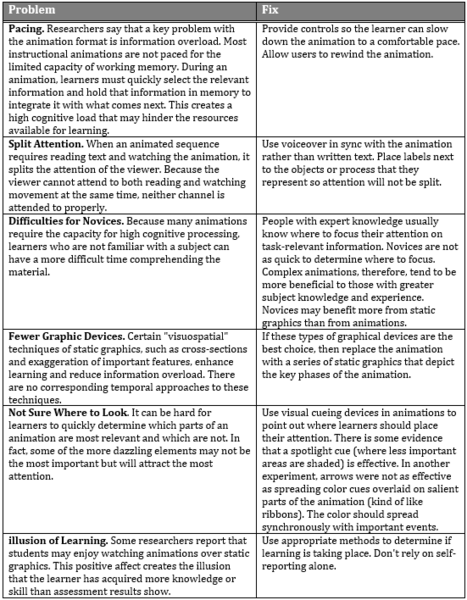
Newer technologies make animations easier to create at a reasonable cost, making the format a viable choice for instruction. With educational researchers piecing together the data on its effectiveness for learning, a set of design principles based on evidence is emerging. It is important to consider the research before choosing to use the animation format. Then animations will be able to meet their potential for learning.
Editor’s Note: Another version of this article first appeared on http://theelearningcoach.com.
References
Hegarty, M. 1992. "Mental Animation: Inferring Motion From Static Diagrams of Mechanical Systems." Journal of Experimental Psychology: Learning, Memory and Cognition 18:1084-1102.
Hegarty, M., N.H. Narayanan, and P. Freitas. 2002. "Understanding Machines From Multimedia and Hypermedia Presentations." In The Psychology of Science Text Comprehension, edited by J. Otero, J.A. Leon, and A. Graesser, 357-384. Hillsdale, NJ: Lawrence Erlbaum.
Hoeffler, T.N., and D. Leutner. 2007. "Instructional Animation Versus Static Pictures: A Meta-Analysis." Learning and Instruction 17(6): 722-738.
Lowe, R.K. 2004. "Animation and Learning: Value for Money?" In Beyond the Comfort Zone: Proceedings of the 21st ASCILITE Conference, edited by R. Atkinson, C. McBeath, D. Jonas-Dwyer, and R. Phillips, 558-561. Perth, December 5-8.
Rosen, Y. 2009. "The Effects of an Animation-Based On-Line Learning Environment on Transfer of Knowledge and on Motivation for Science and Technology Learning." Journal of Educational Computing Research 40(4): 451-467.
Schnotz, W., and T. Rasch. 2005. “Enabling, Facilitating, and Inhibiting Effects of Animations in Multimedia Learning: Why Reduction of Cognitive Load Can Have Negative Results on Learning.” Educational Technology Research and Development. 53(3): 47-58.
Tversky, B., M. Betrancourt, and J.B. Morrison. 2002. “Animation: Does It Facilitate Learning?” International Journal of Human-Computer Studies 57:247-262.
Want to know more about how to use animation for learning? Join us for the next offering of our Essentials of Adobe Animate for E-Learning Designers online workshop.
View Courses Recommended for You