TD Magazine Article
Member Benefit
Your Guide to Developing Sales Managers: How to Effectively Maximize Neglected Talent
Content
Training for the neglected sales manager must entail more than leadership and coaching how-to’s.
Fri Jun 08 2012

Content
You know the routine:
Content
Step 1: Invest heavily to develop your frontline sellers.
Content
Step 2: Promote the best salespeople to the role of sales manager.
Content
Step 3: They struggle to succeed in that sales management role.
Content
Step 4: Repeat as needed.
Content
This pattern of turning star salespeople into mediocre managers is one that is recognized by most companies with whom we work. But interestingly, the observation is commonly accompanied by a casual shrug of the shoulders and the defeated concession, "That's how it always happens. I guess that's just the way it is."
Content
Sadly, that is the way it is—or at least that's how it has been for more than a century. But more and more companies are coming to recognize the real source of the problem: Sales managers have been neglected and generally mis-served from a training and development perspective.
Content
In fact, a recent ASTD study found that only 11 percent of companies train their sales managers to a high extent, while 22 percent don't train their sales managers at all. In contrast, the same study found that about 66 percent of those same companies train their salespeople on selling skills at least once each year. Houston, we have a problem.
Content
The problem is not just conceptual. The same ASTD study found a "significant positive correlation" between the extent to which those managers were trained and the percentage of their reps who meet their sales quota. Conversely, companies that didn't train their sales managers suffered lower sales performance. So if you want more from your salespeople, the solution is not always to retrain the sellers. Sometimes the solution is to train their sales managers.
Content
Conveniently, this solution is also a good investment of a company's time and resources. Given a typical span of managerial control, organizations will have one-tenth as many sales managers as they have frontline salespeople. Therefore, the formula is pretty simple. If you train one salesperson, you improve one salesperson. But if you train one manager, you improve his entire team. Repeat as needed.
What's going on here?
Content
So why has sales management been overlooked as the high-leverage, high-impact training investment that it is? In our opinion, it has resulted from a persistent and vexing combination of weak demand and low supply in the marketplace. Let's examine each side of this equation to see why this might be the case.
Content
As we highlighted earlier, there has not been an overwhelming demand for sales manager training. Historically, the strategy has been to improve salesperson performance by improving salesperson skills. The skills most often targeted by sales training initiatives involve
Content
presentation skills—how to develop and deliver high-impact presentations
Content
call execution—how to plan and execute more effective sales conversations
Content
negotiation—how to plan and
Content
conduct an effective negotiation
Content
discussion with a buyer.
Content
It's an intuitive strategy that you can't fault. However, sales managers are the point of reinforcement for any change in a salesforce. At this point it's almost a cliché to say, but a salesperson's skill will atrophy almost immediately after a training event if the sales manager is not capable or motivated to reinforce it.
Content
However, the numbers above reveal that we have yet to put our money where our mouths are. We still train sellers and ignore their managers. At best, sales managers attend the same training as their sales teams, but typically with an added section on how to coach the skills represented in the training.
Content
Also on the demand side, sales managers do not clamor for more training. By the time a seller is promoted to manager, she probably has been through a dozen or more training events, many of which were more pain than pleasure. In a sense, sales managers are jaded. And since time is every sales manager's most precious resource, sitting through another training class is not at the top of her to-do list. The value proposition just isn't there.
Content
But there is a supply side issue that somewhat justifies the lack of demand. Most sales management training in the marketplace falls into one of two categories: leadership or coaching. While both of these are important skills, they are commonly big-picture discussions. Leadership can build a vision, and coaching can put a troubled rep back on track, but these have little to do with what sales managers do from day to day—manage salespeople to sell more deals.
Content
Most leadership training focuses on how to manage people differently based on tenure, skill set, and personality type. Situational leadership is an example of typical leadership training many sales managers attend. This approach helps sales managers to determine which type of coaching is appropriate for a given sales representative based on the seller's level of competence and commitment. While this popular approach can be helpful, it is not sales specific and does not directly target the types of conversations sales managers have every day—how to win more deals.
Content
Coaching training is another typical type of training that sales managers receive. Coaching training most often includes methods for improving the interpersonal component of manager-subordinate interactions, as well as practical guidelines for how to create accountability and follow-up regarding performance issues. Again, most coaching training is not sales specific—unless it is an add-on component of a sales training program aimed to coach specific skills such as call presentation skills or negotiation. We have had clients whose sales managers have attended upwards of six different coaching programs and, according to their sales representatives, they were still not coaching.
Content
Leadership doesn't happen first thing Monday morning, but team meetings certainly do. And coaching might not happen this Friday afternoon, but you can bet that the sales forecasts will. Sales managers live in a tactical world. From their perspective, coaching and leadership are nice-to-have's, not got-to-have's. They need more got-to-have training.
The next generation of sales manager training
Content
From 2008 to 2010, we conducted extensive research about the sales management best practices of 30 leading salesforces, and the insights from that study were recently published in the book Cracking the Sales Management Code. Among other conclusions, there were some "aha moments" that have direct implications for the nature of sales management training—training that will be appealing to sales managers and have practical applications between Monday morning and Friday afternoon.
Sales managers are not all alike
Content
One of the most interesting realizations from the research was that there is not a single prototype for a sales manager. We've come to acknowledge that different types of salespeople have different types of roles. For example, some salespeople manage a handful of major accounts, while others oversee vast territories with hundreds of customers and prospects. Typically these different types of sellers would be armed with different types of skills and tools.
Content
What we haven't yet come to appreciate is that there also are different types of sales managers. Depending on the type of salespeople they manage, their required skill set also will differ. For instance, the manager of the major account rep will need to have strategic discussions with that seller about strategic alignment with his customer. Account management also has a heavy project management component, so the manager will need to be able to help the rep develop and execute a long-term plan.
Content
However, the manager of the territory rep might need a completely different set of skills. For example, if a sales manager is managing a sales representative with 200 accounts in a fairly large geographic area, prioritization of sales effort is critical to sales success. That territory rep would need help segmenting the customer base, determining appropriate call cycles, and then mapping out a plan to cover the territory. Even though many organizations have segmentation strategies, we often see a lack of follow-up between sales managers and sales reps to determine if the sellers executed according to plan. In short, if the management tasks differ from sales manager to sales manager, so should their training.
Content
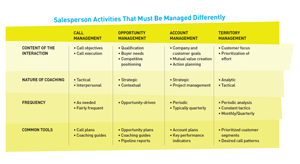
In our research, we uncovered four salesperson activities that must be managed differently: account management, territory management, opportunity management, and call management (see table).
Content
Account management is applicable when a seller has a few large accounts. Large accounts typically represent multiple opportunities for a seller and are worthy of a greater amount of planning. If an account manager has only three or four accounts, it is not necessary to segment them or develop differential call cycles. It is important, however, to strategically align the seller's solutions with the account's strategic objectives. It also is necessary to have a broad base of contacts in different business units within the same account. Account management training typically involves in-depth planning to include
Content
different business units
Content
strategic initiatives by business unit
Content
key players and their political ties
Content
action plans to navigate each business unit to generate new opportunities.
Content
Territory management is applicable when the number of assigned accounts in a territory is too large for the seller to treat all accounts in the same manner. Segmentation and prioritization methods are critical elements of any training on territory management. Territory management training typically involves
Content
prioritizing accounts
Content
designing call patterns
Content
executing calls according to the desired patterns.
Content
Opportunity management is applicable when sellers are pursuing deals that require multiple interactions over time to close a sale. If a seller is involved in a transactional sale that is typically closed in one interaction, opportunity management is not relevant. Opportunity management involves educating sellers and sales managers on the process a buyer navigates when purchasing the seller's solution.
Content
If it is effective, it also will compare and contrast the specific company sales process with the buying process. To effectively navigate an opportunity, the seller must understand the milestones and activities at each stage of the sales process and possess the necessary skills to move the customer through the various stages to a close.
Content
Call management is necessary when a seller is involved in sales in which each sales call is important to the outcome of the deal and each interaction is different enough to warrant planning. If all calls are roughly the same, then planning for each interaction is impractical and unhelpful.
Content
Depending on which types of processes a sales manager supervises, she will need a different set of skills and tools to manage her team appropriately. One-size-fits-all training doesn't work for varied salespeople, nor will it work for varied sales managers.
Content
Therefore, the first task in designing relevant, practical sales manager training is to understand the unique management tasks of the individuals. Then build sales training that has direct applicability to what he does from Monday to Friday, which is to manage his sellers.
Content
It has been our experience that when managers are exposed to training that equips them to better execute their day-to-day activities, they are extremely willing participants. Many even thank us. Research and experience tells us that generic sales management training needs to be a thing of the past.
You must have rhythm
Content
Sales managers exist in a chaotic world, primarily because they serve two demanding groups—the salespeople below and the executives above. Consequently, they live reactive lives. They respond with haste to every fire their sellers encounter, and they feed constant information up the chain of command. Sales managers always tell us that no two days are ever the same—but perhaps they should be.
Content
One of the key insights from our research and work with clients is that sales managers need more structure. It's difficult to coach a salesperson when the seller's hair is on fire. Unless some structure is given to a sales manager's week, ad hoc interactions will populate the day.
Content
We have spent a significant amount of time observing manager-seller interactions, and we've found that little coaching takes place in ad-hoc discussions. Such discussions are hurried interruptions where the goal is to solve immediate problems, not to look farther down the road. Effective management and coaching is best done in a formal environment with an agenda and two parties who are prepared for the conversation.
Content
Therefore, sales manager training needs to help them structure what they do during the course of a day, week, month, and year. They need a management process or rhythm to quell the chaos and let them interact with their sellers in an effective, value-added way.
Content
Most managers we know need help thinking through the management rhythm that is right for their teams. How often do they need to meet? What is the purpose of each meeting? Are they best conducted one-on-one or in a group? What are the inputs and outputs of the interaction?
Content
Sales managers need an operating manual that defines their specific jobs. They have been taught how to lead and coach; now they need to learn how to manage. An example of applicable structure and associated management rhythm for a sales manager managing a group of territory sales reps might include quarterly and monthly meetings.
Content
Quarterly territory reviews with each sales rep. This quarterly meeting might be two hours in length; incorporate a segmented and prioritized list of accounts that the seller has prepared; and provide the venue for a facilitated discussion about the selected segmentation, top accounts in each segment, and then a desired call pattern over the course of the next three months.
Content
Monthly one-on-one meetings with each sales rep. These monthly one-on-one discussions might be one hour in length, and include a discussion about overall pipeline health for the given seller, as well as a more extensive discussion about two or three early-stage opportunities. As appropriate, each of these opportunity coaching discussions may include a specific planning discussion for any upcoming sales call associated with this opportunity.
Content
Clearly the comprehensive management rhythm would include additional interactions. However, what is critical is the inclusion of the most significant interactions—by sales role—needed to produce the desired results. We often find that sales managers are busy and are involved in many various types of activities with their sellers, but they are often not representative of the activities most likely to yield the best results.
Content
Because the majority of manager-seller interactions are ad hoc, they are not conducive to the type of in-depth coaching that drives results and builds seller skill. The incorporation of intentional, planned manager-seller interactions also helps managers to focus their efforts on the most manageable aspects of their job—the activities being executed by their salespeople.
Focus on the manageable
Content
The single greatest learning from our research was this: There are factors you can manage, and there are factors that you can't. While this might seem boringly obvious, it's not.
Content
If you asked 10 sales managers to name their primary responsibility, more than half of them would respond with some form of the following: "To make sure my reps make their quota." And what do all 10 sales managers stare at each Friday afternoon? Reports of their salespeople's recent performance. Can a sales manager actually manage a quota? Of course not. Can sales managers manage historical performance? No, but they
Content
sure do try.
sure do try.
Content
In reality, the only factor managers can manage, and directly affect, are the activities of their sellers—which customers they call, what they say during those calls, which deals they pursue, and how they pursue them. In the end, all of these activities will determine whether they make their number and hit their revenue target, but the target itself can't be managed. You only can manage activities, not their outcomes.
Content
Most managers we work with find this concept liberating. There's so much complexity and noise in a sales manager's world that she wants to simplify. Sales managers need to focus. Winnowing their attention to only what they can manage has two desirable effects. First, sales managers are more confident in the things they do because they know they will have an impact. Second, salespeople get better direction because the managers are focused on the tactics that will lead to the desired results—better sales management.
Content
Training for sales managers needs to go beyond traditional leadership and coaching; it should emphasize the manageable. These manageable activities will look different for different management roles because, as we learned, one sales manager does not equal another sales manager. The activities will need to reside within a solid management rhythm to ensure consistency and impact. But the simplest concepts are often the most powerful. There are factors you can manage, and there are those you cannot.
In the end
Content
Despite the fact that sales management has been a profession for more than a century, we are still trying to figure it out. It's not as simple as we want it to be, and it's not as complex as we make it. It's somewhere in between, and we need to cut through the noise and help sales managers understand exactly what they must do to succeed.
Content
In the end, there's plenty of good training out there for frontline salespeople. They've been studied for decades, and their tools and frameworks are tried and true. However, this is not the case for sales managers. They need better education and development, and the time has come to give it to them. We have some of the pieces, but certainly not the whole. We have some work to do. Let's do it.
Content
[
[

Content

Content
Training for the neglected sales manager must entail more than leadership and coaching how-to's.
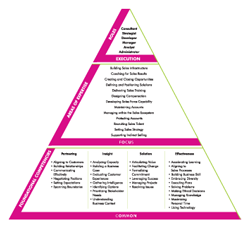
ASTD's World-Class Sales Competency Model
Content
The ASTD World-Class Sales Competency Model is the only widely available, occupation-specific model for sales team members, including those who are directly responsible for revenue generation, as well as those who consult with, train, develop, and support them.
Content
The model is a blueprint to successful sales performance that will help you to align your sales training objectives to your corporate goals and provides a common language and framework for sales competence. It describes the roles, areas of expertise, and foundational competencies that can be leveraged by organizations to develop the necessary behaviors all individuals involved in the sales process should possess.
Content
Additionally, the World-Class Sales Competency Model provides a context to help you understand and identify your company's professional selling competencies and internal process for developing those competencies. Finally, the model provides tools you can use to assess your organization's current state and readiness for change. Armed with that information you can prepare a roadmap that will take you through all five of ASTD's sales effectiveness levels: sales science, sales process, sales relationships, sales technology, and sales competence.]( http://files.astd.org/TD-Article-Images/2012/06/JordanSB1-L.png )
Additionally, the World-Class Sales Competency Model provides a context to help you understand and identify your company's professional selling competencies and internal process for developing those competencies. Finally, the model provides tools you can use to assess your organization's current state and readiness for change. Armed with that information you can prepare a roadmap that will take you through all five of ASTD's sales effectiveness levels: sales science, sales process, sales relationships, sales technology, and sales competence.](http://files.astd.org/TD-Article-Images/2012/06/JordanSB1-L.png)