
ATD Blog
The Impact of Mentoring for a Virtual Workforce
Fri Sep 16 2022

Content
Mentoring relationships can have a tremendous impact on an individual’s skills, engagement, career growth, and even their sense of inclusion and belonging. Contrary to common belief, the benefits of mentoring extend beyond just the mentee. Mentors tend to benefit just as much from the mentoring experience. Consequently, participant-wide, positive experiences and growth are some of the primary reasons why mentoring is not only an exceptional approach to employee engagement but one of the few where the benefits are tangibly felt by everyone involved.
A High-Level Look at the Impact of Mentoring
Content
Understanding the impact of mentoring provides you with insights that you can use to recruit more mentees and mentors for your program, gain critical buy-in from stakeholders, and build the business case for a culture of mentoring at your organization.
Content
Mentors
Mentors
Content
Mentors benefit from participating in mentoring relationships in numerous ways. The wide range of benefits include:
Content
Build leadership skills while helping others develop.
Content
Increase their networks and their sphere of influence.
Content
Obtain a fresh perspective on a subject.
Content
Enhance their experience in their areas of expertise.
Content
Increase awareness of personal biases, assumptions, and areas for improvement.
Content
Promote inclusive practices and leadership behaviors.
Content
Create an environment that fosters personal and professional growth.
Content
Mentees
Mentees
Content
Mentees are the traditional focus of mentoring research and objectives for good reason; the relationships are intended to help mentees grow in some personal or professional way. The benefits of mentoring for mentees include:
Content
Accelerate career development.
Content
Expand their leadership abilities.
Content
Increase their technical skills.
Content
Learn about another division of the company.
Content
Acquaint themselves with the company if they are new hires.
Content
Find allies and advocates within the company.
Content
Expand their personal network.
Content
Organizations
Organizations
Content
Organizations typically implement mentoring programs with the purpose of developing and engaging employees. However, the cumulative results of individual mentoring experiences build strategic benefits for organizations, including:
Content
Build bench strength.
Content
Accelerate the identification, development, and retention of talent.
Content
Increase job satisfaction and employee engagement.
Content
Share and leverage strategic knowledge and skills throughout the organization.
Content
Onboard new employees with a structured way to acquaint themselves with the organization.
Content
Build deep expertise across the organization that connects to impactful business intelligence.
Content
Create an environment that fosters personal and professional growth.
Content
There’s a robust and growing body of data to back up the exceptional benefits of mentoring programs and the ROI of mentoring . Our research shows that 91 percent of people involved in at least one mentoring relationship report significant competency improvement. We’ve also found that 90 percent of participants said that they developed a positive relationship with another person in the company. A further 83 percent shared that their mentoring experience positively impacted their desire to stay at their organization
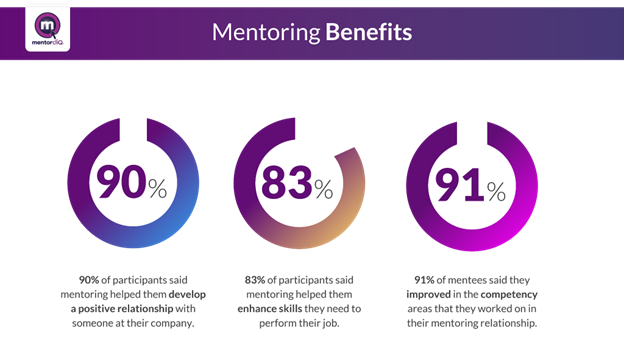
There’s a robust and growing body of data to back up the exceptional benefits of mentoring programs and the ROI of mentoring. Our research shows that 91 percent of people involved in at least one mentoring relationship report significant competency improvement. We’ve also found that 90 percent of participants said that they developed a positive relationship with another person in the company. A further 83 percent shared that their mentoring experience positively impacted their desire to stay at their organization

Mentoring in the COVID-19 Era and Beyond
Content
What does mentoring look like in our new virtual (and hybrid) work environment? There are three significant changes in mentoring that we’ve observed:
Content
1. Mentoring Virtually
Content
As we shifted to virtual experiences for so many aspects of our lives, mentoring was no different. Mentoring software helps facilitate connections and make matches among participants, but without the barriers of location hampering who could be matched with whom. The impact of this shift is an exponentially increased ability for any given individual to make mentoring work the way they need it to, such as through video chats and online messaging.
Content
For virtual mentoring, the pool of potential mentees and mentors is no longer limited to those in a geographic area, or even by who you know. Also, participants can schedule their mentoring meetings at times that are convenient for them—even outside of normal business hours. They can also take those meetings in a home office or another remote or private location, which allows for deeper and more authentic conversations.
Content
2. Expectations of Formality
Content
We have also seen a shift in expectations of how formal the mentoring relationship should be. People have far more understanding and empathy for one another concerning our busy and chaotic lives. It’s no longer scandalous to show up to our mentoring meeting in a t-shirt or to take the meeting from our car after dropping kids off at school. In fact, it helps show the whole authentic person that each of us is, which can help deepen the meaningful nature of the mentoring relationship.
Content
If you think about it, this is huge from a diversity, equity, and inclusion standpoint:
Content
In years past, the single parent might have had to choose between enrolling their kids in extracurricular activities or being able to physically show up at the office for a mentoring meeting at the end of the workday.
Content
An entry-level associate with a ton of potential, who is just learning how to navigate the professional world, but who doesn’t have the financial means (yet) to dress for the job they want, can now feel comfortable enrolling in a mentoring experience to build their network and accelerate their career.
Content
We could go on and on. But suffice it to say, this is something we’re genuinely excited about!
Content
3. Balance of Topics
Content
We’ve been working on mentoring programs for more than 20 years. When we started, the companies we worked with did a lot of work to emphasize strictly professional topics of conversation. This largely stemmed from fear—fear of mentoring relationships getting too personal, fear of what people might talk about, fear of opening those work relationships to how complex we are as humans, and so on.
Content
This has shifted dramatically in the last few years for the betterment of us all. Most companies now recognize that we are complex and that other parts of our lives have a tremendous impact on how we show up as professionals, team members, and leaders.
Content
So instead of conducting training on how to keep mentoring conversations about a very narrow band of topics, we are embracing the idea that every individual is free to set the boundaries of the mentoring conversations that work best for them. Many participants will sometimes detour into aspects of their personal lives that might be influential in how engaged they are at work. This shifting balance has a big impact on how people view mentoring because it helps them show up as their full, authentic selves, which leads to a feeling of connectedness and belonging.
Content
Authentic conversations lead to transformational growth.
Content
We know mentoring can have incredible positive impacts on people. Building a mentoring program that supports the potential in all of us is key. Be sure to check out our chapter in ATD’s Handbook for Training and Development that discusses how to implement a mentoring program that works.