ATD, association for talent development

ATD Blog

A Pathway for Tripling Productivity

By

Tue Nov 09 2021

A Pathway for Tripling Productivity
Loading...

Content

Years ago, Lew Platt, a former CEO of HP once stated, “If only HP knew what HP knows, we would be three times more productive.” Recently, extensive buzz in the profession about knowledge sharing across boundaries via peer learning, collaborative problem solving, and other similar opportunities has been acknowledged. This seems to be more prevalent with the advent of intentionally integrating learning with the work and recent technology disruptions.

Years ago, Lew Platt, a former CEO of HP once stated, “If only HP knew what HP knows, we would be three times more productive.” Recently, extensive buzz in the profession about knowledge sharing across boundaries via peer learning, collaborative problem solving, and other similar opportunities has been acknowledged. This seems to be more prevalent with the advent of intentionally integrating learning with the work and recent technology disruptions.

Content

As a consortium based on the mantra Everyone a Learner, Everyone a Teacher, with a focus on peer-to-peer learning and collaboration, the ATD Forum was curious to find out how our members define, operationalize, promote, and measure the opportunities associated with knowledge sharing to advance performance and enhance engagement both virtually and in person. We used a quick survey to dig deeper.

As a consortium based on the mantra Everyone a Learner, Everyone a Teacher, with a focus on peer-to-peer learning and collaboration, the ATD Forum was curious to find out how our members define, operationalize, promote, and measure the opportunities associated with knowledge sharing to advance performance and enhance engagement both virtually and in person. We used a quick survey to dig deeper.

Content

The results indicated 95 percent of the respondents have some sort of process in place for internal knowledge sharing. While this practice is prevalent, it can look different in every organization. Like many aspects of learning, a similar technique might be called something different, or it might start off with one framework and over time morph into a different framework. Most common venues for this sharing are lunch & learns, Slack or Teams groups, course cohort groups, project teams, peer coaching, communities of practice, and action learning teams. Other venues include mastermind groups, hackathon teams, and groups for user-generated content such as learning or knowledge boards.

The results indicated 95 percent of the respondents have some sort of process in place for internal knowledge sharing. While this practice is prevalent, it can look different in every organization. Like many aspects of learning, a similar technique might be called something different, or it might start off with one framework and over time morph into a different framework. Most common venues for this sharing are lunch & learns, Slack or Teams groups, course cohort groups, project teams, peer coaching, communities of practice, and action learning teams. Other venues include mastermind groups, hackathon teams, and groups for user-generated content such as learning or knowledge boards.

Content

One interesting phenomenon is that peer can have different meanings. In some circles, it means employees with a similar rank, like midlevel managers. In other circles, it means all employees. Thus, this is the reason for putting peer learning and collaboration under a broader and more general topic of employee knowledge sharing.

One interesting phenomenon is that peer can have different meanings. In some circles, it means employees with a similar rank, like midlevel managers. In other circles, it means all employees. Thus, this is the reason for putting peer learning and collaboration under a broader and more general topic of employee knowledge sharing.

Content

The overarching goal for these groups is building performance capability within the organization, especially capability aligned with the work and the related functional domains. For example, there may be a group for the sales team, or the engineers, or the talent professionals. Regardless of the group configuration, according to the respondents, other benefits include:

The overarching goal for these groups is building performance capability within the organization, especially capability aligned with the work and the related functional domains. For example, there may be a group for the sales team, or the engineers, or the talent professionals. Regardless of the group configuration, according to the respondents, other benefits include:

  • Content

    Building connections between departments and geographies

    Building connections between departments and geographies

  • Content

    Advancing networking

    Advancing networking

  • Content

    Promoting self-directed learning

    Promoting self-directed learning

  • Content

    Providing support for learning in the flow of work

    Providing support for learning in the flow of work

  • Content

    Opportunities for recognition, especially if badging is involved

    Opportunities for recognition, especially if badging is involved

  • Content

    Help with advancing in the organization, possibly into other departments or functional areas

    Help with advancing in the organization, possibly into other departments or functional areas

Content

According to the survey results, most of these groups are informal, and only a few of them are moderated or curated by a designated person. If it does happen, the moderating and or curation is done by one of the group members or the L&D team. Tracking of the employee learning is required by less than half of the respondent companies. This is done using the LMS, especially through the xAPI or via the performance review process. Other ways for tracking and documenting the learning experiences include detailing in a portfolio, using a badging system, and capturing in a development plan. Documentation by the participate is done primarily when the peer knowledge sharing and learning group is part of a formal course, such as a follow-up cohort group designed to facilitate practice skills and behaviors.

According to the survey results, most of these groups are informal, and only a few of them are moderated or curated by a designated person. If it does happen, the moderating and or curation is done by one of the group members or the L&D team. Tracking of the employee learning is required by less than half of the respondent companies. This is done using the LMS, especially through the xAPI or via the performance review process. Other ways for tracking and documenting the learning experiences include detailing in a portfolio, using a badging system, and capturing in a development plan. Documentation by the participate is done primarily when the peer knowledge sharing and learning group is part of a formal course, such as a follow-up cohort group designed to facilitate practice skills and behaviors.

Content

Besides internal employee sharing, 45 percent of the responding organizations had processes in place for employees to share with external sources. This sharing is done through professional consortiums like the ATD Forum, vendor-owned groups, and pay-for-services opportunities like the Katahdin Group (formerly the Raffoni Group). This type of knowledge sharing between and among peers provides various opportunities typically unavailable with internal sharing. Some of these benefits include benchmarking processes, staying in front of trends and practices, sharing resources, and learning from others. These opportunities can save time and money, accelerate solving business challenges, and are highly valued. For groups like the ATD Forum, there are extensive leadership opportunities available like hosting an experiential lab, sharing case studies, co-facilitating interactive sessions with senior professionals from other companies, and even authoring blogs and book chapters.
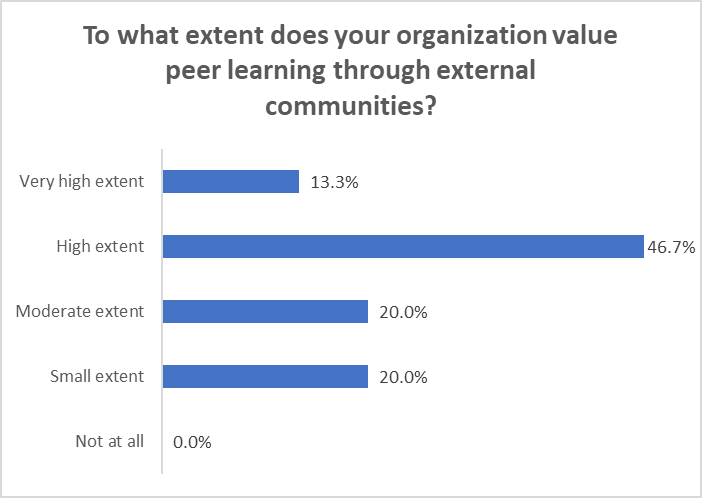
Besides internal employee sharing, 45 percent of the responding organizations had processes in place for employees to share with external sources. This sharing is done through professional consortiums like the ATD Forum, vendor-owned groups, and pay-for-services opportunities like the Katahdin Group (formerly the Raffoni Group). This type of knowledge sharing between and among peers provides various opportunities typically unavailable with internal sharing. Some of these benefits include benchmarking processes, staying in front of trends and practices, sharing resources, and learning from others. These opportunities can save time and money, accelerate solving business challenges, and are highly valued. For groups like the ATD Forum, there are extensive leadership opportunities available like hosting an experiential lab, sharing case studies, co-facilitating interactive sessions with senior professionals from other companies, and even authoring blogs and book chapters.

A Pathway for Tripling Productivity-FORUM_Peer Learning Survey Figure1.png

Content

According to the respondents, many benefits are associated with performance and engagement with employee knowledge groups, such as:

According to the respondents, many benefits are associated with performance and engagement with employee knowledge groups, such as:

  • Content

    Extending the opportunities from formal learning sessions, especially for practicing skills

    Extending the opportunities from formal learning sessions, especially for practicing skills

  • Content

    Promoting a continuous learning culture

    Promoting a continuous learning culture

  • Content

    Enhancing cross-functional awareness between departments, especially to gain acumen around how the business works

    Enhancing cross-functional awareness between departments, especially to gain acumen around how the business works

  • Content

    Building personal connections across the organization

    Building personal connections across the organization

  • Content

    Supporting self-directed learning

    Supporting self-directed learning

  • Content

    Providing a safe space to experiment and test new ideas especially from diverse perspectives

    Providing a safe space to experiment and test new ideas especially from diverse perspectives

  • Content

    Promoting opportunities for lateral moves or advancement

    Promoting opportunities for lateral moves or advancement

Content

The survey respondents provided excellent ideas for making any peer knowledge sharing venue more successful:

The survey respondents provided excellent ideas for making any peer knowledge sharing venue more successful:

  • Content

    Have a common goal or purpose

    Have a common goal or purpose

  • Content

    Align the program with company goals and the business objectives then connecting measurement to those goals

    Align the program with company goals and the business objectives then connecting measurement to those goals

  • Content

    Develop a loose, overarching strategy that allows for flexibility while providing the structure necessary to be successful

    Develop a loose, overarching strategy that allows for flexibility while providing the structure necessary to be successful

  • Content

    Include content and ideas that are germane to the needs of the organization with options for employees to curate content

    Include content and ideas that are germane to the needs of the organization with options for employees to curate content

  • Content

    Engage champions (for example, executive or senior sponsorship to ensure the group is seen as part of the corporate culture)

    Engage champions (for example, executive or senior sponsorship to ensure the group is seen as part of the corporate culture)

  • Content

    Tie participation and demonstration of learning needs to the annual performance accomplishments

    Tie participation and demonstration of learning needs to the annual performance accomplishments

  • Content

    Offer technical support to better enable access and contributions by a dispersed workforce

    Offer technical support to better enable access and contributions by a dispersed workforce

  • Content

    Advertise

    Advertise

  • Content

    Make it habitual and integrated with the broader learning ecosystem by embedding it in culture, tracking it, and reporting on it

    Make it habitual and integrated with the broader learning ecosystem by embedding it in culture, tracking it, and reporting on it

Content

While these groups are usually informal, some have guidelines. For more details on peer learning, please read this post from the Peer Learning Institute. For more details on communities of practice, a great resource is “ Expand Employee Learning With Communities of Practice .” In Leading the Learning Function , Laura Solomon and Caroline Fernandes disseminate various peer sharing practices, especially detailing peer coaching used by IBM. John Parsell’s TD at Work article imparts ideas and tips for successfully executing a hackathon.

While these groups are usually informal, some have guidelines. For more details on peer learning, please read this post from the Peer Learning Institute. For more details on communities of practice, a great resource is “Expand Employee Learning With Communities of Practice.” In Leading the Learning Function, Laura Solomon and Caroline Fernandes disseminate various peer sharing practices, especially detailing peer coaching used by IBM. John Parsell’s TD at Work article imparts ideas and tips for successfully executing a hackathon.

Content

It is a known fact that much of the know-how in an organization, both the institutional knowledge and techniques for doing the tasks, is tacit. With time and resources at a premium and the constant need to upskill and reskill, dynamic and engaged knowledge sharing groups in organizations can be a game changer. Technology advancements have made it easier to connect and share across geographies and time zones. Learning in the flow of work is only possible when there are myriad ways for employees to access information.

It is a known fact that much of the know-how in an organization, both the institutional knowledge and techniques for doing the tasks, is tacit. With time and resources at a premium and the constant need to upskill and reskill, dynamic and engaged knowledge sharing groups in organizations can be a game changer. Technology advancements have made it easier to connect and share across geographies and time zones. Learning in the flow of work is only possible when there are myriad ways for employees to access information.

Content

Think about the Platt quote for tripling productivity in your organization. Consider the opportunities to learn from other organizations. How is your learning function promoting and supporting knowledge sharing? How can you enhance the process and thus build greater capacity for extending performance capability using some of these suggestions?

Think about the Platt quote for tripling productivity in your organization. Consider the opportunities to learn from other organizations. How is your learning function promoting and supporting knowledge sharing? How can you enhance the process and thus build greater capacity for extending performance capability using some of these suggestions?

You've Reached ATD Member-only Content

Become an ATD member to continue

Already a member?Sign In


Copyright © 2026 ATD

ASTD changed its name to ATD to meet the growing needs of a dynamic, global profession.

Terms of UsePrivacy NoticeCookie Policy