
ATD Blog
Designing Upskilling for Impact With Learning in the Flow of Work
Three ways to design upskilling into the flow of work.
Mon Jan 26 2026

Roles are evolving faster and expanding in more ways than before. New tools arrive before teams are ready to use them. And performance expectations keep climbing.
The ways in which many organizations view training, however, has yet to evolve along with these needs.
The focus is still primarily on providing formal training, often overlooking a very important truth: Learning that sticks happens in the flow of work, or at least aligns and relates to real tasks. So, in many cases, the issue isn’t a lack of effort or investment in training, but a mindset that overlooks the symbiotic relationship between learning and the actual work.
Why Upskilling Efforts Aren’t Delivering Impact
Globally, upskilling initiatives are on the rise. According to the TalentLMS 2026 Annual L&D Benchmark Report, 57 percent of employees claim to receive upskilling opportunities. This is up from 50 percent in 2022.
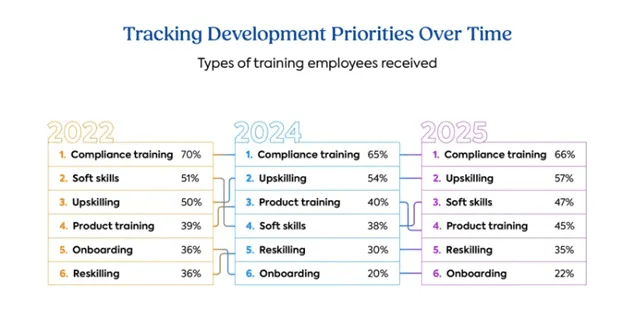
On the surface, it looks like progress, but the reality reveals a more complicated story:
Performance expectations are rising even faster than training developments, as 65 percent of employees report that more is expected of them this year. At the same time, lack of time remains the top barrier to learning, as 46 percent of employees and 49 percent of HR leaders claim training is still perceived as time away from “real” work.
In similar surveys, employees and companies reported building their training offerings around dedicated “time blocks,” while also citing “time constraints” and “workload“ as key learning blockers.
As a result, courses are pushed to after-hours sessions. Learning happens in bursts between meetings. Completion rates may look fine, but do they lead to actual behavior change? When learning feels like a detour, it rarely creates meaningful change. No matter how well-designed, we know very well that people will eventually forget most new information if they can’t apply what they learn to their day-to-day work.
Upskilling doesn’t fail because people don’t want to learn. It fails because learning is still treated as an interruption, not as a performance and development tool embedded in employees’ daily work.
What Learning in the Flow of Work Really Means
Eighty-six percent of employees say they pick up new skills by figuring things out as they work. According to 65 percent, on-the-job experience is the top way to build skills. This doesn’t point to a gap in need of fixing, but rather signals how to design training. We know this from adult learning theory and common practice. This strategy has also been widely popularized through various learning frameworks, such as the 70-20-10.
Learning in the flow of work means triggering and supporting people’s learning while they work, not pulling them away for training. It’s timely, practical, and tied to real tasks. When implemented effectively, we transition from solely consuming static content to a more dynamic experience. Learners apply problem-solving skills to actual challenges, often ill-defined, with various types of support (for example, from peers, learning materials, or mentoring).
3 Design Shifts to Build Influential Upskilling
Here’s how to design training for impact:
1. Offer support at the moment of need.
People don’t always need a full, lengthy training course when they’re stuck. They need quick, clear support to complete the challenge in front of them.
Designing for the moment of need means bringing support into the learning process. For instance, an AI coach inside your LMS may guide learners as they move through training by answering questions in real time.
AI can also provide ad-hoc support in other practical ways:
Offer pre-built prompts. Allow employees to run simulated scenarios with an AI bot, helping them practice before working on a real task.
Identify colleagues with relevant expertise. When connected to the organization’s skills matrix,
AI assistants can suggest who to reach out to for support with a specific problem.
Generate structured action plans. Such plans aid in completing tasks, especially those involving other stakeholders. This may include preparing for a difficult conversation, organizing responsibilities for a cross-team project, or outlining steps to achieve a specific goal.
In all of these cases, AI acts as a thinking partner, helping employees move forward and complete their work.
2. Prioritize practical training.
Nearly 1 in 3 employees say training is too theoretical, which points to a design problem. Instead of asking “What should people know?” ask “What should people be able to do on Monday?” Then design training from there.
In addition to reinforcing the tacit learning that happens on the job, organizations should also ensure that formal training aligns with employees’ day-to-day needs with easy application.
Upskilling works best when people can practice with hands-on tasks, realistic scenarios, or short simulations that mirror the work they actually do. Approaches like this lead to more persistent learning gain and present a clear “Why do this?” to gain buy-in early on.
3. Anchor upskilling to growth paths.
According to our report, only 45 percent of employees say training is clearly tied to their career growth. And when learning feels disconnected from development, motivation drops.
Upskilling needs to have a visible link to what comes next. Could that be new responsibilities or role shifts? Clear skill paths show employees how today’s efforts lead to future opportunities.
A clear career framework (with defined skills and requirements for each role) is a foundational enabler of effective upskilling. It creates an effective base for both formal learning and on-the-job development.
When employees have a transparent road map, they can actively codesign their paths forward. As long as they understand their starting points (current strengths and gaps) and their goals (the skills or experiences required for the next role), development becomes a planning exercise—supported by the right tools and people.
Formal training sessions, mentorship schemes, on-the-job stretch assignments, job shadowing, and many more are upskilling opportunities drive employee growth.
Learning Should Be the Work
Learning is work. That mindset shift changes everything. Learning becomes ever-present, embedded in the flow of work, and feels personal.
For L&D leaders, this is both a challenge and an opportunity. Designing in the flow of work takes restraint, empathy, and a sharp focus on real learner needs.
But when it’s done right, with the proper strategies and tools, upskilling stops feeling like another task on employees’ checklists and starts driving real results.
View Courses Recommended for You