
ATD Blog
The Adaptive Enterprise: AI, Learning, and the Work of Making Sense
AI can amplify learning, but it can’t replace the human work that makes learning and adaptation possible.
Mon Apr 27 2026

Organizations are investing heavily in AI. Some are seeing real gains; others are still waiting; still others—and not just a few—are quietly rehiring the people AI was meant to replace. When technology initiatives fall short, the reflex is predictable. We look for better tools, implement tighter governance, and order up more training on how to use the platform.
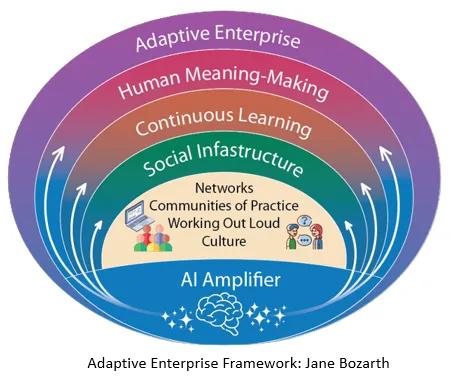
Sometimes those things help. Often, though, the issue is more basic: It has to do with how well the organization learns. The Adaptive Enterprise Framework offers a useful way to think about this. It suggests that adaptability isn’t simply about moving faster or reacting more efficiently. It’s about building the collective capacity to notice what is changing, interpret what that change actually means, decide what to do next, and then adjust practice accordingly—over and over again.
In other words, adaptation is less an event than a habit.
Meaning Comes Before Action
At the center of the framework is human meaning-making. Data rarely speaks for itself: Someone must interpret it, apply context, compare perspectives, weigh trade-offs, and decide what a signal is and what is noise. This is why work improves when learning happens socially. When colleagues talk through cases, narrate decisions, and share lessons learned, they begin to see patterns sooner. They recognize implications earlier and, ultimately, make better judgments.
The effectiveness and speed of this meaning-making depend on what I think of as an organization’s social infrastructure, the conditions that allow knowledge to move. The pillars of the social infrastructure are:
Networks that connect people across boundaries
Communities of Practice that sustain professional dialogue
Habits of working out loud that make thinking visible
Cultural signals that curiosity and sharing are valued rather than risky
Where AI Fits—and Where It Doesn’t
AI has an important role to play in adaptive organizations; it’s just not always the role people assume.
AI is an amplifier, not a driver.
AI can help surface patterns across large volumes of activity. It can summarize discussions, connect related ideas, and make emerging themes easier to see. And it can reduce the friction involved in capturing and distributing learning. In doing so, it strengthens the organization’s ability to recognize what it already knows, and what it may be missing.
What AI does not do is replace interpretive work, discretionary thinking, and gray-area judgment calls.
Judgment still requires context; context still requires experience; meaning still emerges through human conversation and reflection. And as I’ve written elsewhere: You can’t automate trust. While learning—formal, informal, social, structured, serendipitous, intentional, or unanticipated —generates insight, human sensemaking interprets it. Then AI helps scale it and, we hope, speeds it up.
The Opportunity and Challenge for L&D
For L&D practitioners, this framing is both familiar and unsettling. We’ve long known that most workplace learning doesn’t happen in classrooms or formal courses. It happens in the flow of work through collaboration, experimentation, and reflection—the spaces in between the formal events.
If adaptability depends on how effectively people learn together, then L&D’s role extends well beyond content production. It includes shaping the environment in which learning takes place.
Design experiences that build relationships as well as skills. Cohort programs, peer problem-solving sessions, and case discussions help participants form connections they can draw on long after a formal event ends.
Help sustain communities of practice. When practitioners have structured opportunities to discuss emerging challenges and exchange insights, learning remains anchored in real work rather than abstract content.
Encourage habits that make work more visible. Brief reflections, documented experiments, narrated decisions—small signals that allow others to learn vicariously. Over time, these practices strengthen collective intelligence.
Perhaps most importantly: Facilitate the conversations that support shared interpretation. After a major initiative, a technology rollout, or a significant project, structured reflection helps teams move beyond activity to understanding.
These interventions don’t always look like training. They often look like connection, dialogue, and inquiry. In adaptive organizations, that distinction matters less than we sometimes assume.
AI as a Learning Amplifier
The rise of AI introduces new leverage into this work.
AI tools can help transform rough notes into usable summaries. They can synthesize themes across multiple discussions or surface relevant examples from other parts of the organization. They can act as a kind of documentation layer, making everyday learning more accessible and reusable.
But amplification depends on the signal. If people aren’t sharing experiences, questioning assumptions, or reflecting on outcomes, there is little for AI to extend. When social learning is active, however, AI can dramatically increase its reach. Insights that might once have remained local can become organizational assets.
This shifts the design challenge for L&D. The question is not only how to implement AI tools, but how to cultivate the learning behaviors those tools can support.
Learning as Adaptive Capacity
The Adaptive Enterprise Framework reframes adaptability as a function of learning capacity. Organizations that can interpret change together and adjust practice accordingly are better positioned to navigate uncertainty. Technology can accelerate this process, but it can’t replace the human work that makes it possible.
For L&D, this is both an opportunity and a responsibility. By strengthening social infrastructure, encouraging visible work, and helping teams make sense of their experience, learning functions contribute directly to organizational performance.
In a period defined by rapid technological change, the organizations that thrive will be those that treat learning not as an event, but as an ongoing capability.
AI may amplify learning. But it is people, learning together, who make adaptation possible.
View Courses Recommended for You