
ATD Blog
Use Coaching to Develop Team Norms
Tue Feb 12 2019

Content
This is the fourth in a five-part series that describes how managers can coach people to practice genuine collaboration in the workplace. Each post represents an excerpt from ATD’s new book, Focus on Them , scheduled for publication in December 2018. Winsor Jenkins is a contributing author of the book.
This is the fourth in a five-part series that describes how managers can coach people to practice genuine collaboration in the workplace. Each post represents an excerpt from ATD’s new book, Focus on Them, scheduled for publication in December 2018. Winsor Jenkins is a contributing author of the book.
Content
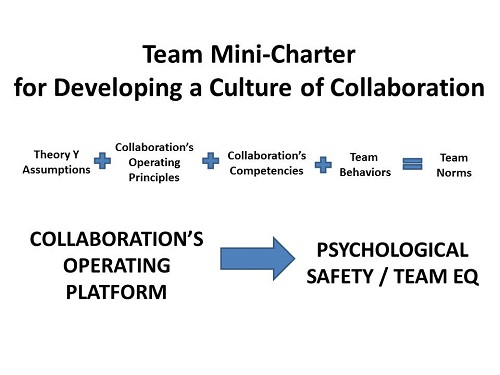
My first post established a road map for developing a collaboration culture (see figure below). The second and third posts examined collaboration’s operating principles and how managers can leverage them to support their teams’ efforts to produce outstanding results. Combined with Theory Y Assumptions, those principles represent collaboration’s operating platform for leading with mindset to produce outstanding team results.
My first post established a road map for developing a collaboration culture (see figure below). The second and third posts examined collaboration’s operating principles and how managers can leverage them to support their teams’ efforts to produce outstanding results. Combined with Theory Y Assumptions, those principles represent collaboration’s operating platform for leading with mindset to produce outstanding team results.
Content
In this post, we explore why coaching is beneficial to developing team norms. Because norms are established by teams and used as ground rules for creating collaboration habits, your coaching should center on ensuring that your team’s norms improve team effectiveness.
In this post, we explore why coaching is beneficial to developing team norms. Because norms are established by teams and used as ground rules for creating collaboration habits, your coaching should center on ensuring that your team’s norms improve team effectiveness.
Content
Meaningful team norms typically address how the team makes decisions, how team goals are managed, and how the team promotes shared responsibility and accountability. Essentially, team decision making deals with building consensus and managing conflict, whereas goal setting addresses the need to manage shared agendas. Gaining commitments across the team deals with modeling what you expect from others. These applications require you to demonstrate inclusion in your actions as the team coach. Without inclusiveness, there is not an opportunity to tap into the talent on your team.
Meaningful team norms typically address how the team makes decisions, how team goals are managed, and how the team promotes shared responsibility and accountability. Essentially, team decision making deals with building consensus and managing conflict, whereas goal setting addresses the need to manage shared agendas. Gaining commitments across the team deals with modeling what you expect from others. These applications require you to demonstrate inclusion in your actions as the team coach. Without inclusiveness, there is not an opportunity to tap into the talent on your team.
Content
Because decision making is such a critical team norm, let’s review a few key issues. First, the team’s decision-making process can evoke emotions, prompting the need to manage conflict in a productive way. That’s not always bad news, if the team’s norm for managing conflict has been establish and conflict is treated as healthy, and team members feel free to actively engage differences of opinion. However, most new managers are not well-equipped to manage conflict. Indeed, this is a specialized skill that calls on your commitment to develop as quickly as possible.
Because decision making is such a critical team norm, let’s review a few key issues. First, the team’s decision-making process can evoke emotions, prompting the need to manage conflict in a productive way. That’s not always bad news, if the team’s norm for managing conflict has been establish and conflict is treated as healthy, and team members feel free to actively engage differences of opinion. However, most new managers are not well-equipped to manage conflict. Indeed, this is a specialized skill that calls on your commitment to develop as quickly as possible.
Content
Talking about team conflict is a perfect segue to remind you about the second key issue: psychological safety. This is critical for developing and maintaining a culture of collaboration. Ensuring psychological safety of all team members means that your coaching must be proactive, and people will need to see your coaching presence to ensure safety and high performance.
Talking about team conflict is a perfect segue to remind you about the second key issue: psychological safety. This is critical for developing and maintaining a culture of collaboration. Ensuring psychological safety of all team members means that your coaching must be proactive, and people will need to see your coaching presence to ensure safety and high performance.
Content
In their research, Jacqueline Peters and Catherine Carr, describe three essential conditions that support psychological safety: clear boundaries; a sense of meaning, urgency, and impact; and team competence. The first two conditions are addressed in collaboration’s operating principles, and third condition is covered in collaboration’s competencies.
In their research, Jacqueline Peters and Catherine Carr, describe three essential conditions that support psychological safety: clear boundaries; a sense of meaning, urgency, and impact; and team competence. The first two conditions are addressed in collaboration’s operating principles, and third condition is covered in collaboration’s competencies.
Content
Peters and Carr also describe three enabling conditions for supporting high performance:
Peters and Carr also describe three enabling conditions for supporting high performance:
Content
Does the team have a charter that can be used to describe roles and responsibilities?
Does the team have a charter that can be used to describe roles and responsibilities?
Content
Does the team work in an organization with a supportive infrastructure to provide adequate resources?
Does the team work in an organization with a supportive infrastructure to provide adequate resources?
Content
Is team coaching established as part of the organization’s platform to support the team’s efforts, including using competent team coaches?
Is team coaching established as part of the organization’s platform to support the team’s efforts, including using competent team coaches?
Content
Clearly, how people on the team work together is more important than who is on the team. In other words, the “how” trumps the “who” when it comes to team performance.
Clearly, how people on the team work together is more important than who is on the team. In other words, the “how” trumps the “who” when it comes to team performance.