
CTDO Magazine Article
8 Talent Ecosystem Building Blocks
Content
Align the core drivers of learning—into a balanced system.
Align the core drivers of learning—into a balanced system.
Fri Oct 14 2022

Content
Align the core drivers of learning—motivation and opportunity—into a balanced system.
Align the core drivers of learning—motivation and opportunity—into a balanced system.
Content
Building employee capabilities is critical to business success. Leaders at all levels of an organization need to identify the capabilities required to drive the business forward, hire for those capabilities, and continuously develop them in employees.
Building employee capabilities is critical to business success. Leaders at all levels of an organization need to identify the capabilities required to drive the business forward, hire for those capabilities, and continuously develop them in employees.
Content
That isn't a new concept—most companies have established L&D teams and corporate universities specifically to address it. But the challenge of truly implementing a capability-based talent approach—and implications from failing to do so successfully—are different than they were in the past.
That isn't a new concept—most companies have established L&D teams and corporate universities specifically to address it. But the challenge of truly implementing a capability-based talent approach—and implications from failing to do so successfully—are different than they were in the past.
Content
Three major forces drive organizations to double down on their capability-based talent ecosystem:
Three major forces drive organizations to double down on their capability-based talent ecosystem:
Content
Scope of capabilities to be learned. Permanent and fundamental disruption is facing all industries, driven by new technologies, changing customer expectations, and an exponential increase in data. To be rapid and responsive, everyone—from frontline employees to executives—must develop new knowledge, skills, mindset, and ways of working.
Scope of capabilities to be learned. Permanent and fundamental disruption is facing all industries, driven by new technologies, changing customer expectations, and an exponential increase in data. To be rapid and responsive, everyone—from frontline employees to executives—must develop new knowledge, skills, mindset, and ways of working.
Content
Pace of change. It's not enough to teach employees what they need to learn about technology, customers, and data, because those are constantly changing. Workers need to learn to stay continuously relevant and productive in their roles.
Pace of change. It's not enough to teach employees what they need to learn about technology, customers, and data, because those are constantly changing. Workers need to learn to stay continuously relevant and productive in their roles.
Content
Employee expectations. A recent McKinsey report found that lack of career development and advancement potential was the top reason employees left companies. It ranked higher than compensation. People want to work for employers that prioritize and support their career growth. That is especially true of roles that are threatened by offshoring or automation.
Employee expectations. A recent McKinsey report found that lack of career development and advancement potential was the top reason employees left companies. It ranked higher than compensation. People want to work for employers that prioritize and support their career growth. That is especially true of roles that are threatened by offshoring or automation.
Content
This situation may rest heavily on your mind, and you may even wonder whether a scalable, effective, and evergreen capability-building approach is even possible. I am here to confirm that it is.
This situation may rest heavily on your mind, and you may even wonder whether a scalable, effective, and evergreen capability-building approach is even possible. I am here to confirm that it is.
Content
My employer, EPAM Systems—a global digital transformation services and product engineering company with an award-winning learning culture and low attrition rates—is proof that evergreen capability building is not only viable but creates organizational agility and continuous learning. Our approach is an integrated talent ecosystem.
My employer, EPAM Systems—a global digital transformation services and product engineering company with an award-winning learning culture and low attrition rates—is proof that evergreen capability building is not only viable but creates organizational agility and continuous learning. Our approach is an integrated talent ecosystem.
Theory One
Content
David Perkins, a renowned cognitive psychologist and Harvard University professor, distilled decades of research in psychology, neuroscience, organizational change, and other fields into a deceptively simple summary he termed Theory One: People will learn much of what they have the reasonable opportunity and motivation to learn.
David Perkins, a renowned cognitive psychologist and Harvard University professor, distilled decades of research in psychology, neuroscience, organizational change, and other fields into a deceptively simple summary he termed Theory One: People will learn much of what they have the reasonable opportunity and motivation to learn.
Content
EPAM's integrated talent ecosystem works because it neatly aligns the two core drivers of learning—reasonable opportunity and motivation—into one seamless system. In practice, that means rethinking and aligning key HR and L&D activities.
EPAM's integrated talent ecosystem works because it neatly aligns the two core drivers of learning—reasonable opportunity and motivation—into one seamless system. In practice, that means rethinking and aligning key HR and L&D activities.
Content
In most organizations, people-related functions work in parallel: HR defines the characteristics of success and oversees the mechanisms for rewarding and motivating employees, while L&D fosters formal and informal training opportunities, job rotations, and mentorships as well as helps guide employees to develop growth plans and skills.
In most organizations, people-related functions work in parallel: HR defines the characteristics of success and oversees the mechanisms for rewarding and motivating employees, while L&D fosters formal and informal training opportunities, job rotations, and mentorships as well as helps guide employees to develop growth plans and skills.
Content
At EPAM and other companies that have adopted an integrated talent ecosystem, HR and L&D have been retooled to work together, collaborating to drive mutual effectiveness. In short, L&D offers continuous learning—providing the opportunity aspect of Theory One —while HR provides motivation via the talent management system.
At EPAM and other companies that have adopted an integrated talent ecosystem, HR and L&D have been retooled to work together, collaborating to drive mutual effectiveness. In short, L&D offers continuous learning—providing the opportunity aspect of Theory One—while HR provides motivation via the talent management system.
Content
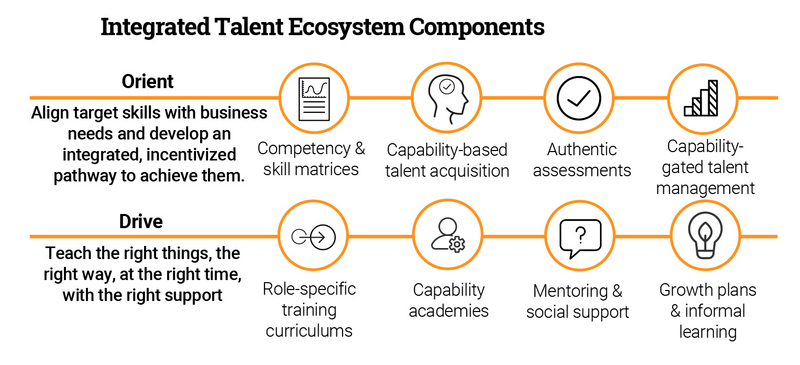
At EPAM, our integrated talent ecosystem has eight components that build on one another and work in harmony:
At EPAM, our integrated talent ecosystem has eight components that build on one another and work in harmony:
Content
Competency and skill matrices
Competency and skill matrices
Content
Authentic assessments
Authentic assessments
Content
Capability-gated talent management
Capability-gated talent management
Content
Role-specific training curriculums
Role-specific training curriculums
Content
Growth plans and informal learning
Growth plans and informal learning
Content
Mentoring and social support
Mentoring and social support
Content
Capability academies
Capability academies
Content
Capability-based talent acquisition
Capability-based talent acquisition
Content
Collectively, they orient us toward the capabilities required for the business to succeed and drive learning by creating the right opportunities and infrastructure for employees to develop them.
Collectively, they orient us toward the capabilities required for the business to succeed and drive learning by creating the right opportunities and infrastructure for employees to develop them.
Content
Source: Eight Elements of an Integrated Talent Ecosystem, EPAM Systems, 2022
Source: Eight Elements of an Integrated Talent Ecosystem, EPAM Systems, 2022
Competency and skill matrices
Content
The first and most important action when creating an integrated talent ecosystem is retooling employee role expectations to reflect the capabilities necessary to realize your business strategy.
The first and most important action when creating an integrated talent ecosystem is retooling employee role expectations to reflect the capabilities necessary to realize your business strategy.
Content
For instance, cloud adoption is critical for many companies because it helps them move faster and drives innovation. Many identify cloud as a critical capability for IT employees. But what exactly that means in practice varies by role. An IT senior manager, team leader, and individual developer need different cloud capabilities.
For instance, cloud adoption is critical for many companies because it helps them move faster and drives innovation. Many identify cloud as a critical capability for IT employees. But what exactly that means in practice varies by role. An IT senior manager, team leader, and individual developer need different cloud capabilities.
Content
To realize any business strategy, identify the roles affected by the new direction, detail what each role must know and do differently, and adjust competency and skill matrices to reflect updated expectations.
To realize any business strategy, identify the roles affected by the new direction, detail what each role must know and do differently, and adjust competency and skill matrices to reflect updated expectations.
Content
Because realizing business strategy is the integrated talent ecosystem's goal, it often doesn't make sense to rely on generic matrices you can find online. Create matrices that are specific to your organization and dynamic, evolving alongside technology and the business. Partner with internal or external subject matter experts to identify the technical, soft, and growth skills needed in each job function at each level.
Because realizing business strategy is the integrated talent ecosystem's goal, it often doesn't make sense to rely on generic matrices you can find online. Create matrices that are specific to your organization and dynamic, evolving alongside technology and the business. Partner with internal or external subject matter experts to identify the technical, soft, and growth skills needed in each job function at each level.
Authentic assessments
Content
Define what "good" looks like. Create job-relevant tasks that enable employees to demonstrate capabilities. Be sure to match assessment activities to the capability and incorporate several data sources, such as observations (peer or manager), behavioral interviews, portfolios of authentic work products, and direct assessment tasks.
Define what "good" looks like. Create job-relevant tasks that enable employees to demonstrate capabilities. Be sure to match assessment activities to the capability and incorporate several data sources, such as observations (peer or manager), behavioral interviews, portfolios of authentic work products, and direct assessment tasks.
Content
For example, performance tasks will let you know whether a cloud developer has the technical capabilities necessary for her role, but her ability to communicate effectively is better assessed through teammates and managers' feedback.
For example, performance tasks will let you know whether a cloud developer has the technical capabilities necessary for her role, but her ability to communicate effectively is better assessed through teammates and managers' feedback.
Capability-gated talent management
Content
In most organizations, talent management—that is, retention and promotion—is based on a set of nebulous criteria. In contrast, capability-gated talent management requires workers to demonstrate mastery of skills and competencies to progress in their careers.
In most organizations, talent management—that is, retention and promotion—is based on a set of nebulous criteria. In contrast, capability-gated talent management requires workers to demonstrate mastery of skills and competencies to progress in their careers.
Content
Retention and promotion decisions are based, at least in part, on authentic capability assessments. To be eligible for a promotion, for instance, a cloud developer would need to show proof of her technical skills and have her peers rate her as highly collaborative.
Retention and promotion decisions are based, at least in part, on authentic capability assessments. To be eligible for a promotion, for instance, a cloud developer would need to show proof of her technical skills and have her peers rate her as highly collaborative.
Content
Capability-gated talent management helps demystify often opaque promotion processes and gives staff a feeling of control over their professional growth. It also turns the learning economy upside-down.
Capability-gated talent management helps demystify often opaque promotion processes and gives staff a feeling of control over their professional growth. It also turns the learning economy upside-down.
Content
In most companies, L&D pushes education at employees, with relatively few taking up the challenge. Making capability demonstration a prerequisite to promotion or retention changes that dramatically. At EPAM, we have a continuous learning culture driven by employees who pull learning from L&D and demand high-quality programming.
In most companies, L&D pushes education at employees, with relatively few taking up the challenge. Making capability demonstration a prerequisite to promotion or retention changes that dramatically. At EPAM, we have a continuous learning culture driven by employees who pull learning from L&D and demand high-quality programming.
Role-specific training curriculums
Content
Many employers have a training catalog, a collection of hundreds or thousands of formal learning resources available to employees, both internal and through third-party licenses. Instead, create a subset of the training catalog curated specifically to support skill development by role and level.
Many employers have a training catalog, a collection of hundreds or thousands of formal learning resources available to employees, both internal and through third-party licenses. Instead, create a subset of the training catalog curated specifically to support skill development by role and level.
Content
A more granular approach by job function saves employees time, focuses them, and reduces their risk of being overwhelmed by a laundry list of potential training activities. Like your dynamic competency and skill matrices, the role-specific curriculums need to evolve with the business.
A more granular approach by job function saves employees time, focuses them, and reduces their risk of being overwhelmed by a laundry list of potential training activities. Like your dynamic competency and skill matrices, the role-specific curriculums need to evolve with the business.
Growth plans and informal learning
Content
Growth plans lay out specific learning opportunities that help workers prepare for the next stage in their career. Staff at EPAM can input a target role—such as a cloud architect—into our growth planning tool and receive a list of resources that will help them develop the capabilities required for that role.
Growth plans lay out specific learning opportunities that help workers prepare for the next stage in their career. Staff at EPAM can input a target role—such as a cloud architect—into our growth planning tool and receive a list of resources that will help them develop the capabilities required for that role.
Content
Because we know that most learning occurs outside of formal training, our growth plans lean heavily on informal learning opportunities such as communities of practice, mentoring, internal learning programs, job shadowing, and external certification.
Because we know that most learning occurs outside of formal training, our growth plans lean heavily on informal learning opportunities such as communities of practice, mentoring, internal learning programs, job shadowing, and external certification.
Mentoring and social support
Content
Humans are social creatures. People learn best when they can get input and benefit from others' expertise, so it pays to develop a robust mentorship culture and social support infrastructure.
Humans are social creatures. People learn best when they can get input and benefit from others' expertise, so it pays to develop a robust mentorship culture and social support infrastructure.
Content
That means supplementing individual content consumption with small groups in which employees discuss topics, share ideas, and provide feedback. When building new skills, a supportive mentor or coach is also valuable.
That means supplementing individual content consumption with small groups in which employees discuss topics, share ideas, and provide feedback. When building new skills, a supportive mentor or coach is also valuable.
Content
A common barrier to creating a mentoring culture is a lack of people willing to mentor and insufficient guidance to make the mentoring relationships fruitful. At EPAM, we've addressed that challenge by building mentorship into pre-management roles.
A common barrier to creating a mentoring culture is a lack of people willing to mentor and insufficient guidance to make the mentoring relationships fruitful. At EPAM, we've addressed that challenge by building mentorship into pre-management roles.
Content
Staff who want to become people managers get practice by first becoming mentors. Because mentoring is a role expectation, they receive feedback from mentees to improve their skills. We also provide education to mentors and offer a mentor-the-mentor program to help them troubleshoot challenging situations and get advice from more-experienced peers.
Staff who want to become people managers get practice by first becoming mentors. Because mentoring is a role expectation, they receive feedback from mentees to improve their skills. We also provide education to mentors and offer a mentor-the-mentor program to help them troubleshoot challenging situations and get advice from more-experienced peers.
Capability academies
Content
Many organizations struggle with effective teaching. Often L&D professionals think of dispensing educational content like pouring water onto a sponge. But training programs' poor return on investment shows that people aren't nearly as absorbent as sponges.
Many organizations struggle with effective teaching. Often L&D professionals think of dispensing educational content like pouring water onto a sponge. But training programs' poor return on investment shows that people aren't nearly as absorbent as sponges.
Content
Instead of offering simple training programs, create high-impact capability academies for complex constellations of knowledge and skills. Invest in expert instruction and content, plenty of on-the-job application of knowledge, ongoing feedback from experts, and individual assessments.
Instead of offering simple training programs, create high-impact capability academies for complex constellations of knowledge and skills. Invest in expert instruction and content, plenty of on-the-job application of knowledge, ongoing feedback from experts, and individual assessments.
Capability-based talent acquisition
Content
The last component of an integrated talent ecosystem is also the first: Source the right talent. The competency and skill matrices for the role and level should largely determine whom you hire.
The last component of an integrated talent ecosystem is also the first: Source the right talent. The competency and skill matrices for the role and level should largely determine whom you hire.
Content
To find the best talent, repurpose authentic assessments during the hiring process and as part of interviewing and onboarding activities. Hire for skills and competencies, but also seek out people who are eager to grow their skills on an ongoing basis, comfortable with change, and excited about what's on the horizon for your company and industry.
To find the best talent, repurpose authentic assessments during the hiring process and as part of interviewing and onboarding activities. Hire for skills and competencies, but also seek out people who are eager to grow their skills on an ongoing basis, comfortable with change, and excited about what's on the horizon for your company and industry.
Getting started
Content
EPAM's integrated talent ecosystem evolved over many years and is seamlessly integrated in our culture and organizational structure. For those starting this journey, here is some advice.
EPAM's integrated talent ecosystem evolved over many years and is seamlessly integrated in our culture and organizational structure. For those starting this journey, here is some advice.
Content
Start small. Achieve quick wins by carefully selecting roles that present minimal challenge or have high potential upside. Critical roles with high turnover, departments eager to partner and try something new, and roles that have the most advanced ecosystem components are good places to start.
Start small. Achieve quick wins by carefully selecting roles that present minimal challenge or have high potential upside. Critical roles with high turnover, departments eager to partner and try something new, and roles that have the most advanced ecosystem components are good places to start.
Content
Break down department and data silos. Successful implementation of the integrated talent ecosystem requires rethinking who owns talent management and development. Subject matter expertise is required to optimize many aspects of the talent ecosystem—HR and L&D don't have sufficient knowledge of the roles to go in alone.
Break down department and data silos. Successful implementation of the integrated talent ecosystem requires rethinking who owns talent management and development. Subject matter expertise is required to optimize many aspects of the talent ecosystem—HR and L&D don't have sufficient knowledge of the roles to go in alone.
Content
Create cross-functional teams of SMEs, HR, L&D, and talent acquisition to develop ecosystem components. It's equally important to integrate data, especially to achieve predictive analytics and track ROI. EPAM created a data lake that all of our people-related platforms feed and an interaction layer to make that data accessible and meaningful.
Create cross-functional teams of SMEs, HR, L&D, and talent acquisition to develop ecosystem components. It's equally important to integrate data, especially to achieve predictive analytics and track ROI. EPAM created a data lake that all of our people-related platforms feed and an interaction layer to make that data accessible and meaningful.
Content
Make it evergreen. Even if you could snap your fingers and bring an integrated talent ecosystem to life in your organization, the work would not be done. Changes in technology, data, customer expectations, and the business landscape mean you need to regularly assess and adjust your ecosystem.
Make it evergreen. Even if you could snap your fingers and bring an integrated talent ecosystem to life in your organization, the work would not be done. Changes in technology, data, customer expectations, and the business landscape mean you need to regularly assess and adjust your ecosystem.
Content
At EPAM, the cross-functional teams led by SMEs meet at least annually to review competency and skill matrices to determine whether updates are required. If they are, the other ecosystem components are adjusted accordingly.
At EPAM, the cross-functional teams led by SMEs meet at least annually to review competency and skill matrices to determine whether updates are required. If they are, the other ecosystem components are adjusted accordingly.
Content
Manage expectations. Developing an integrated talent ecosystem will take time to affect business metrics such as retention and will involve a lot of organizational change management. Be sure to state those facts early and often, budget for change management resources, and be prepared for the inevitable dips in enthusiasm and momentum that characterize any major transformation.
Manage expectations. Developing an integrated talent ecosystem will take time to affect business metrics such as retention and will involve a lot of organizational change management. Be sure to state those facts early and often, budget for change management resources, and be prepared for the inevitable dips in enthusiasm and momentum that characterize any major transformation.
Content
Implementing an integrated talent ecosystem is not easy—it requires organizational collaboration and visionary leadership. But the payoff is well worth it. A dynamic, fully integrated, business-driven talent ecosystem turbocharges organizational transformation, facilitates a culture of continuous learning, and ensures your company develops and maintains the necessary capabilities to be successful tomorrow.
Implementing an integrated talent ecosystem is not easy—it requires organizational collaboration and visionary leadership. But the payoff is well worth it. A dynamic, fully integrated, business-driven talent ecosystem turbocharges organizational transformation, facilitates a culture of continuous learning, and ensures your company develops and maintains the necessary capabilities to be successful tomorrow.
Common Barriers to Capability Building
Content
The integrated talent ecosystem was designed to overcome four major barriers to equipping employees with capabilities necessary to achieve business objectives.
The integrated talent ecosystem was designed to overcome four major barriers to equipping employees with capabilities necessary to achieve business objectives.
Content
Employees need to be told what capabilities are necessary for their role—someone must make the connection between the business strategy and individual job responsibilities.
Employees need to be told what capabilities are necessary for their role—someone must make the connection between the business strategy and individual job responsibilities.
Content
There needs to be some way to determine when an employee has a capability—a method to assess mastery in a valid and reliable manner.
There needs to be some way to determine when an employee has a capability—a method to assess mastery in a valid and reliable manner.
Content
Employees need to have the appropriate support to learn, both in formal and informal settings.
Employees need to have the appropriate support to learn, both in formal and informal settings.
Content
Employees need to be motivated to devote the time and mental energy to learn complex things on a continual basis.
Employees need to be motivated to devote the time and mental energy to learn complex things on a continual basis.
Content
Read more from CTDO magazine : Essential talent development content for C-suite leaders.
Read more from CTDO magazine: Essential talent development content for C-suite leaders.
View Courses Recommended for You