
CTDO Magazine Article
Are You Grooming Your Successor?
Content
ATD and i4cp found that four in five organizations have a designated talent development leader or leaders. The bad news is that only 20 percent of organizations have formal succession plans in place for those talent leaders. Clearly, as talent leaders’ roles become greater and the organization becomes more dependent on their work, the need for a succession plan for this position becomes more pertinent, especially to avoid organizational culture deterioration and the loss of institutional knowledge. But where can talent development professionals look to fill their bench with talent?
ATD and i4cp found that four in five organizations have a designated talent development leader or leaders. The bad news is that only 20 percent of organizations have formal succession plans in place for those talent leaders. Clearly, as talent leaders’ roles become greater and the organization becomes more dependent on their work, the need for a succession plan for this position becomes more pertinent, especially to avoid organizational culture deterioration and the loss of institutional knowledge. But where can talent development professionals look to fill their bench with talent?
Fri Sep 29 2017
Content
The talent development leader's role is evolving. In fact, 89 percent say that their scope of responsibilities has increased during the past two years. According to Chief Talent Development Officers: Driving Strategy and Performance, a new report from ATD Research and the Institute for Corporate Productivity (i4cp), talent leaders also are starting to steer performance management efforts, employee engagement, knowledge management, and talent acquisition and retention, to name a few.
The talent development leader's role is evolving. In fact, 89 percent say that their scope of responsibilities has increased during the past two years. According to Chief Talent Development Officers: Driving Strategy and Performance, a new report from ATD Research and the Institute for Corporate Productivity (i4cp), talent leaders also are starting to steer performance management efforts, employee engagement, knowledge management, and talent acquisition and retention, to name a few.
Content
Here's the good news: ATD and i4cp found that four in five organizations (79 percent) have a designated talent development leader or leaders. The bad news is that only 20 percent of organizations have formal succession plans in place for those talent leaders.
Here's the good news: ATD and i4cp found that four in five organizations (79 percent) have a designated talent development leader or leaders. The bad news is that only 20 percent of organizations have formal succession plans in place for those talent leaders.
Content
Clearly, as talent leaders' roles become greater and the organization becomes more dependent on their work, the need for a succession plan for this position becomes more pertinent, especially to avoid organizational culture deterioration and the loss of institutional knowledge. But where can talent development professionals look to fill their bench with talent?
Clearly, as talent leaders' roles become greater and the organization becomes more dependent on their work, the need for a succession plan for this position becomes more pertinent, especially to avoid organizational culture deterioration and the loss of institutional knowledge. But where can talent development professionals look to fill their bench with talent?
Content
According to ATD and i4cp, nearly half of survey respondents say their organizations will most likely promote internal talent to replace a talent development leader. Not surprisingly, 85 percent of organizations would look in the talent development or learning function for future leadership candidates. However, with the expansion of responsibilities—from traditional learning and development to more HR-related tasks—70 percent say they would look to the human resources department for new talent.
According to ATD and i4cp, nearly half of survey respondents say their organizations will most likely promote internal talent to replace a talent development leader. Not surprisingly, 85 percent of organizations would look in the talent development or learning function for future leadership candidates. However, with the expansion of responsibilities—from traditional learning and development to more HR-related tasks—70 percent say they would look to the human resources department for new talent.
Content
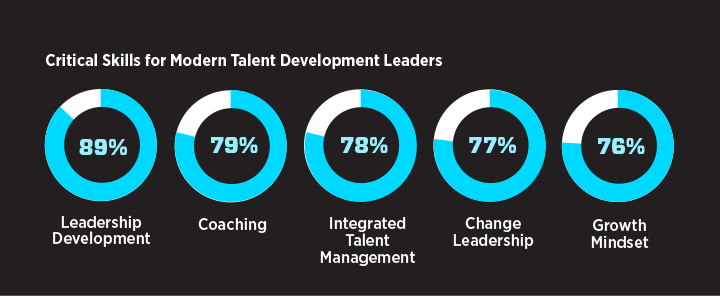
Once potential leaders are identified, they need to be groomed for the promotion. Eighty-five percent of talent development professionals agree that leadership development is the most critical competency for talent development leaders in coming years. No doubt, strong leadership is needed to manage the changing roles of talent development leaders, particularly as they become a more strategic organizational partner in developing business performance. The study found that other skills organizations need to develop in their talent leaders are coaching, change leadership, business acumen, and a growth mindset.
Once potential leaders are identified, they need to be groomed for the promotion. Eighty-five percent of talent development professionals agree that leadership development is the most critical competency for talent development leaders in coming years. No doubt, strong leadership is needed to manage the changing roles of talent development leaders, particularly as they become a more strategic organizational partner in developing business performance. The study found that other skills organizations need to develop in their talent leaders are coaching, change leadership, business acumen, and a growth mindset.
Content
To be successful in managing your talent development pipeline, the importance of understanding the dynamic and shifting role of talent development leaders cannot be understated. Prioritize learning for current and future talent development leaders to keep pace with their expanding roles and formalize a succession plan for talent development leaders to give your organization a competitive edge.
To be successful in managing your talent development pipeline, the importance of understanding the dynamic and shifting role of talent development leaders cannot be understated. Prioritize learning for current and future talent development leaders to keep pace with their expanding roles and formalize a succession plan for talent development leaders to give your organization a competitive edge.
Content
Read more from CTDO magazine : Essential talent development content for C-suite leaders.
Read more from CTDO magazine: Essential talent development content for C-suite leaders.