
CTDO Magazine Article
Are Your Leaders Ready for Anything?
Content
A leader's ability to conquer common business challenges is a critical measure of leadership readiness. But a new research study reports that it's not only the personal characteristics of the leader that ultimately determine success. Context matters. Unfortunately, context can change quickly. "It won't take long for most leaders to find themselves in an environment that they are ill-prepared to...
A leader's ability to conquer common business challenges is a critical measure of leadership readiness. But a new research study reports that it's not only the personal characteristics of the leader that ultimately determine success. Context matters. Unfortunately, context can change quickly. "It won't take long for most leaders to find themselves in an environment that they are ill-prepared to...
Wed Jun 15 2016

Content
A leader's ability to conquer common business challenges is a critical measure of leadership readiness. But a new research study from Development Dimensions International reports that it's not only the personal characteristics of the leader that ultimately determine success. Context matters. Unfortunately, context can change quickly. "It won't take long for most leaders to find themselves in an environment that they are ill-prepared to navigate and manage," states DDI.
A leader's ability to conquer common business challenges is a critical measure of leadership readiness. But a new research study from Development Dimensions International reports that it's not only the personal characteristics of the leader that ultimately determine success. Context matters. Unfortunately, context can change quickly. "It won't take long for most leaders to find themselves in an environment that they are ill-prepared to navigate and manage," states DDI.
Content
To compile data for High-Resolution Leadership, DDI examined more than a decade of real behaviors observed during its "day in a life" leadership simulations. It reviewed data from approximately 15,000 candidates being considered for leadership roles, ranging from the front line to the C-suite and representing more than 300 organizations across 20 industries in 18 countries.
To compile data for High-Resolution Leadership, DDI examined more than a decade of real behaviors observed during its "day in a life" leadership simulations. It reviewed data from approximately 15,000 candidates being considered for leadership roles, ranging from the front line to the C-suite and representing more than 300 organizations across 20 industries in 18 countries.
Content
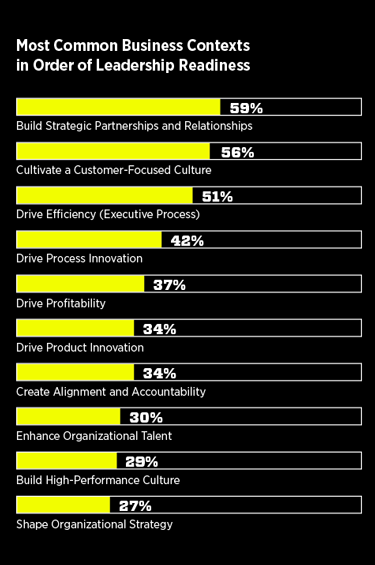
The data reveal that executives are more equipped to focus on some challenges: improving quality, building relationships, and focusing on customers and efficiency. But even these numbers aren't great. Little more than half of those studied are prepared to build strategic partnerships (59 percent), and even fewer are ready to cultivate a customer-focused culture (56 percent).
The data reveal that executives are more equipped to focus on some challenges: improving quality, building relationships, and focusing on customers and efficiency. But even these numbers aren't great. Little more than half of those studied are prepared to build strategic partnerships (59 percent), and even fewer are ready to cultivate a customer-focused culture (56 percent).
Content
What's more worrisome is that the report indicates that execs are far less ready to navigate the ambiguity that comes with more strategic challenges such as building or reinventing brands, markets, organizations, and cultures. About one-quarter (27 percent) are equipped to shape organizational strategy, and only one in three executives have the know-how to enhance organizational talent. "Given the speed of change, executives have some catching up to do," writes DDI.
What's more worrisome is that the report indicates that execs are far less ready to navigate the ambiguity that comes with more strategic challenges such as building or reinventing brands, markets, organizations, and cultures. About one-quarter (27 percent) are equipped to shape organizational strategy, and only one in three executives have the know-how to enhance organizational talent. "Given the speed of change, executives have some catching up to do," writes DDI.
Content
So, how can organizations better prepare their leaders for business challenges? High-Resolution Leadership offers three recommendations:
So, how can organizations better prepare their leaders for business challenges? High-Resolution Leadership offers three recommendations:
Content
Don't just assess leaders, assess context as well. Taking the time to objectively assess both enables an assessment of fit and reduces the risk of mistakes.
Don't just assess leaders, assess context as well. Taking the time to objectively assess both enables an assessment of fit and reduces the risk of mistakes.
Content
Align skill and personality requirements with context. This means assessing business-driver readiness with multiple competencies and personality characteristics that interact with one another.
Align skill and personality requirements with context. This means assessing business-driver readiness with multiple competencies and personality characteristics that interact with one another.
Content
Contextualize skill development efforts. Efforts to accelerate the growth of leaders should train them to apply newly learned skills to the specific challenges and needs an organization faces today and may face in the future.
Contextualize skill development efforts. Efforts to accelerate the growth of leaders should train them to apply newly learned skills to the specific challenges and needs an organization faces today and may face in the future.
Content
Read more from CTDO magazine : Essential talent development content for C-suite leaders.
Read more from CTDO magazine: Essential talent development content for C-suite leaders.