
CTDO Magazine Article
Chain of Evidence
Content
Prove that your learning solutions contribute to business results.
Prove that your learning solutions contribute to business results.
Thu Sep 15 2016

Content
Jane is the director for worldwide sales talent development in a global organization. This past year she partnered with the executive vice president of sales and his leadership team to enhance the skills of the sales force.
Jane is the director for worldwide sales talent development in a global organization. This past year she partnered with the executive vice president of sales and his leadership team to enhance the skills of the sales force.
Content
The marketplace for their product line is rapidly changing, with the products moving into a commodity status, placing pressure on fees that can be charged. Despite the higher quality of their product, sales reps were challenged to negotiate higher fees when customers are focused on price. So, a decision was made to implement a two-day learning experience throughout the worldwide organization that focused on negotiating fees in a highly competitive market. The investment in this learning solution was significant. Implementation of the program concluded about four months ago. The program was evaluated at Level 1 (reaction). The results were very strong, indicating that sales reps found the program extremely helpful and beneficial. In fact, the findings were some of the strongest Jane has ever seen.
The marketplace for their product line is rapidly changing, with the products moving into a commodity status, placing pressure on fees that can be charged. Despite the higher quality of their product, sales reps were challenged to negotiate higher fees when customers are focused on price. So, a decision was made to implement a two-day learning experience throughout the worldwide organization that focused on negotiating fees in a highly competitive market. The investment in this learning solution was significant. Implementation of the program concluded about four months ago. The program was evaluated at Level 1 (reaction). The results were very strong, indicating that sales reps found the program extremely helpful and beneficial. In fact, the findings were some of the strongest Jane has ever seen.
Content
Fast forward several months. Jane received the sales report for the first full quarter since the training concluded. The report indicates that revenue is 11 percent higher than for the same quarter in the previous year, and is 4 percent ahead of plan. In a meeting with the sales leadership team, Jane reported on several metrics related to the training solution in terms of its cost, number of people participating, etc. She then shared results from the Level 1 evaluation. Lastly, Jane acknowledged the Level 4 (business) results, which showed a significant increase in revenue. She concluded by saying that "clearly the learning solution has yielded a positive ROI to our organization."
Fast forward several months. Jane received the sales report for the first full quarter since the training concluded. The report indicates that revenue is 11 percent higher than for the same quarter in the previous year, and is 4 percent ahead of plan. In a meeting with the sales leadership team, Jane reported on several metrics related to the training solution in terms of its cost, number of people participating, etc. She then shared results from the Level 1 evaluation. Lastly, Jane acknowledged the Level 4 (business) results, which showed a significant increase in revenue. She concluded by saying that "clearly the learning solution has yielded a positive ROI to our organization."
Content
The response from some of the leaders was not what Jane anticipated. They indicated a disbelief that the training program was the cause of the revenue increase. They commented that other factors, such as the enhanced marketing strategy and the revised sales process, were implemented during the same time period. Jane was perplexed that she received pushback on the learning solution's contribution to business results—but what could she say?
The response from some of the leaders was not what Jane anticipated. They indicated a disbelief that the training program was the cause of the revenue increase. They commented that other factors, such as the enhanced marketing strategy and the revised sales process, were implemented during the same time period. Jane was perplexed that she received pushback on the learning solution's contribution to business results—but what could she say?
Content
Communicating the contribution of learning solutions to business results is a goal for many in the talent development field. And this is the category of information most valued by leaders. The good news is that it is absolutely possible to show this linkage. Jane's approach was flawed in several ways. Her most critical omission was her failure to develop a chain of evidence, which must be designed prior to the launch of any learning solution.
Communicating the contribution of learning solutions to business results is a goal for many in the talent development field. And this is the category of information most valued by leaders. The good news is that it is absolutely possible to show this linkage. Jane's approach was flawed in several ways. Her most critical omission was her failure to develop a chain of evidence, which must be designed prior to the launch of any learning solution.
What is a chain of evidence?
Content
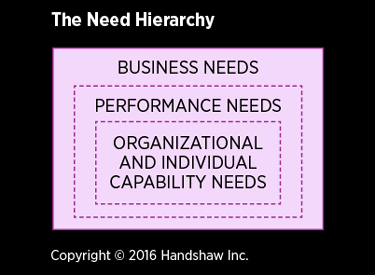
A chain of evidence is data that connect learning to doing (that's to say, performance on the job) and this performance to business results. What we know is that business results do not occur because of what people know; they move because of what people do with what they know. The figure below is a need hierarchy that illustrates what is meant by chain of evidence.
A chain of evidence is data that connect learning to doing (that's to say, performance on the job) and this performance to business results. What we know is that business results do not occur because of what people know; they move because of what people do with what they know. The figure below is a need hierarchy that illustrates what is meant by chain of evidence.
Content
[
[
Content
Prove that your learning solutions contribute to business results.
Prove that your learning solutions contribute to business results.
Content
Business needs are the highest-order needs in any organization. They are operational goals for entities such as a business function or department. These needs always are measured numerically. Increase in revenue and profits, or a decrease in quality defects, are examples.
Business needs are the highest-order needs in any organization. They are operational goals for entities such as a business function or department. These needs always are measured numerically. Increase in revenue and profits, or a decrease in quality defects, are examples.
Content
Performance needs define what people must do on the job more, better, or differently if the business needs are to be achieved. Performance is defined in behavioral, not skill, language. An example is that sales reps must identify the highest priority need of a prospect and link product features and benefits to that customer need.
Performance needs define what people must do on the job more, better, or differently if the business needs are to be achieved. Performance is defined in behavioral, not skill, language. An example is that sales reps must identify the highest priority need of a prospect and link product features and benefits to that customer need.
Content
Organizational capability needs refer to the infrastructure within an organization, including work processes, information, and incentives that are required so people can perform successfully. When these needs act as obstacles to desired performance, they must be addressed through solutions. In the example at the start of this article, two such solutions were implemented: a new marketing strategy and a redesigned sales process.
Organizational capability needs refer to the infrastructure within an organization, including work processes, information, and incentives that are required so people can perform successfully. When these needs act as obstacles to desired performance, they must be addressed through solutions. In the example at the start of this article, two such solutions were implemented: a new marketing strategy and a redesigned sales process.
Content
Individual capability needs are the skills, knowledge, and attributes that people require to perform effectively. Learning solutions are designed to address this category of need.
Individual capability needs are the skills, knowledge, and attributes that people require to perform effectively. Learning solutions are designed to address this category of need.
Content
A chain of evidence begins with identification of the business needs to be addressed. After those are determined, the next step is to identify what people must do on the job if business results are to be achieved. The final step in building this chain is to determine the root causes that prevent the type of performance that will be required. Are there organizational capability obstacles that must be addressed? Are there skills gaps that need to be closed? The answers to these questions lead to decisions made with leaders regarding the specific solutions to be implemented for the performance of people to be enhanced and business results achieved.
A chain of evidence begins with identification of the business needs to be addressed. After those are determined, the next step is to identify what people must do on the job if business results are to be achieved. The final step in building this chain is to determine the root causes that prevent the type of performance that will be required. Are there organizational capability obstacles that must be addressed? Are there skills gaps that need to be closed? The answers to these questions lead to decisions made with leaders regarding the specific solutions to be implemented for the performance of people to be enhanced and business results achieved.
Putting the chain of evidence into action
Content
There are four actions talent development professionals must take to design and communicate this chain of evidence so business results that follow a learning solution are accepted by leaders.
There are four actions talent development professionals must take to design and communicate this chain of evidence so business results that follow a learning solution are accepted by leaders.
Content
Measurement is a front-end process. The chain must be developed prior to the launch of any learning solution. Additionally, the logic within this chain needs to be communicated to, and agreed upon with, the leaders who are partners in the initiative. Waiting until the conclusion of the learning solution, as Jane did, is too late.
Measurement is a front-end process. The chain must be developed prior to the launch of any learning solution. Additionally, the logic within this chain needs to be communicated to, and agreed upon with, the leaders who are partners in the initiative. Waiting until the conclusion of the learning solution, as Jane did, is too late.
Content
Measure at all levels. In our scenario, Jane reported on Level 1 and Level 4 results. The chain is broken with this approach. What must be shared are results from:
Measure at all levels. In our scenario, Jane reported on Level 1 and Level 4 results. The chain is broken with this approach. What must be shared are results from:
Content
Level 2 (learning): Did people acquire the skills?
Level 2 (learning): Did people acquire the skills?
Content
Level 3 (performance): Are people using the skills?
Level 3 (performance): Are people using the skills?
Content
Level 4 (business): What are the results operationally?
Level 4 (business): What are the results operationally?
Content
In this way, the measurement data are reporting on results for the chain and its logic, both of which leaders have endorsed.
In this way, the measurement data are reporting on results for the chain and its logic, both of which leaders have endorsed.
Content
Multiple solutions must be implemented. What we know about human performance is that it is complex and multicaused. It is improbable that any single solution will be sufficient to change performance of people and affect business results.
Multiple solutions must be implemented. What we know about human performance is that it is complex and multicaused. It is improbable that any single solution will be sufficient to change performance of people and affect business results.
Content
Identifying the specific organizational and individual capability factors causing insufficient performance must be done prior to launching an initiative. There then needs to be a set of solutions used to address all causes. Also, when reporting results acknowledge the degree to which the nonlearning solutions were implemented successfully. If results are less than desired, these data provide information on the reasons for the disappointing outcome and what can be done to reverse the situation.
Identifying the specific organizational and individual capability factors causing insufficient performance must be done prior to launching an initiative. There then needs to be a set of solutions used to address all causes. Also, when reporting results acknowledge the degree to which the nonlearning solutions were implemented successfully. If results are less than desired, these data provide information on the reasons for the disappointing outcome and what can be done to reverse the situation.
Content
Use "contribute" and not "cause" language. Because multiple solutions are implemented, it is important to acknowledge the contribution of all solutions, not just learning. Do we need to separate the specific percentage of the results due to the investment made in learning? While that can be determined if leaders so require, my opinion is to avoid that step if possible.
Use "contribute" and not "cause" language. Because multiple solutions are implemented, it is important to acknowledge the contribution of all solutions, not just learning. Do we need to separate the specific percentage of the results due to the investment made in learning? While that can be determined if leaders so require, my opinion is to avoid that step if possible.
Content
Consider an airplane: Does it take flight because it has wings or because it has an engine? Which is most important, and does it matter? The goal is to get a win and to know that the investment made in learning was a key contributor to that win.
Consider an airplane: Does it take flight because it has wings or because it has an engine? Which is most important, and does it matter? The goal is to get a win and to know that the investment made in learning was a key contributor to that win.
Content
Learning solutions can and do contribute to business results. We know that leaders seek this information from investments made in learning. It is up to us, as talent development professionals, to partner with leaders to form and agree on the chain of evidence for a specific situation. Then our measurement data will be viewed as credible and authentic.
Learning solutions can and do contribute to business results. We know that leaders seek this information from investments made in learning. It is up to us, as talent development professionals, to partner with leaders to form and agree on the chain of evidence for a specific situation. Then our measurement data will be viewed as credible and authentic.
Content
Read more from ]( https://files.astd.org/CTDO-Images/Fall2016/ProveltSB1-L.png ) CTDO magazine : Essential talent development content for C-suite leaders.
Read more from](https://files.astd.org/CTDO-Images/Fall2016/ProveltSB1-L.png) CTDO magazine: Essential talent development content for C-suite leaders.