ATD, association for talent development

CTDO Magazine Article

Change Is Exhausting

Content

To thrive in spite of increased change, first learn to lead yourself through it and then lead others.

To thrive in spite of increased change, first learn to lead yourself through it and then lead others.

By

Fri Jan 14 2022

Change Is Exhausting
Loading...

Content

We've had ample opportunity the past two years to practice leading ourselves through change. According to the 2020 Gartner Employee Change Impact Model Survey, on average employees face 39 changes per year, and that number is expected to keep rising.

We've had ample opportunity the past two years to practice leading ourselves through change. According to the 2020 Gartner Employee Change Impact Model Survey, on average employees face 39 changes per year, and that number is expected to keep rising.

Content

Yet, despite all that practice, people aren't getting better at leading through change. That's because as a society we are change fatigued. And that fatigue is slowing us down.

Yet, despite all that practice, people aren't getting better at leading through change. That's because as a society we are change fatigued. And that fatigue is slowing us down.

Content

The combination of increased change and a less change-resilient workforce means leaders must prioritize building enterprise change capabilities to resolve change fatigue now and for the future.

The combination of increased change and a less change-resilient workforce means leaders must prioritize building enterprise change capabilities to resolve change fatigue now and for the future.

Move to a holistic approach

Content

You may want to turn to traditional change management applications, such as deploying a team of change management practitioners to help support employees through organizational changes. With 40-plus changes expected this year, applying a traditional approach would mean that the company is providing some level of change management support on dozens of unique projects or situations to help large groups of stakeholders adopt each one.

You may want to turn to traditional change management applications, such as deploying a team of change management practitioners to help support employees through organizational changes. With 40-plus changes expected this year, applying a traditional approach would mean that the company is providing some level of change management support on dozens of unique projects or situations to help large groups of stakeholders adopt each one.

Content

The problem: That doesn't build the individual or organizational muscle required to thrive in current and future environments. It won't help employees navigate the type of change that is fatiguing them: the day-to-day adjustments versus larger disruptive changes.

The problem: That doesn't build the individual or organizational muscle required to thrive in current and future environments. It won't help employees navigate the type of change that is fatiguing them: the day-to-day adjustments versus larger disruptive changes.

Content

The traditional approach is too singular and isolated to help an organizational system thrive. It's focused on making a single change successful—not on how the overall company is performing through all those changes collectively. Nor does it mature organizational change capability.

The traditional approach is too singular and isolated to help an organizational system thrive. It's focused on making a single change successful—not on how the overall company is performing through all those changes collectively. Nor does it mature organizational change capability.

Content

To truly build staff's capability with change, reimagine the change management strategy to focus on how the company is responding to ongoing change holistically. That involves looking at all the change management fundamentals differently, including who is accountable for driving change, the methodology in use, the way change is measured, the models for driving change, the mindsets around and the application of change, the goal of change management, and the tools and assessments used.

To truly build staff's capability with change, reimagine the change management strategy to focus on how the company is responding to ongoing change holistically. That involves looking at all the change management fundamentals differently, including who is accountable for driving change, the methodology in use, the way change is measured, the models for driving change, the mindsets around and the application of change, the goal of change management, and the tools and assessments used.

Content

How do you begin to make that transition from a singular to holistic approach? Think about the traditional change management fundamentals within four areas—individual change competency, leader change competency, initiative change support, and evidence-based enterprise change capability—and mature those areas.
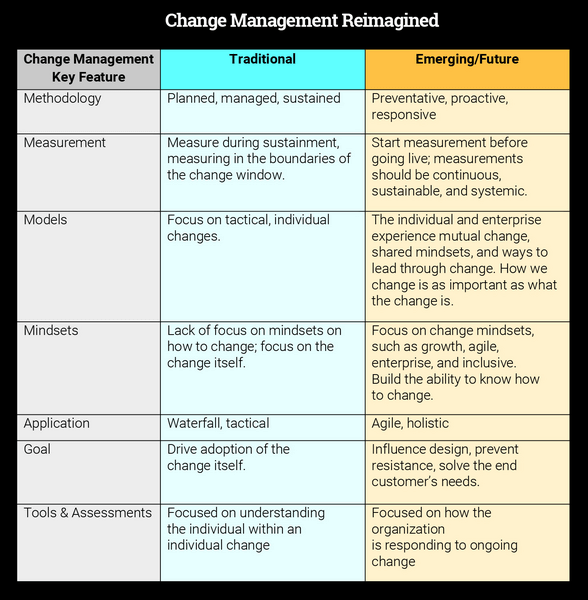
How do you begin to make that transition from a singular to holistic approach? Think about the traditional change management fundamentals within four areas—individual change competency, leader change competency, initiative change support, and evidence-based enterprise change capability—and mature those areas.

Change Is Exhausting-AngstIndex_Chart_Winter22CTDO.jpg

Individual change competency

Content

A critical first step in building this competency is having an organizational expectation that it is an employee's job or role to help the business succeed in spite of change.

A critical first step in building this competency is having an organizational expectation that it is an employee's job or role to help the business succeed in spite of change.

Content

Often, leadership teams believe they are accountable for compelling employees to get on board with required change. That cultural attribute slows organizational progress because it is time-consuming. Instead, instill a culture of change where employees are held accountable for helping the organization adjust as quickly as possible.

Often, leadership teams believe they are accountable for compelling employees to get on board with required change. That cultural attribute slows organizational progress because it is time-consuming. Instead, instill a culture of change where employees are held accountable for helping the organization adjust as quickly as possible.

Content

That shifts the employee's perspective from "What's in it for me—convince me I should do this" to "What is my role in making the organization succeed, and how can I help?" To develop this culture, invest in employees' ability to lead themselves through change.

That shifts the employee's perspective from "What's in it for me—convince me I should do this" to "What is my role in making the organization succeed, and how can I help?" To develop this culture, invest in employees' ability to lead themselves through change.

Content

That is a critical organizational advantage, and you can accomplish that by having a shared set of models to lead through change.

That is a critical organizational advantage, and you can accomplish that by having a shared set of models to lead through change.

Content

When everyone is using the same model to lead themselves through change, they form a shared lexicon, which makes helping each other through change far easier. Employees who know what to do can diagnose their own resistance and apply tactics to get past their sticking points. And because everyone speaks the same change language, colleagues can help each other identify tactics to overcome their sticking point.

When everyone is using the same model to lead themselves through change, they form a shared lexicon, which makes helping each other through change far easier. Employees who know what to do can diagnose their own resistance and apply tactics to get past their sticking points. And because everyone speaks the same change language, colleagues can help each other identify tactics to overcome their sticking point.

Content

Takeaway : Having a shared model for how individuals move through change is essential. That will translate into a shared language, which translates into building capability as well as culture of self-accountability to lead through change.

Takeaway: Having a shared model for how individuals move through change is essential. That will translate into a shared language, which translates into building capability as well as culture of self-accountability to lead through change.

Leader change competency

Content

Once you've developed a culture of change, you must—as a leader—sustain it. Do that by being an expert at leading yourself through change and serving as a trusted coach for leading others through it.

Once you've developed a culture of change, you must—as a leader—sustain it. Do that by being an expert at leading yourself through change and serving as a trusted coach for leading others through it.

Content

It's no longer adequate to simply create and manage a plan to sustain the change. You must be savvier and more iterative.

It's no longer adequate to simply create and manage a plan to sustain the change. You must be savvier and more iterative.

Content

That starts with being preventative. Do your best to prevent resistance from ever occurring by knowing your team members, predicting the aspects of a change that may cause resistance, and neutralizing that resistance before it can materialize.

That starts with being preventative. Do your best to prevent resistance from ever occurring by knowing your team members, predicting the aspects of a change that may cause resistance, and neutralizing that resistance before it can materialize.

Content

For example, when rolling out a new technology that will automate portions of employees' jobs, employees may feel uncertain about their future. Neutralize that fear by showing that the automation will free up their time to be more strategic in other areas.

For example, when rolling out a new technology that will automate portions of employees' jobs, employees may feel uncertain about their future. Neutralize that fear by showing that the automation will free up their time to be more strategic in other areas.

Content

Explain how that enables them to grow and advance their skills in new ways. Show them how their role positively changes as a result of the new technology. Such communications will enable individuals to move through the change more quickly.

Explain how that enables them to grow and advance their skills in new ways. Show them how their role positively changes as a result of the new technology. Such communications will enable individuals to move through the change more quickly.

Content

Next, be proactive—check in with staff to see how the change process is going and serving as partner, coach, and resistance manager as necessary.

Next, be proactive—check in with staff to see how the change process is going and serving as partner, coach, and resistance manager as necessary.

Content

If you employ the traditional manage-through-change tactic, you put yourself in charge of leading others through change. A proactive change stance creates a partnership between you and employees, with staff responsible for opting in and helping the organization succeed.

If you employ the traditional manage-through-change tactic, you put yourself in charge of leading others through change. A proactive change stance creates a partnership between you and employees, with staff responsible for opting in and helping the organization succeed.

Content

Finally, take a responsive approach and drive change adoption faster. That means that you and the organization share a goal of mutual influence over solution design to jointly solve customers' needs.

Finally, take a responsive approach and drive change adoption faster. That means that you and the organization share a goal of mutual influence over solution design to jointly solve customers' needs.

Content

When leaders design change collectively with those closest to the problem, they generally more efficiently adopt solutions. And employees will follow suit.

When leaders design change collectively with those closest to the problem, they generally more efficiently adopt solutions. And employees will follow suit.

Content

Takeaway : Even with an expectation that employees are accountable for leading themselves through change, you have a responsibility to partner with them in the process. You must see around corners and help prevent any possible resistance in the first place. Using the same change lexicon of how to move through change greatly helps the process.

Takeaway: Even with an expectation that employees are accountable for leading themselves through change, you have a responsibility to partner with them in the process. You must see around corners and help prevent any possible resistance in the first place. Using the same change lexicon of how to move through change greatly helps the process.

Content

Proactively assist staff through the process and respond to employees by incorporating their voices in solution design and continuous solution improvement to solve customers' needs. The current paradigm of plan, manage, and sustain is far too static for today's rapidly changing landscape.

Proactively assist staff through the process and respond to employees by incorporating their voices in solution design and continuous solution improvement to solve customers' needs. The current paradigm of plan, manage, and sustain is far too static for today's rapidly changing landscape.

Initiative change support 

Content

For strategic, disruptive change, lean on your change management practitioner for support. That individual is an essential component to achieving evidence-based enterprise change capability.

For strategic, disruptive change, lean on your change management practitioner for support. That individual is an essential component to achieving evidence-based enterprise change capability.

Content

Initiative change support capitalizes on the change management practitioner's behavioral science expertise to apply the preventative, proactive, and responsive approach to an initiative to eliminate as much resistance as possible. They can use keen predictive methods and insights to help you design adoptable solutions.

Initiative change support capitalizes on the change management practitioner's behavioral science expertise to apply the preventative, proactive, and responsive approach to an initiative to eliminate as much resistance as possible. They can use keen predictive methods and insights to help you design adoptable solutions.

Content

Ensure your change management practitioner has a seat at the table during solution design. They should be responsible for knowing the end-user population so well that they can predict, or know by fact, what could cause resistance and loss of productivity, and they should present a solution to avoid that scenario. That approach aligns much better with agile and holistic solution design methods than traditional waterfall approaches** . **

Ensure your change management practitioner has a seat at the table during solution design. They should be responsible for knowing the end-user population so well that they can predict, or know by fact, what could cause resistance and loss of productivity, and they should present a solution to avoid that scenario. That approach aligns much better with agile and holistic solution design methods than traditional waterfall approaches**.**

Content

Measurement also takes center stage in initiative change support. The change management practitioner is responsible for achieving the results that are dependent on human adoption of the solution. The measures should not only include the project's dimensions but the impact the project is having on the company.

Measurement also takes center stage in initiative change support. The change management practitioner is responsible for achieving the results that are dependent on human adoption of the solution. The measures should not only include the project's dimensions but the impact the project is having on the company.

Content

In most organizations, there isn't a clear-cut way to measure human adoption of projects, and change metrics are only captured during the project's sustainment window. Today's change environment requires measurement before you start a project, and that should be continuous, systemic, and sustainable as long as the change is in place.

In most organizations, there isn't a clear-cut way to measure human adoption of projects, and change metrics are only captured during the project's sustainment window. Today's change environment requires measurement before you start a project, and that should be continuous, systemic, and sustainable as long as the change is in place.

Content

The moment you stop measuring the change is the moment you and the company will lose sight over whether the change is still effective.

The moment you stop measuring the change is the moment you and the company will lose sight over whether the change is still effective.

Content

Takeaway : Support from the change management practitioner is critical for strategically important and disruptive change to help everyone successfully thrive through change. Agile approaches serve the organization better because they enable faster learning and responsiveness than traditional waterfall approaches.

Takeaway: Support from the change management practitioner is critical for strategically important and disruptive change to help everyone successfully thrive through change. Agile approaches serve the organization better because they enable faster learning and responsiveness than traditional waterfall approaches.

Content

Holistic measures are important to understand success within the change itself. Roll them up with metrics from other projects to compile an enterprise view of how the business is responding to ongoing change.

Holistic measures are important to understand success within the change itself. Roll them up with metrics from other projects to compile an enterprise view of how the business is responding to ongoing change.

Evidence-based enterprise change capability

Content

Achieving enterprise change capability is truly a strategic differentiator. Organizations with that level of maturity can outpace their competition because they can take on a greater amount of change more quickly and successfully than others.

Achieving enterprise change capability is truly a strategic differentiator. Organizations with that level of maturity can outpace their competition because they can take on a greater amount of change more quickly and successfully than others.

Content

Determine whether your company is getting better at change, increasing capacity for it, and increasing the velocity of the change the business can successfully take on while decreasing loss of productivity through change. Initiative-based change management practitioners are a key source of those analytics.

Determine whether your company is getting better at change, increasing capacity for it, and increasing the velocity of the change the business can successfully take on while decreasing loss of productivity through change. Initiative-based change management practitioners are a key source of those analytics.

Content

Data such as stakeholder disruption, the quality of change leadership and sponsorship, the available capacity stakeholders have to take on the change, and whether the change itself is successful show how the company is responding to ongoing change and the required pace of change.

Data such as stakeholder disruption, the quality of change leadership and sponsorship, the available capacity stakeholders have to take on the change, and whether the change itself is successful show how the company is responding to ongoing change and the required pace of change.

Content

Takeaway : Gathering data from each change and rolling it all up to an enterprise view will enable you and the business to make better decisions around how and when to deploy change. Further, it enables you to understand where you need to improve elements of organizational change competency.

Takeaway: Gathering data from each change and rolling it all up to an enterprise view will enable you and the business to make better decisions around how and when to deploy change. Further, it enables you to understand where you need to improve elements of organizational change competency.

Join forces with other leaders

Content

Maturing change capability is a necessity for any organization to leapfrog its competition and thrive through planned and unplanned change. And the C-suite must ensure organizations rise to the occasion of succeeding through change. CEOs, together with chief operating officers, set the pace of change and establish the culture of change and accountability of self-leadership through it.

Maturing change capability is a necessity for any organization to leapfrog its competition and thrive through planned and unplanned change. And the C-suite must ensure organizations rise to the occasion of succeeding through change. CEOs, together with chief operating officers, set the pace of change and establish the culture of change and accountability of self-leadership through it.

Content

Work with your HR leadership team to ensure there is individual competency in self-leadership through change and leader competency in leading others through change.

Work with your HR leadership team to ensure there is individual competency in self-leadership through change and leader competency in leading others through change.

Content

Chief administrative officers, chief risk officers, and chief financial officers together with the head of change management ensure excellent change management application through practitioners by standardizing enterprise methodology and measurement. Collectively, C-suite leaders monitor how the business is responding to ongoing change and employ evidence-based enterprise data on change to inform their decisions.

Chief administrative officers, chief risk officers, and chief financial officers together with the head of change management ensure excellent change management application through practitioners by standardizing enterprise methodology and measurement. Collectively, C-suite leaders monitor how the business is responding to ongoing change and employ evidence-based enterprise data on change to inform their decisions.

Content

Read more from CTDO magazine : Essential talent development content for C-suite leaders.

Read more from CTDO magazine: Essential talent development content for C-suite leaders.

You've Reached ATD Member-only Content

Become an ATD member to continue

Already a member?Sign In


Copyright © 2026 ATD

ASTD changed its name to ATD to meet the growing needs of a dynamic, global profession.

Terms of UsePrivacy NoticeCookie Policy