
CTDO Magazine Article
Customer Service Training Pays Dividends
Content
Prove the value of customer service training.
Prove the value of customer service training.
Mon Jun 17 2019
Content
Discover the secrets to implementing customer service training and measuring ROI.
Discover the secrets to implementing customer service training and measuring ROI.
Content
Talent management and skills training are the lifeblood of an organization’s ability to achieve and sustain long-term success, especially because these affect the customer experience and customer retention. To proactively manage the customer experience and retention, customer service training requires relevant and transparent metrics (leading and lagging indicators of success), executive sponsorship, and the ability to communicate the return on investment (ROI).
Talent management and skills training are the lifeblood of an organization’s ability to achieve and sustain long-term success, especially because these affect the customer experience and customer retention. To proactively manage the customer experience and retention, customer service training requires relevant and transparent metrics (leading and lagging indicators of success), executive sponsorship, and the ability to communicate the return on investment (ROI).
Content
While a fundamental core process for every organization is delivering excellent customer service, not all of them succeed in this. Failure to do so results in significant customer frustration, high costs, low employee morale, and a poor reputation. But when an organization is results-driven and customer-centric, the customers benefit by receiving value for their purchases and a great experience.
While a fundamental core process for every organization is delivering excellent customer service, not all of them succeed in this. Failure to do so results in significant customer frustration, high costs, low employee morale, and a poor reputation. But when an organization is results-driven and customer-centric, the customers benefit by receiving value for their purchases and a great experience.
Content
Some of the largest and most creative companies in the world have mastered this concept. These companies constantly invest in their customer service people, processes, and technologies. They invest in customer service and problem-solving training and monitor performance in real time so that they achieve a positive ROI from these efforts.
Some of the largest and most creative companies in the world have mastered this concept. These companies constantly invest in their customer service people, processes, and technologies. They invest in customer service and problem-solving training and monitor performance in real time so that they achieve a positive ROI from these efforts.
Content
So, what’s their secret?
So, what’s their secret?
Content
Initially, organizations need a competency-based recruitment and selection process for a high-caliber customer service team. Additionally, to achieve a great customer-oriented culture, organizations need a robust blended learning and training program based on six components:
Initially, organizations need a competency-based recruitment and selection process for a high-caliber customer service team. Additionally, to achieve a great customer-oriented culture, organizations need a robust blended learning and training program based on six components:
Content
customer service and problem-solving training competencies
customer service and problem-solving training competencies
Content
on-the-job application tools and feedback to reinforce best practices
on-the-job application tools and feedback to reinforce best practices
Content
executive sponsorship and change management to support the program
executive sponsorship and change management to support the program
Content
specific measurement of customer service and problem-solving performance
specific measurement of customer service and problem-solving performance
Content
calculation of training ROI
calculation of training ROI
Content
communication vehicles.
communication vehicles.
Content
Let’s look at each of these more closely.
Let’s look at each of these more closely.
Customer service best practices
Content
Several best practices will ensure an effective customer service and problem-solving training program. An instructor-led, blended learning model—either face-to-face or in the virtual classroom—strengthens employee commitment to outcomes because it reinforces expectations and performance measures. Adopting a modularized approach allows for short, focused training sessions on specific behaviors and skills, which are reinforced with learning elements, including short videos, articles, infographics, and podcasts. Post-session reinforcement tools increase how much the training information sticks with participants—for example, using a performance support tool to apply the skills developed in the course to on-the-job problems or using a feedback mechanism so participants can report on the outcomes of their action plans.
Several best practices will ensure an effective customer service and problem-solving training program. An instructor-led, blended learning model—either face-to-face or in the virtual classroom—strengthens employee commitment to outcomes because it reinforces expectations and performance measures. Adopting a modularized approach allows for short, focused training sessions on specific behaviors and skills, which are reinforced with learning elements, including short videos, articles, infographics, and podcasts. Post-session reinforcement tools increase how much the training information sticks with participants—for example, using a performance support tool to apply the skills developed in the course to on-the-job problems or using a feedback mechanism so participants can report on the outcomes of their action plans.
Content
Take, for instance, the operations team at a major hotel that realized that, while it had successfully oriented and trained its call center and customer-facing staff in the technical systems required to deliver service in the hotel’s multiple global locations, the team had failed to develop the staff’s interpersonal skills necessary to create strong customer experiences. To correct this, the team redesigned its two-week orientation program to include a focus on the nontechnical aspects of delivering a high-quality customer experience: understanding styles and preferences, listening actively, empathizing with customers, taking appropriate action, owning the customer’s problem and taking it to successful resolution, and responding constructively in emotional situations. Customer surveys reflected increased satisfaction with the quality of service delivered.
Take, for instance, the operations team at a major hotel that realized that, while it had successfully oriented and trained its call center and customer-facing staff in the technical systems required to deliver service in the hotel’s multiple global locations, the team had failed to develop the staff’s interpersonal skills necessary to create strong customer experiences. To correct this, the team redesigned its two-week orientation program to include a focus on the nontechnical aspects of delivering a high-quality customer experience: understanding styles and preferences, listening actively, empathizing with customers, taking appropriate action, owning the customer’s problem and taking it to successful resolution, and responding constructively in emotional situations. Customer surveys reflected increased satisfaction with the quality of service delivered.
Change management plans
Content
Training is only one piece of the puzzle. Change management is another critical component, because the more employees understand how the changes will enable them to better serve customers, the more they will embrace the change.
Training is only one piece of the puzzle. Change management is another critical component, because the more employees understand how the changes will enable them to better serve customers, the more they will embrace the change.
Content
Change management best practices that executives implement for great customer service training include:
Change management best practices that executives implement for great customer service training include:
Content
setting a vision and communicating a vivid picture of the future state
setting a vision and communicating a vivid picture of the future state
Content
focusing on the levers with the greatest impact on customer service outcomes
focusing on the levers with the greatest impact on customer service outcomes
Content
setting a positive environment for discussing what is going well and what is not
setting a positive environment for discussing what is going well and what is not
Content
ensuring change management is constantly managed from beginning to end.
ensuring change management is constantly managed from beginning to end.
Content
Every change effort also requires engaging early adopters and skeptics. Many skeptics ascribe to the “show me” mantra. To ensure as many individuals join the cause as possible, one of the best strategies is to leverage performance data.
Every change effort also requires engaging early adopters and skeptics. Many skeptics ascribe to the “show me” mantra. To ensure as many individuals join the cause as possible, one of the best strategies is to leverage performance data.
Measuring customer service and problem-solving performance
Content
Scottish physicist Lord Kelvin said, “What gets measured gets managed.” He understood that by monitoring performance levels, you can better identify when to improve them. On the other hand, a lack of measurement is a clear indication of avoidance, denial, and—eventually—undesired surprises, often when it is too late to make improvements.
Scottish physicist Lord Kelvin said, “What gets measured gets managed.” He understood that by monitoring performance levels, you can better identify when to improve them. On the other hand, a lack of measurement is a clear indication of avoidance, denial, and—eventually—undesired surprises, often when it is too late to make improvements.
Content
Several qualitative and quantitative performance metrics exist to measure the effectiveness of a customer service training program. For example, outcome measures focus on long-term organizational objectives that answer the question: What accomplishments will define our success? These are lagging indicators of success and represent a historical or rear-view mirror look at what occurred in the past. Typical outcome measures include revenue, profit, market share, customer satisfaction, customer satisfaction, and employee engagement.
Several qualitative and quantitative performance metrics exist to measure the effectiveness of a customer service training program. For example, outcome measures focus on long-term organizational objectives that answer the question: What accomplishments will define our success? These are lagging indicators of success and represent a historical or rear-view mirror look at what occurred in the past. Typical outcome measures include revenue, profit, market share, customer satisfaction, customer satisfaction, and employee engagement.
Content
On the other hand, process measures focus on short-term results that answer the question: What will gauge our progress toward our key goals? These are leading indicators of success and represent a present state or front windshield view of what is occurring in the present. Typical process measures include cost, quality, and time—of how effectively a given work process is functioning, especially from the customer’s point of view of that process.
On the other hand, process measures focus on short-term results that answer the question: What will gauge our progress toward our key goals? These are leading indicators of success and represent a present state or front windshield view of what is occurring in the present. Typical process measures include cost, quality, and time—of how effectively a given work process is functioning, especially from the customer’s point of view of that process.
Content
Process measures answer the question: What will show us that we are doing the routine work well? Consider these as the daily and weekly performance measures, such as customer call wait times, customer delivery process times, customer complaints resolution times, and service quality.
Process measures answer the question: What will show us that we are doing the routine work well? Consider these as the daily and weekly performance measures, such as customer call wait times, customer delivery process times, customer complaints resolution times, and service quality.
Customer service scorecards
Content
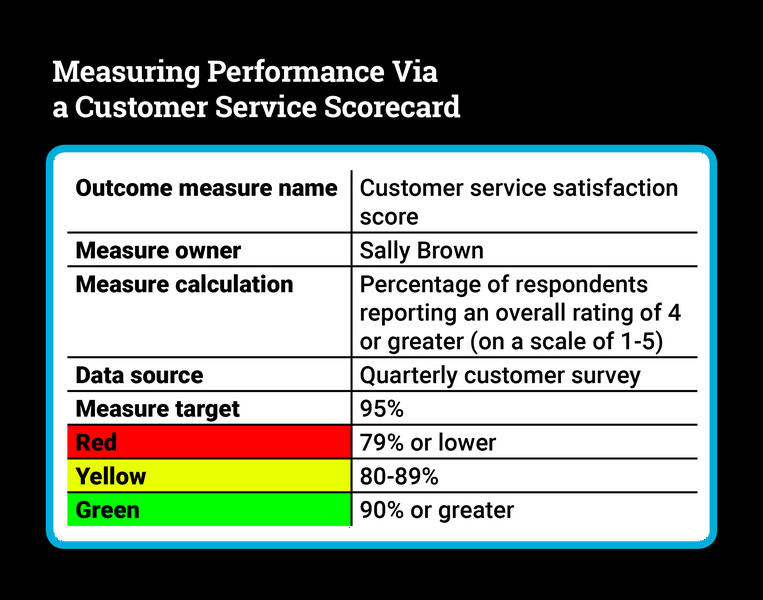
Data are the foundation for results-driven organizations by which executives can immediately determine whether their organization is meeting its outcome and process performance measures. By monitoring performance thresholds (typically as red, yellow, or green status), performance constraints are in plain sight and drive executives to prioritize mitigation efforts in near real time while they still have time to intervene in a meaningful way. This is the power of data-driven organizations that all executives strive for.
Data are the foundation for results-driven organizations by which executives can immediately determine whether their organization is meeting its outcome and process performance measures. By monitoring performance thresholds (typically as red, yellow, or green status), performance constraints are in plain sight and drive executives to prioritize mitigation efforts in near real time while they still have time to intervene in a meaningful way. This is the power of data-driven organizations that all executives strive for.
Content
Note that each organization determines its thresholds for red, yellow, or green status based on a desired improvement target. The figure below is an example of how one customer service organization measures performance status:
Note that each organization determines its thresholds for red, yellow, or green status based on a desired improvement target. The figure below is an example of how one customer service organization measures performance status:
Content
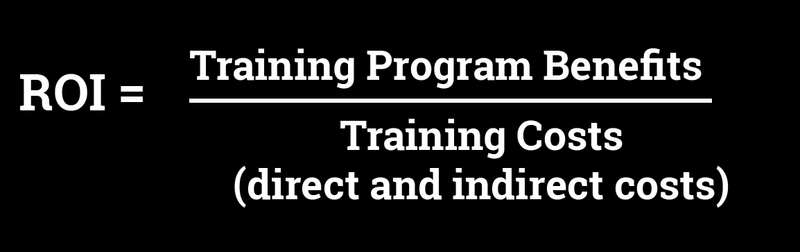
Calculating training ROI. Once the outcome and process measures of customer service and problem-solving performance measures are defined, you can determine the benefit-cost ratio, which is also the ROI:
Calculating training ROI. Once the outcome and process measures of customer service and problem-solving performance measures are defined, you can determine the benefit-cost ratio, which is also the ROI:
Content
Training program benefits are increased organizational revenue, decreased staff labor, and reduced expenses from prolonged processing cycles and waste. And the training costs—both direct and indirect—are program customization, the facilitator’s time, materials, program participants’ time, and solution implementation costs.
Training program benefits are increased organizational revenue, decreased staff labor, and reduced expenses from prolonged processing cycles and waste. And the training costs—both direct and indirect—are program customization, the facilitator’s time, materials, program participants’ time, and solution implementation costs.
Content
Consider this outstanding example of how a public sector agency achieved great strides in improving its customer service levels through targeted problem-solving steps with a measurable ROI.
Consider this outstanding example of how a public sector agency achieved great strides in improving its customer service levels through targeted problem-solving steps with a measurable ROI.
Content
Improving customer service in the public sector is paramount to more effectively using taxpayer dollars to improve citizen outcomes. At one public agency’s quarterly business review, the scorecard indicated that 41 percent of new applications were taking more than 60 days to complete. These long delays meant that citizens had to wait more than two months to qualify for rehabilitation and job training services needed to secure employment. Within the first 90 days of customer service problem-solving training, the number of applications taking longer than 60 days was reduced to zero. The number of days from application to eligibility was reduced from an average of 51 days to an average of 21 days. The ROI for this project was calculated at 30 percent.
Improving customer service in the public sector is paramount to more effectively using taxpayer dollars to improve citizen outcomes. At one public agency’s quarterly business review, the scorecard indicated that 41 percent of new applications were taking more than 60 days to complete. These long delays meant that citizens had to wait more than two months to qualify for rehabilitation and job training services needed to secure employment. Within the first 90 days of customer service problem-solving training, the number of applications taking longer than 60 days was reduced to zero. The number of days from application to eligibility was reduced from an average of 51 days to an average of 21 days. The ROI for this project was calculated at 30 percent.
Content
Ultimately, customers benefit from a results-driven organization. Customer service is all about meeting the customers’ needs, and an organization that embraces continuous improvement will be in an excellent position to transfer that ability to solving the customer problems while demonstrating a strong ROI.
Ultimately, customers benefit from a results-driven organization. Customer service is all about meeting the customers’ needs, and an organization that embraces continuous improvement will be in an excellent position to transfer that ability to solving the customer problems while demonstrating a strong ROI.
Communication vehicles
Content
After you have calculated the customer service and problem-solving ROI, communicate these benefits through three communication vehicles. Daily and weekly visual huddle boards are the most critical measures using charts and graphs. They constantly remind everyone what’s important to measure. They close the loop between planning, accountability, and performance while accelerating the change management process and ROI calculations.
After you have calculated the customer service and problem-solving ROI, communicate these benefits through three communication vehicles. Daily and weekly visual huddle boards are the most critical measures using charts and graphs. They constantly remind everyone what’s important to measure. They close the loop between planning, accountability, and performance while accelerating the change management process and ROI calculations.
Content
Next are the monthly and quarterly business reviews, which are safe, open forums to transparently assess progress. During these business reviews, customer service successes are celebrated and challenges are identified and prioritized for problem-solving actions, which leverage the customer service competencies and training expectations previously set forth.
Next are the monthly and quarterly business reviews, which are safe, open forums to transparently assess progress. During these business reviews, customer service successes are celebrated and challenges are identified and prioritized for problem-solving actions, which leverage the customer service competencies and training expectations previously set forth.
Content
Finally, everyone within the organization must be willing to operate in a data-driven, customer-focused, and results-oriented culture. Executives must implement a customer-centric management system that enables Lean concepts. Their management system must include software that helps manage and continually communicate measures, projects, and documents (rather than be hidden in spreadsheets seen by just a few employees). It also includes powerful ways to analyze data, create interactive visuals and dashboards, and connect to a variety of data sources. The ideal system is cloud-based, user-friendly, and uses a software-as-a-service model.
Finally, everyone within the organization must be willing to operate in a data-driven, customer-focused, and results-oriented culture. Executives must implement a customer-centric management system that enables Lean concepts. Their management system must include software that helps manage and continually communicate measures, projects, and documents (rather than be hidden in spreadsheets seen by just a few employees). It also includes powerful ways to analyze data, create interactive visuals and dashboards, and connect to a variety of data sources. The ideal system is cloud-based, user-friendly, and uses a software-as-a-service model.
Content
As the sponsors of training investments, executives are accountable for knowing and communicating the financial benefits and impact on customer retention. Several measurement communication tools are available to executives, and the most significant ones provide a high degree of accountability and transparency, which reinforce the need for an outstanding customer service culture to all employees.
As the sponsors of training investments, executives are accountable for knowing and communicating the financial benefits and impact on customer retention. Several measurement communication tools are available to executives, and the most significant ones provide a high degree of accountability and transparency, which reinforce the need for an outstanding customer service culture to all employees.
Content
Read more from CTDO magazine : Essential talent development content for C-suite leaders.
Read more from CTDO magazine: Essential talent development content for C-suite leaders.