ATD, association for talent development

CTDO Magazine Article

Don't Overlook Accessibility in E-Learning

Content

As online learning expands, organizations need to adapt courses for all learning.

As online learning expands, organizations need to adapt courses for all learning.

By

Thu Oct 15 2020

Don't Overlook Accessibility in E-Learning
Loading...

Content

As online learning expands, organizations need to adapt courses for all learners.

As online learning expands, organizations need to adapt courses for all learners.

Content

In response to the global COVID-19 pandemic and its accompanying social distancing guidelines, many organizations have had to bring more learning online, converting traditional classroom training into self-paced e-learning and live virtual classroom formats. And while those efforts have enabled many employees to continue learning amid extraordinary circumstances, companies may be leaving out some learners.

In response to the global COVID-19 pandemic and its accompanying social distancing guidelines, many organizations have had to bring more learning online, converting traditional classroom training into self-paced e-learning and live virtual classroom formats. And while those efforts have enabled many employees to continue learning amid extraordinary circumstances, companies may be leaving out some learners.

Content

According to the Association for Talent Development’s E-Learning: The Evolving Landscape report , 26 percent of organizations do not make accessibility considerations in their e-learning programs for individuals with disabilities.

According to the Association for Talent Development’s E-Learning: The Evolving Landscape  report, 26 percent of organizations do not make accessibility considerations in their e-learning programs for individuals with disabilities.

Content

The consequences should worry talent development leaders. As accessibility expert Maureen Orey, president and founder of Workplace Learning and Performing Group, commented in an interview for the report, failing to make sufficient accessibility accommodations—which she defines as those that account for auditory, visual, physical, and cognitive access needs—can lead to “unintentional discrimination” against certain groups of employees. Further, talent development professionals who fail to emphasize accessibility are missing an important opportunity to make their e-learning—and therefore their entire functions—more effective.

The consequences should worry talent development leaders. As accessibility expert Maureen Orey, president and founder of Workplace Learning and Performing Group, commented in an interview for the report, failing to make sufficient accessibility accommodations—which she defines as those that account for auditory, visual, physical, and cognitive access needs—can lead to “unintentional discrimination” against certain groups of employees. Further, talent development professionals who fail to emphasize accessibility are missing an important opportunity to make their e-learning—and therefore their entire functions—more effective.

Content

According to the report, when companies make at least one accessibility design consideration in e-learning programs, they increase their likelihood of being a high-performing organization or an organization that is doing well across several key business areas and has a talent development function that makes a strong contribution to business performance.

According to the report, when companies make at least one accessibility design consideration in e-learning programs, they increase their likelihood of being a high-performing organization or an organization that is doing well across several key business areas and has a talent development function that makes a strong contribution to business performance.

Content

The effect was statistically significant at a level of p < 0.01, which implies that there was a less than a 1 percent probability that it appeared in the research because of chance. What’s more, the connection became stronger as organizations further committed to providing accessible e-learning.

The effect was statistically significant at a level of p < 0.01, which implies that there was a less than a 1 percent probability that it appeared in the research because of chance. What’s more, the connection became stronger as organizations further committed to providing accessible e-learning.

Content

Companies that participated in the report and made all or nearly all the accessibility considerations identified for the research (see figure for some features) were more likely to be high performers than those that only made a few of the considerations. That was also statistically significant at level of p < 0.01.
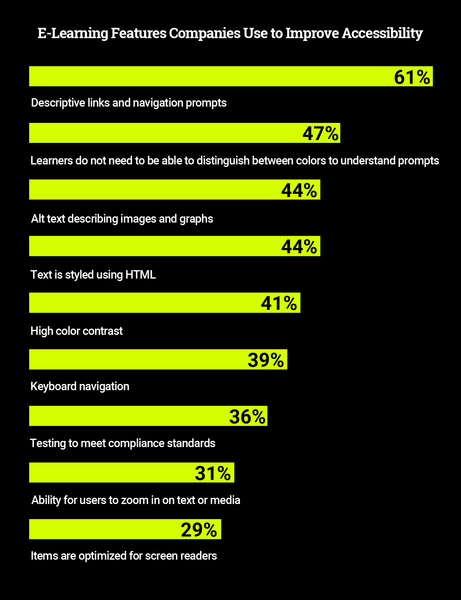
Companies that participated in the report and made all or nearly all the accessibility considerations identified for the research (see figure for some features) were more likely to be high performers than those that only made a few of the considerations. That was also statistically significant at level of p < 0.01.

Don't Overlook Accessibility in E-Learning-snapshotchart.jpg

Content

source: E-Learning: The Evolving Landscape , Association for Talent Development, 2020

source: E-Learning: The Evolving Landscape, Association for Talent Development, 2020

Content

For Orey, accessibility’s capacity to provide value beyond its primary audience explains the relationship between incorporating it into e-learning and being a high-performing organization. To illustrate her point, Orey compared the decision to provide accessible e-learning to the 1990s when the Americans with Disabilities Act started requiring all sidewalks in the US to have curb cuts (concrete ramps from the sidewalk to the streets).

For Orey, accessibility’s capacity to provide value beyond its primary audience explains the relationship between incorporating it into e-learning and being a high-performing organization. To illustrate her point, Orey compared the decision to provide accessible e-learning to the 1990s when the Americans with Disabilities Act started requiring all sidewalks in the US to have curb cuts (concrete ramps from the sidewalk to the streets).

Content

“That was designed for people in wheelchairs, but it really gave any pedestrian who had to deal with wheels—such as mothers with strollers and beer delivery guys—better access to the sidewalk,” she said.

“That was designed for people in wheelchairs, but it really gave any pedestrian who had to deal with wheels—such as mothers with strollers and beer delivery guys—better access to the sidewalk,” she said.

Content

Similarly, closed captioning in e-learning may be targeted to employees who are hearing impaired, but other learners will take advantage of and benefit from being able to read spoken dialogue in a video. As Orey noted, “Tools designed to benefit one audience will benefit everyone.”

Similarly, closed captioning in e-learning may be targeted to employees who are hearing impaired, but other learners will take advantage of and benefit from being able to read spoken dialogue in a video. As Orey noted, “Tools designed to benefit one audience will benefit everyone.”

Content

Read more from CTDO magazine : Essential talent development content for C-suite leaders.

Read more from CTDO magazine: Essential talent development content for C-suite leaders.

You've Reached ATD Member-only Content

Become an ATD member to continue

Already a member?Sign In


Copyright © 2026 ATD

ASTD changed its name to ATD to meet the growing needs of a dynamic, global profession.

Terms of UsePrivacy NoticeCookie Policy