
CTDO Magazine Article
Get Ready for the Learners of the Future
Content
Organizational learning and development functions are unprepared to meet the needs of tomorrow's learners, according to Learners of the Future: Taking Action Today to Prevent Tomorrow's Talent Crisis. Of the 405 talent development professionals surveyed for this study, only 38 percent believed that their organizational learning functions would...
Organizational learning and development functions are unprepared to meet the needs of tomorrow's learners, according to Learners of the Future: Taking Action Today to Prevent Tomorrow's Talent Crisis. Of the 405 talent development professionals surveyed for this study, only 38 percent believed that their organizational learning functions would...
Tue Mar 15 2016

Content
Organizational learning and development functions are unprepared to meet the needs of tomorrow's learners, according to Learners of the Future: Taking Action Today to Prevent Tomorrow's Talent Crisis, a research report by the Association for Talent Development and the Institute for Corporate Productivity and sponsored by Klick Learning Solutions. Of the 405 talent development professionals surveyed for this study, only 38 percent believed that their organizational learning functions would be ready to meet learners' needs five years from now.
Organizational learning and development functions are unprepared to meet the needs of tomorrow's learners, according to Learners of the Future: Taking Action Today to Prevent Tomorrow's Talent Crisis, a research report by the Association for Talent Development and the Institute for Corporate Productivity and sponsored by Klick Learning Solutions. Of the 405 talent development professionals surveyed for this study, only 38 percent believed that their organizational learning functions would be ready to meet learners' needs five years from now.
Content
By 2020, "learning will take place in ways we can't imagine today," said 59 percent of respondents. A few of the factors that study participants believe will have a greater influence on learning between now and 2020 include:
By 2020, "learning will take place in ways we can't imagine today," said 59 percent of respondents. A few of the factors that study participants believe will have a greater influence on learning between now and 2020 include:
Content
blended delivery methods, which combines the traditional classroom with technology-based learning (70 percent)
blended delivery methods, which combines the traditional classroom with technology-based learning (70 percent)
Content
experiential learning and action learning such as simulations (62 percent)
experiential learning and action learning such as simulations (62 percent)
Content
microlearning, which is the delivery of learning in easily consumed bursts (62 percent)
microlearning, which is the delivery of learning in easily consumed bursts (62 percent)
Content
collaborative learning that involves personal and professional networks inside and outside the organization (53 percent).
collaborative learning that involves personal and professional networks inside and outside the organization (53 percent).
Content
However, less than one-third of respondents described their learning functions as leaders in leveraging new technologies to help achieve learning goals.
However, less than one-third of respondents described their learning functions as leaders in leveraging new technologies to help achieve learning goals.
Content
One talent development executive who is actively preparing for 2020 and ensuring her team has the skills necessary to deliver learning in the future is Amy Rouse, the director of AT&T University. Rouse says instruction for AT&T's learning team members is wide-ranging: "We're teaching them about curation, HTML5 and responsive design, gamification, microlearning, video and \[immersive virtual learning\] scripting, social learning—anything we can think of that's going to be coming down the road. We're creating tracks and resources for the learning team."
One talent development executive who is actively preparing for 2020 and ensuring her team has the skills necessary to deliver learning in the future is Amy Rouse, the director of AT&T University. Rouse says instruction for AT&T's learning team members is wide-ranging: "We're teaching them about curation, HTML5 and responsive design, gamification, microlearning, video and \[immersive virtual learning\] scripting, social learning—anything we can think of that's going to be coming down the road. We're creating tracks and resources for the learning team."
Content
[
[
Content
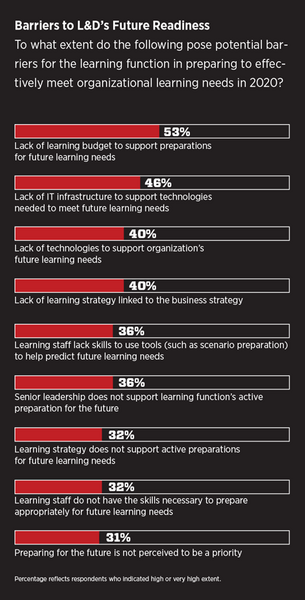
Study finds that learning functions' readiness to capably serve whatever learners of the future might bring is seriously lacking.
Study finds that learning functions' readiness to capably serve whatever learners of the future might bring is seriously lacking.
Content
Actively preparing now to serve future learners and their changing needs is beyond the reach of many L&D functions. Some are hampered by insufficient budgets; others lack the technologies and IT support systems to create and deliver content in ways likely to engage learners who expect their employers' technologies and capabilities to mirror those readily available outside the workplace.
Actively preparing now to serve future learners and their changing needs is beyond the reach of many L&D functions. Some are hampered by insufficient budgets; others lack the technologies and IT support systems to create and deliver content in ways likely to engage learners who expect their employers' technologies and capabilities to mirror those readily available outside the workplace.
Content
Talent development executives can, however, identify issues and involve the entire learning staff to find and implement solutions that will improve current L&D effectiveness—and prepare for the learners of 2020. Talent development executives can start by using ATD's Learning Effectiveness Index statements as a framework to evaluate these six essential areas of learning operations:
Talent development executives can, however, identify issues and involve the entire learning staff to find and implement solutions that will improve current L&D effectiveness—and prepare for the learners of 2020. Talent development executives can start by using ATD's Learning Effectiveness Index statements as a framework to evaluate these six essential areas of learning operations:
Content
Does the learning function regularly meet its L&D goals?
Does the learning function regularly meet its L&D goals?
Content
How does L&D support achievement of the organization's business goals?
How does L&D support achievement of the organization's business goals?
Content
Is learning delivered efficiently? (Consider timeliness, ease of access, and cost-effectiveness.)
Is learning delivered efficiently? (Consider timeliness, ease of access, and cost-effectiveness.)
Content
Is learning delivered effectively? (Review qualitative measures of learning outcomes.)
Is learning delivered effectively? (Review qualitative measures of learning outcomes.)
Content
How capably does the L&D function apply learning technologies to address business problems?
How capably does the L&D function apply learning technologies to address business problems?
Content
What can L&D do to stay current with new learning technologies and apply them to meet learning goals?
What can L&D do to stay current with new learning technologies and apply them to meet learning goals?
Content
Read more from ]( https://files.astd.org/CTDO-Images/Spring2016/StateofTD1-SB1-L.png ) CTDO magazine : Essential talent development content for C-suite leaders.
Read more from](https://files.astd.org/CTDO-Images/Spring2016/StateofTD1-SB1-L.png) CTDO magazine: Essential talent development content for C-suite leaders.