
CTDO Magazine Article
On the Short List
Content
CTDOs are tasked with preparing a pipeline of C-suite candidates capable of leading the organization forward at any time. Strong succession planning and development practices that support smooth leadership transitions and build a culture of development across the entire enterprise are critical. But readying C-level talent to take the next step isn't easy.
CTDOs are tasked with preparing a pipeline of C-suite candidates capable of leading the organization forward at any time. Strong succession planning and development practices that support smooth leadership transitions and build a culture of development across the entire enterprise are critical. But readying C-level talent to take the next step isn't easy.
Wed Mar 15 2017

Content
CTDOs are tasked with preparing a pipeline of C-suite candidates capable of leading the organization forward at any time. Strong succession planning and development practices that support smooth leadership transitions and build a culture of development across the entire enterprise are critical. But readying C-level talent to take the next step isn't easy. The Conference Board explores how organizations can successfully build succession planning that supports candidates for high-impact roles in Is Your C-Suite Pipeline Ready?
CTDOs are tasked with preparing a pipeline of C-suite candidates capable of leading the organization forward at any time. Strong succession planning and development practices that support smooth leadership transitions and build a culture of development across the entire enterprise are critical. But readying C-level talent to take the next step isn't easy. The Conference Board explores how organizations can successfully build succession planning that supports candidates for high-impact roles in Is Your C-Suite Pipeline Ready?
Content
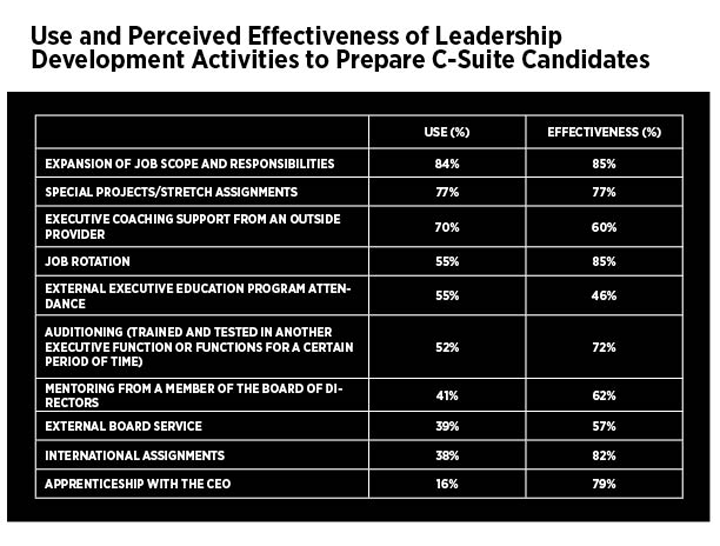
Based on survey responses of 94 public companies, expert interviews, and in-depth case studies and examples, the report reveals that personalized learning experiences that challenge and stretch an individual's capabilities offer the greatest impact to a leader's development. The most effective experiences include expansion of job scope, special stretch assignments, or pairing with an executive coach to facilitate the learning process. While apprenticeship with the CEO is not a common feature of leadership development programs, it is among the five most effective features, along with job rotation, expansion of job responsibilities, international assignments, and special projects/stretch assignments. Conversely, attendance at executive education courses is frequently used but ranked among the least effective program elements.
Based on survey responses of 94 public companies, expert interviews, and in-depth case studies and examples, the report reveals that personalized learning experiences that challenge and stretch an individual's capabilities offer the greatest impact to a leader's development. The most effective experiences include expansion of job scope, special stretch assignments, or pairing with an executive coach to facilitate the learning process. While apprenticeship with the CEO is not a common feature of leadership development programs, it is among the five most effective features, along with job rotation, expansion of job responsibilities, international assignments, and special projects/stretch assignments. Conversely, attendance at executive education courses is frequently used but ranked among the least effective program elements.
Content
"As business environments continue to change amidst uncertainty and increasing levels of complexity, broader opportunities for candidates in varying contexts offer better preparation for candidates," the report states.
"As business environments continue to change amidst uncertainty and increasing levels of complexity, broader opportunities for candidates in varying contexts offer better preparation for candidates," the report states.
Content
So, how can chief talent development officers ensure a strong list of ready-now leaders? In other words, are organizations developing the right people to take over the C-suite?
So, how can chief talent development officers ensure a strong list of ready-now leaders? In other words, are organizations developing the right people to take over the C-suite?
Content
Eighty-three percent of survey participants maintain a short list of senior executives considered ready for a possible succession to a major C-level role—including the CEO. To develop these lists, 81 percent of companies use recent performance reviews. However, the Conference Board study finds that organizations expand the use of data beyond assessment and performance metrics to gain more holistic perspectives of potential candidates. More than half of companies surveyed use a more varied approach, relying on 360-degree surveys and mentorship and coaching feedback. Less frequently, organizations use assessments such as behavioral interviews and employee engagement scores.
Eighty-three percent of survey participants maintain a short list of senior executives considered ready for a possible succession to a major C-level role—including the CEO. To develop these lists, 81 percent of companies use recent performance reviews. However, the Conference Board study finds that organizations expand the use of data beyond assessment and performance metrics to gain more holistic perspectives of potential candidates. More than half of companies surveyed use a more varied approach, relying on 360-degree surveys and mentorship and coaching feedback. Less frequently, organizations use assessments such as behavioral interviews and employee engagement scores.
Content
To jump-start succession initiatives in their organizations, the Conference Board advises CTDOs and executive leaders to consider several questions:
To jump-start succession initiatives in their organizations, the Conference Board advises CTDOs and executive leaders to consider several questions:
Content
What are the current business challenges or drivers that are pushing your need for a successful succession plan? How is your external business environment changing? What workforce demographics are shifting?
What are the current business challenges or drivers that are pushing your need for a successful succession plan? How is your external business environment changing? What workforce demographics are shifting?
Content
What are key business strategic objectives of the organization for the next five to 10 years? What core skills/competencies will be necessary for your leaders to help achieve those objectives?
What are key business strategic objectives of the organization for the next five to 10 years? What core skills/competencies will be necessary for your leaders to help achieve those objectives?
Content
What are the skill levels of your current leadership ranks? What are the strengths and where do critical gaps exist? How will you address the gaps?
What are the skill levels of your current leadership ranks? What are the strengths and where do critical gaps exist? How will you address the gaps?
Content
What programs and initiatives are in place to support the development of these skills in your leaders? What leadership levels will you focus on?
What programs and initiatives are in place to support the development of these skills in your leaders? What leadership levels will you focus on?
Content
What does your succession plan look like? How is your board involved? What is the CTDO's involvement? What other business units are involved?
What does your succession plan look like? How is your board involved? What is the CTDO's involvement? What other business units are involved?
Content
What would a successful C-suite succession look like? How will you evaluate the effectiveness of your succession plan? What are your evaluation criteria?
What would a successful C-suite succession look like? How will you evaluate the effectiveness of your succession plan? What are your evaluation criteria?
Content
Does your organization plan to develop a culture of development and succession planning? What strategies will you incorporate to communicate and demonstrate these behaviors across the organization?
Does your organization plan to develop a culture of development and succession planning? What strategies will you incorporate to communicate and demonstrate these behaviors across the organization?
Content
How do you see your organization's succession pipeline evolving in the future? How will you ensure that development investments are effectively managed over time and aligned with changing business priorities?
How do you see your organization's succession pipeline evolving in the future? How will you ensure that development investments are effectively managed over time and aligned with changing business priorities?
Content
Read more from CTDO magazine : Essential talent development content for C-suite leaders.
Read more from CTDO magazine: Essential talent development content for C-suite leaders.