
CTDO Magazine Article
Pull Back the Curtain on Pay
Content
Talent development professionals can influence how organizations approach pay transparency.
Talent development professionals can influence how organizations approach pay transparency.
Thu Oct 15 2020

Content
Pay transparency has become a significant hot-button issue that every company needs to address. As a company’s senior leadership and HR leaders think through what pay transparency means for their organizations, talent development professionals stand in a unique position to play a lead influencer role on the issue.
Pay transparency has become a significant hot-button issue that every company needs to address. As a company’s senior leadership and HR leaders think through what pay transparency means for their organizations, talent development professionals stand in a unique position to play a lead influencer role on the issue.
Content
If an employer chooses to move toward full pay transparency, that will require increased sophistication of the company’s talent mobility, career path and progression, training, and employee communication programs. Those are all in the talent development team’s sphere of influence.
If an employer chooses to move toward full pay transparency, that will require increased sophistication of the company’s talent mobility, career path and progression, training, and employee communication programs. Those are all in the talent development team’s sphere of influence.
Pay transparency refresher
Content
Pay transparency is as an employer’s willingness and an employee’s knowledge of how individual compensation—whether base salary or overall total direct compensation, which is base salary plus target annual incentive and target long-term incentive grant value—compares with other individuals, including other employees and individuals in the external marketplace. Information is power, and for the better part of the 20th century, most organizations have kept relative compensation information on a need-to-know basis.
Pay transparency is as an employer’s willingness and an employee’s knowledge of how individual compensation—whether base salary or overall total direct compensation, which is base salary plus target annual incentive and target long-term incentive grant value—compares with other individuals, including other employees and individuals in the external marketplace. Information is power, and for the better part of the 20th century, most organizations have kept relative compensation information on a need-to-know basis.
Content
However, the information technology revolution that began in the 1980s has provided the average person with a much greater and evolving comprehension of their relative compensation via third-party surveys, employment search firms, and participant information-sharing websites. This slow but increasing leveling of the playing field on compensation information has resulted in employees pushing back on corporations and asking questions on relative pay.
However, the information technology revolution that began in the 1980s has provided the average person with a much greater and evolving comprehension of their relative compensation via third-party surveys, employment search firms, and participant information-sharing websites. This slow but increasing leveling of the playing field on compensation information has resulted in employees pushing back on corporations and asking questions on relative pay.
Content
Gender pay equity gaps—the compensation of a woman versus a male counterpart with similar education, skills, and experience—have become the primary rallying cry for increased pay transparency. Organizations are now either legally required or feel compelled to proactively report on their gender pay equity and, if there is a gap, how they intend to close it.
Gender pay equity gaps—the compensation of a woman versus a male counterpart with similar education, skills, and experience—have become the primary rallying cry for increased pay transparency. Organizations are now either legally required or feel compelled to proactively report on their gender pay equity and, if there is a gap, how they intend to close it.
Content
This issue will only continue to gain momentum in the US. Forty-two states have now expanded on the federal Equal Pay Act to include legislation preventing wage discrimination for protected classes.
This issue will only continue to gain momentum in the US. Forty-two states have now expanded on the federal Equal Pay Act to include legislation preventing wage discrimination for protected classes.
Content
Further, racial pay equity gaps will become even more prominent as the issues of race, fairness, and transparency come to the forefront in light of George Floyd’s death and the subsequent worldwide protests for racial economic and social justice. Many companies felt compelled to write carefully worded public relations and social media posts that they supported those movements. But then they found themselves questioned on what specific human capital actions and monetary commitments they were willing to make to back up their words.
Further, racial pay equity gaps will become even more prominent as the issues of race, fairness, and transparency come to the forefront in light of George Floyd’s death and the subsequent worldwide protests for racial economic and social justice. Many companies felt compelled to write carefully worded public relations and social media posts that they supported those movements. But then they found themselves questioned on what specific human capital actions and monetary commitments they were willing to make to back up their words.
Content
Companies are being required to address the pay transparency issue and determine the pros and cons of their situation (see sidebar). The pros and cons illustrate the complexity of this issue and potential danger of quickly implementing ill-advised solutions as a knee-jerk reaction.
Companies are being required to address the pay transparency issue and determine the pros and cons of their situation (see sidebar). The pros and cons illustrate the complexity of this issue and potential danger of quickly implementing ill-advised solutions as a knee-jerk reaction.
Content
Pay transparency is not a simple, binary yes-or-no issue; rather, it’s a continuum. A company not only needs to understand where it currently stands on the pay transparency continuum (PTC) and determine its desired future state but also needs to comprehend the necessary conditions required to close the gap.
Pay transparency is not a simple, binary yes-or-no issue; rather, it’s a continuum. A company not only needs to understand where it currently stands on the pay transparency continuum (PTC) and determine its desired future state but also needs to comprehend the necessary conditions required to close the gap.
Pay transparency continuum
Content
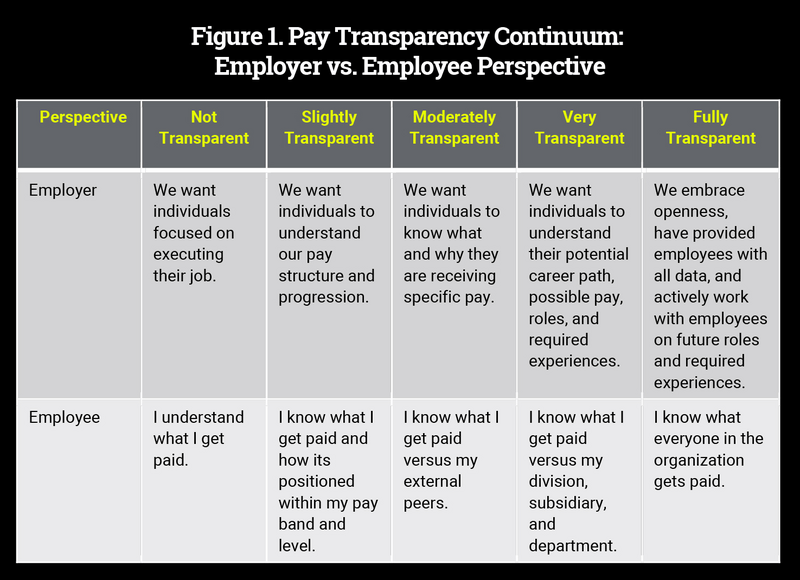
The PTC provides a simple framework to think about the issue, but the complexity is in the details. The continuum consists of a five-phase rating scale that ranges from not transparent to fully transparent. Figure 1 shows how pay transparency differs throughout the continuum by illustrating what the employer or employee would experience in different phases.
The PTC provides a simple framework to think about the issue, but the complexity is in the details. The continuum consists of a five-phase rating scale that ranges from not transparent to fully transparent. Figure 1 shows how pay transparency differs throughout the continuum by illustrating what the employer or employee would experience in different phases.
Content
Using the PTC, any company can determine at a high level where it’s uniquely positioned. Generic profiling on where a typical company may lie on the continuum can prove difficult. However, as I delve into the details of specific programs and conditions at each PTC phase, those generic lines will begin to blur.
Using the PTC, any company can determine at a high level where it’s uniquely positioned. Generic profiling on where a typical company may lie on the continuum can prove difficult. However, as I delve into the details of specific programs and conditions at each PTC phase, those generic lines will begin to blur.
Content
Some HR programs that can drive more pay transparency require significant infrastructure and planning, which may benefit more established companies. Some HR policies and operating cultures suggest less pay transparency is indicative of newer, smaller companies. Let’s look more closely at the variations of talent development programs, policies, and operating culture as the necessary conditions to move along the PTC.
Some HR programs that can drive more pay transparency require significant infrastructure and planning, which may benefit more established companies. Some HR policies and operating cultures suggest less pay transparency is indicative of newer, smaller companies. Let’s look more closely at the variations of talent development programs, policies, and operating culture as the necessary conditions to move along the PTC.
Required conditions for full transparency
Content
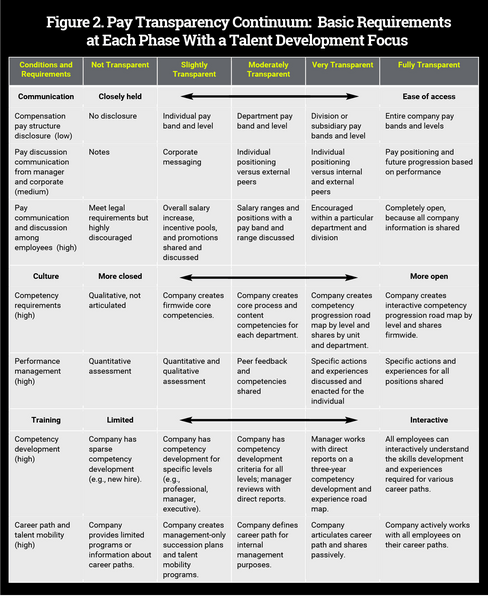
Each phase along the PTC requires certain conditions to provide the desired employee and employer experience and perspective. Figure 2 outlines some of these requirements to illustrate how they evolve in complexity as you move across the continuum, the interrelationship among the requirements within a particular phase, and how talent development professionals affect a company’s movement along the PTC.
Each phase along the PTC requires certain conditions to provide the desired employee and employer experience and perspective. Figure 2 outlines some of these requirements to illustrate how they evolve in complexity as you move across the continuum, the interrelationship among the requirements within a particular phase, and how talent development professionals affect a company’s movement along the PTC.
Content
Note: Figure 2 is representative but not exhaustive. Moving left to right across the table, each phase subsumes the prior phase. And keep in mind that any information companies provide must comply with all applicable federal, state, and local laws.
Note: Figure 2 is representative but not exhaustive. Moving left to right across the table, each phase subsumes the prior phase. And keep in mind that any information companies provide must comply with all applicable federal, state, and local laws.
Content
Moving from the not transparent to the slightly transparent section requires you to develop baseline, simplistic programs and processes for core company competencies, management succession, talent mobility, and training and development.
Moving from the not transparent to the slightly transparent section requires you to develop baseline, simplistic programs and processes for core company competencies, management succession, talent mobility, and training and development.
Content
Moving from slightly transparent to moderately transparent requires you to develop comprehensive programs and processes for the same areas for which you developed basic programs. Those programs and policies are independent approaches within a company at this stage. Your focus on developing those areas to meet business needs may range in comprehensiveness.
Moving from slightly transparent to moderately transparent requires you to develop comprehensive programs and processes for the same areas for which you developed basic programs. Those programs and policies are independent approaches within a company at this stage. Your focus on developing those areas to meet business needs may range in comprehensiveness.
Content
Moving from moderately transparent to very transparent requires you to integrate the aforementioned programs and processes across the company’s culture, communication, and training. Collaborate with other HR teams to ensure a seamless individual experience. And enable the employee to understand the connections among pay, competencies, training and development opportunities, work experiences, and career paths.
Moving from moderately transparent to very transparent requires you to integrate the aforementioned programs and processes across the company’s culture, communication, and training. Collaborate with other HR teams to ensure a seamless individual experience. And enable the employee to understand the connections among pay, competencies, training and development opportunities, work experiences, and career paths.
Content
Last, moving from very transparent to fully transparent requires you to leverage technology, culture, and communication to provide an interactive employee and manager experience. Individual pay gaps at this level not only exist, but the company and employees understand, acknowledge, and celebrate them. You can have a significant influence on a variety of talent development programs and processes when helping your organization move along its PTC.
Last, moving from very transparent to fully transparent requires you to leverage technology, culture, and communication to provide an interactive employee and manager experience. Individual pay gaps at this level not only exist, but the company and employees understand, acknowledge, and celebrate them. You can have a significant influence on a variety of talent development programs and processes when helping your organization move along its PTC.
Content
When these conditions are mapped to the PTC, three primary themes emerge. First, while most companies may say they aspire to be fully transparent in pay, few companies would actually move, develop, and enact the required conditions. It’s more likely they would want to position themselves at the very transparent or moderately transparent levels.
When these conditions are mapped to the PTC, three primary themes emerge. First, while most companies may say they aspire to be fully transparent in pay, few companies would actually move, develop, and enact the required conditions. It’s more likely they would want to position themselves at the very transparent or moderately transparent levels.
Content
Second, while companies want to be proactive on managing and messaging their unique pay transparency approach to multiple constituents, such as employees, the board of directors, shareholders, and the media and public relations, they are likely to be cautious and deliberate in their actions to address this issue. Organizations will naturally look to minimize potential business disruption because of the financial, operating, and cultural implications of addressing and rectifying their specific pay transparency issues on a timely and successful basis.
Second, while companies want to be proactive on managing and messaging their unique pay transparency approach to multiple constituents, such as employees, the board of directors, shareholders, and the media and public relations, they are likely to be cautious and deliberate in their actions to address this issue. Organizations will naturally look to minimize potential business disruption because of the financial, operating, and cultural implications of addressing and rectifying their specific pay transparency issues on a timely and successful basis.
Content
Finally, companies are likely positioned at various phases along the PTC for each of the conditions and would need to develop a unique road map to move from their current state to their desired future state.
Finally, companies are likely positioned at various phases along the PTC for each of the conditions and would need to develop a unique road map to move from their current state to their desired future state.
Content
While the merits and potential benefits of pay transparency have been discussed and debated over the past few years, its definition and the notion of what fully transparent really means has seemed opaque. By articulating the PTC concept and defining specific phases and components, talent development professionals can discuss pay transparency in their organizations with more clarity. Working collaboratively with senior management and other senior HR leaders, the talent development function can not only assist in establishing the company’s desired pay transparency positioning but also participate in the required evolution of various HR cultural, communication, and training programs and policies.
While the merits and potential benefits of pay transparency have been discussed and debated over the past few years, its definition and the notion of what fully transparent really means has seemed opaque. By articulating the PTC concept and defining specific phases and components, talent development professionals can discuss pay transparency in their organizations with more clarity. Working collaboratively with senior management and other senior HR leaders, the talent development function can not only assist in establishing the company’s desired pay transparency positioning but also participate in the required evolution of various HR cultural, communication, and training programs and policies.
Pay Transparency Benefits and Drawbacks
Content
As you and your organization look into pursuing pay transparency, consider the pros and cons of doing so.
As you and your organization look into pursuing pay transparency, consider the pros and cons of doing so.
Content
Pros
Pros
Content
Create fair pay; hold employers accountable.
Create fair pay; hold employers accountable.
Content
Avoid pay discrimination issues and lawsuits.
Avoid pay discrimination issues and lawsuits.
Content
Enable employees to align pay with expectations.
Enable employees to align pay with expectations.
Content
Eliminate employee gossip.
Eliminate employee gossip.
Content
Increase trust.
Increase trust.
Content
Enhance productivity.
Enhance productivity.
Content
Enable employees to understand the impact of potential career moves.
Enable employees to understand the impact of potential career moves.
Content
Cons
Cons
Content
Decrease differentiation and nuance and increase clustered pay.
Decrease differentiation and nuance and increase clustered pay.
Content
Pay disclosure on unfair or inconsistent practices could lead to lawsuits.
Pay disclosure on unfair or inconsistent practices could lead to lawsuits.
Content
Create greater pressure on the upper end of the pay range and level.
Create greater pressure on the upper end of the pay range and level.
Content
Reduce morale for employees paid below average.
Reduce morale for employees paid below average.
Content
Pay disclosure on unfair or inconsistent practices could lead to mistrust.
Pay disclosure on unfair or inconsistent practices could lead to mistrust.
Content
Increase employee turnover for good employees who believe they are underpaid.
Increase employee turnover for good employees who believe they are underpaid.
Content
Limit negotiating power for new employees or promotions.
Limit negotiating power for new employees or promotions.
Content
Read more from CTDO magazine : Essential talent development content for C-suite leaders.
Read more from CTDO magazine: Essential talent development content for C-suite leaders.