
CTDO Magazine Article
Refresh Your Learning Strategy
Content
The world is moving forward, but in many ways talent development is still stuck in the 1980s.
The world is moving forward, but in many ways talent development is still stuck in the 1980s.
Thu Apr 15 2021

Content
It’s not news that the world of work is changing. During the past 40 years, we’ve watched our organizations get flatter and leaner. We’ve also watched our leaders become more connected and more empathetic, and we’ve watched our workforce get more savvy.
It’s not news that the world of work is changing. During the past 40 years, we’ve watched our organizations get flatter and leaner. We’ve also watched our leaders become more connected and more empathetic, and we’ve watched our workforce get more savvy.
Content
In my early days in the talent development industry, one of the topics we often discussed was the end of mushroom management—keeping workers in the dark and feeding them, well, you know what we feed mushrooms, all in the hopes of making the best cog possible in the quickest way possible for the lowest price possible.
In my early days in the talent development industry, one of the topics we often discussed was the end of mushroom management—keeping workers in the dark and feeding them, well, you know what we feed mushrooms, all in the hopes of making the best cog possible in the quickest way possible for the lowest price possible.
Content
In the 1990s, ending those practices was the stuff that leadership development programs were made of, but today that’s old hat. Why then, if so much has changed, are talent development professionals still leaning on an L&D model from the 1980s?
In the 1990s, ending those practices was the stuff that leadership development programs were made of, but today that’s old hat. Why then, if so much has changed, are talent development professionals still leaning on an L&D model from the 1980s?
Content
Researchers working with the Center for Creative Leadership created the 70-20-10 model in the 1980s. We all know it: Seventy percent of learning is hands on; 20 percent happens through interactions with others; and 10 percent of professional development comes from classroom-type situations. Several articles call into question those percentages and the role that they allow training and talent development professionals to play in individuals’ full learning journey.
Researchers working with the Center for Creative Leadership created the 70-20-10 model in the 1980s. We all know it: Seventy percent of learning is hands on; 20 percent happens through interactions with others; and 10 percent of professional development comes from classroom-type situations. Several articles call into question those percentages and the role that they allow training and talent development professionals to play in individuals’ full learning journey.
Content
Additionally, as the world of talent development grows, so do the arguments over what’s formal learning versus informal learning versus social learning. Is a mentorship program social learning? What if it’s sponsored by HR—does that make it formal?
Additionally, as the world of talent development grows, so do the arguments over what’s formal learning versus informal learning versus social learning. Is a mentorship program social learning? What if it’s sponsored by HR—does that make it formal?
Content
Still, with all the advancements and criticism and questions, the model persists. Why? Is it because we haven’t yet found a new model to replace the way we think of our role?
Still, with all the advancements and criticism and questions, the model persists. Why? Is it because we haven’t yet found a new model to replace the way we think of our role?
Content
That is a question I have been asking myself for years. But I may have landed on an alternative.
That is a question I have been asking myself for years. But I may have landed on an alternative.
Workforce development 2.0
Content
As we think about our role as leaders of workforce, talent, and organization development, we need to consider so many factors: remote teams, conflicting goals, ever-shifting key performance indicators—the list goes on and on. The days of having an equation that can tell us exactly how to most efficiently and effectively add value to our organization is long past.
As we think about our role as leaders of workforce, talent, and organization development, we need to consider so many factors: remote teams, conflicting goals, ever-shifting key performance indicators—the list goes on and on. The days of having an equation that can tell us exactly how to most efficiently and effectively add value to our organization is long past.
Content
The standard advice holds: Get yourself a seat at the table when discussing the organization’s strategic vision. Make sure you align your workforce development strategy to the organization’s goals. Add value not just through return-on-investment calculations but by finding ways to truly show the value that you, your team, and your services bring.
The standard advice holds: Get yourself a seat at the table when discussing the organization’s strategic vision. Make sure you align your workforce development strategy to the organization’s goals. Add value not just through return-on-investment calculations but by finding ways to truly show the value that you, your team, and your services bring.
Content
But how can we truly do that if, as some falsely believe, only 10 percent of successful professional development happens in the formal learning space—a space where we have set up camp and successfully maneuvered for years?
But how can we truly do that if, as some falsely believe, only 10 percent of successful professional development happens in the formal learning space—a space where we have set up camp and successfully maneuvered for years?
Content
My advice is simple: Change the conversation.
My advice is simple: Change the conversation.
The You-Me-We Learning Model
Content
Stop talking about your work through the 70-20-10 model. If you don’t talk about it in that way, good—but find a new way to talk about your value.
Stop talking about your work through the 70-20-10 model. If you don’t talk about it in that way, good—but find a new way to talk about your value.
Content
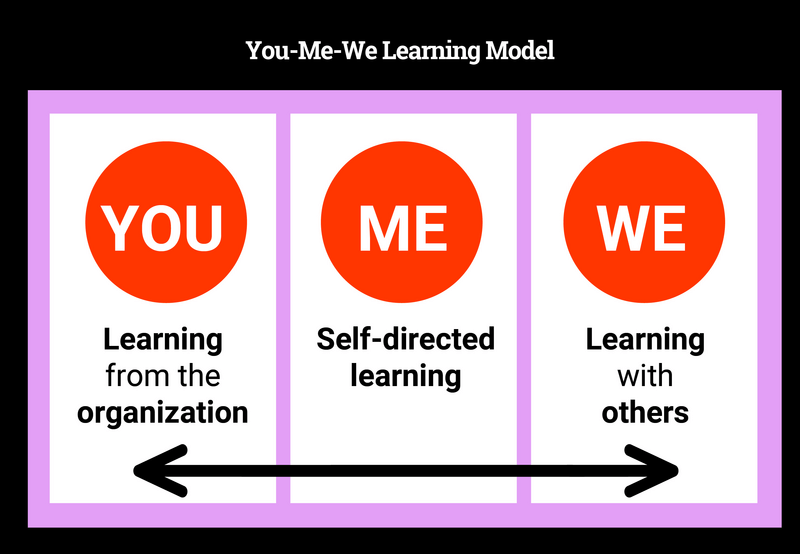
To that end, I’d like to suggest the model I’ve created to build and show value: the You-Me-We Learning Model.
To that end, I’d like to suggest the model I’ve created to build and show value: the You-Me-We Learning Model.
Content
It is the product of numerous experiments and born of my years of working with talent professionals, hearing their stories, and discussing their experience.
It is the product of numerous experiments and born of my years of working with talent professionals, hearing their stories, and discussing their experience.
Content
It’s simple—just like 70-20-10—and it opens several doors that you can walk through to build your talent strategy.
It’s simple—just like 70-20-10—and it opens several doors that you can walk through to build your talent strategy.
Learner-centered model
Content
At the center of the You-Me-We Learning Model is “me,” which refers to the learner (not us as talent development professionals). This model enables the learners to see themselves in our strategy.
At the center of the You-Me-We Learning Model is “me,” which refers to the learner (not us as talent development professionals). This model enables the learners to see themselves in our strategy.
Content
Me learning is all about working to create empowered, self-motivated learners. Doing so enables us as talent development professionals to claim numerous new areas as part of our talent development strategy—we no longer only play in the 10 percent.
Me learning is all about working to create empowered, self-motivated learners. Doing so enables us as talent development professionals to claim numerous new areas as part of our talent development strategy—we no longer only play in the 10 percent.
Content
As you start to build your you-me-we strategy, begin with the informal, formal, and social plan you already have, but then go deeper and grow your thinking beyond that to be truly learner focused. Anything in your me learning strategy should focus on creating content that people go in search of, right when they need it or are ready for it. They own their learning journey, and they know where to go and whom to ask for help.
As you start to build your you-me-we strategy, begin with the informal, formal, and social plan you already have, but then go deeper and grow your thinking beyond that to be truly learner focused. Anything in your me learning strategy should focus on creating content that people go in search of, right when they need it or are ready for it. They own their learning journey, and they know where to go and whom to ask for help.
Content
A good me learning portfolio enables learners to feel in control, supported, and ready to seek out learning opportunities throughout the day as part of their job, right in their workflow.
A good me learning portfolio enables learners to feel in control, supported, and ready to seek out learning opportunities throughout the day as part of their job, right in their workflow.
Content
As you create your me learning strategy, keep these tips in mind:
As you create your me learning strategy, keep these tips in mind:
Content
Empower learners on self-discovery by building understanding, value, and acceptance using tailored, accessible resources.
Empower learners on self-discovery by building understanding, value, and acceptance using tailored, accessible resources.
Content
Curate learning paths that learners can navigate on their own as they develop their self-directed learning muscles.
Curate learning paths that learners can navigate on their own as they develop their self-directed learning muscles.
Content
Pick the right partners, both internally and externally, to provide content.
Pick the right partners, both internally and externally, to provide content.
Content
Think about what’s needed just in time, and design the systems around what you learn.
Think about what’s needed just in time, and design the systems around what you learn.
Content
Use both push and pull strategies as you create and share resources and tools.
Use both push and pull strategies as you create and share resources and tools.
Content
Review organizational job descriptions, and create libraries of learning around the key transferable skills you see in those descriptions.
Review organizational job descriptions, and create libraries of learning around the key transferable skills you see in those descriptions.
Content
Ask managers to add “5 percent continuing professional development” to everyone’s job descriptions.
Ask managers to add “5 percent continuing professional development” to everyone’s job descriptions.
Content
Model the behaviors you wish to see.
Model the behaviors you wish to see.
Content
Acknowledge and reward the behaviors you want individuals to continue.
Acknowledge and reward the behaviors you want individuals to continue.
Content
As you create your me learning plan, remember that encouraging and facilitating these types of learning experiences can be effective. While self-directed learning has a reputation of being hard to keep going because people often see it as extra work outside their job, a good me learning strategy will change the conversation to help people think of development as part of their job.
As you create your me learning plan, remember that encouraging and facilitating these types of learning experiences can be effective. While self-directed learning has a reputation of being hard to keep going because people often see it as extra work outside their job, a good me learning strategy will change the conversation to help people think of development as part of their job.
Learners need your help
Content
To create your you learning strategy, first remember that this model is focused on the learner. So, when I say “you learning,” I am speaking as the learner. When a learner looks to you, and your organization, for a learning experience, that’s you learning.
To create your you learning strategy, first remember that this model is focused on the learner. So, when I say “you learning,” I am speaking as the learner. When a learner looks to you, and your organization, for a learning experience, that’s you learning.
Content
As you develop your you learning strategy, remember these tips:
As you develop your you learning strategy, remember these tips:
Content
Always think of your organization’s employees as your clients.
Always think of your organization’s employees as your clients.
Content
Brand the talent development team as indispensable experts.
Brand the talent development team as indispensable experts.
Content
Create learning journeys that employees know about and value as golden opportunities to advancement and achievement within the company.
Create learning journeys that employees know about and value as golden opportunities to advancement and achievement within the company.
Content
Create program tracks and milestone certificates or badges that enable people to share their successes and keep their motivation.
Create program tracks and milestone certificates or badges that enable people to share their successes and keep their motivation.
Content
Complement your programs and workshops with menus of wraparound learning opportunities in different modalities.
Complement your programs and workshops with menus of wraparound learning opportunities in different modalities.
Content
Update your policies and job descriptions to support your internal L&D opportunities.
Update your policies and job descriptions to support your internal L&D opportunities.
Content
Provide employees who complete learning programs with letters of recommendation that they can use when seeking advancements within the organization.
Provide employees who complete learning programs with letters of recommendation that they can use when seeking advancements within the organization.
Content
Partner with the talent acquisition team to build your internal programs into hiring requirements or preferences for internal mobility.
Partner with the talent acquisition team to build your internal programs into hiring requirements or preferences for internal mobility.
Content
Measure and reward action and participation.
Measure and reward action and participation.
Content
Celebrate learning leaders with recognition from your most senior leaders.
Celebrate learning leaders with recognition from your most senior leaders.
Content
By creating learning journeys for employees, as opposed to one-and-done programs that aren’t integrated into the business strategy, you can make great strides in getting employees to look to you to support their learning. Engage top leaders to talk about the importance and impact of development, and market development offerings like you are the number 1 L&D company.
By creating learning journeys for employees, as opposed to one-and-done programs that aren’t integrated into the business strategy, you can make great strides in getting employees to look to you to support their learning. Engage top leaders to talk about the importance and impact of development, and market development offerings like you are the number 1 L&D company.
Engage a workforce development network
Content
The final component of the model is “we.” Begin by thinking of we learning as social learning—but go deeper.
The final component of the model is “we.” Begin by thinking of we learning as social learning—but go deeper.
Content
Develop and distribute vehicles that will engage learners to build and use personal learning networks. Think: How is my team creating and enabling safe space opportunities for people in the organization to gather and learn from one another?
Develop and distribute vehicles that will engage learners to build and use personal learning networks. Think: How is my team creating and enabling safe space opportunities for people in the organization to gather and learn from one another?
Content
As you develop your we learning strategy, consider these tips:
As you develop your we learning strategy, consider these tips:
Content
It’s your job to educate what, why, and how we learning can enhance the employee learning experience.
It’s your job to educate what, why, and how we learning can enhance the employee learning experience.
Content
Find what’s happening organically and support it.
Find what’s happening organically and support it.
Content
Sponsor the creation of communities of practice that are scalable and sustainable by creating and sharing toolkits.
Sponsor the creation of communities of practice that are scalable and sustainable by creating and sharing toolkits.
Content
Support individual connections—for example, use your staff directory to share connection triggers, or encourage staff to list skills that they can teach others on a social learning platform.
Support individual connections—for example, use your staff directory to share connection triggers, or encourage staff to list skills that they can teach others on a social learning platform.
Content
Complement formal classes with online discussion groups, such as mastermind groups, that include subject matter experts.
Complement formal classes with online discussion groups, such as mastermind groups, that include subject matter experts.
Content
Seek out individuals who are community creators and connectors, acknowledge their contributions, and share their value with their managers and other senior leaders.
Seek out individuals who are community creators and connectors, acknowledge their contributions, and share their value with their managers and other senior leaders.
Content
Build guides to support watch parties, book clubs, and other social learning opportunities.
Build guides to support watch parties, book clubs, and other social learning opportunities.
Content
Create and support mentorship and fellowship programs.
Create and support mentorship and fellowship programs.
Content
Create awards for contributing to the creation of supportive learning communities.
Create awards for contributing to the creation of supportive learning communities.
Content
Ask executive leaders to write thank-you emails to those who are making the biggest impact in creating these networks, and then send the email to the employees and their managers.
Ask executive leaders to write thank-you emails to those who are making the biggest impact in creating these networks, and then send the email to the employees and their managers.
Content
Strong social networks that enhance learning increase the effectiveness of your general L&D strategy, and they greatly increase the impact of your onboarding and culture-building programs. Use those social networks to deepen communication strategies and to engage and retain employees, all while you also enhance your training and development programs. Doing so will help you get your L&D shop out of exclusively focusing on training and compliance and into the workforce strategy and organization vision arena.
Strong social networks that enhance learning increase the effectiveness of your general L&D strategy, and they greatly increase the impact of your onboarding and culture-building programs. Use those social networks to deepen communication strategies and to engage and retain employees, all while you also enhance your training and development programs. Doing so will help you get your L&D shop out of exclusively focusing on training and compliance and into the workforce strategy and organization vision arena.
The model in action
Content
In the end, I can assure you that embedding this new way of thinking into my learning strategies has proven successful. The You-Me-We Learning Model enables us to broaden the definition of what talent development is and how we can influence and support it for all learners.
In the end, I can assure you that embedding this new way of thinking into my learning strategies has proven successful. The You-Me-We Learning Model enables us to broaden the definition of what talent development is and how we can influence and support it for all learners.
Content
It focuses on the learner as the owner and conductor of their individualized learning journey. That leaves us to do what we’re best at: acting as a guide, champion, supporter, and proactive partner for growth and development.
It focuses on the learner as the owner and conductor of their individualized learning journey. That leaves us to do what we’re best at: acting as a guide, champion, supporter, and proactive partner for growth and development.
Content
Read more from CTDO magazine : Essential talent development content for C-suite leaders.
Read more from CTDO magazine: Essential talent development content for C-suite leaders.