
CTDO Magazine Article
The Far-Reaching Costs of Ageism
Content
Although the Age Discrimination in Employment Act of 1967 prohibits employers from displaying bias against most applicants and those 40 years and older, older workers still face bias and discriminations.
Although the Age Discrimination in Employment Act of 1967 prohibits employers from displaying bias against most applicants and those 40 years and older, older workers still face bias and discriminations.
Thu Apr 15 2021

Content
The US Bureau of Labor Statistics predicts that one in four workers in 2026 will be age 55 and older—that’s up from one in eight in 1990. And although the Age Discrimination in Employment Act of 1967 prohibits employers from displaying bias against most applicants and employees 40 years or older with regard to hiring and firing, promotions, compensation, or employment terms and conditions, older workers still face bias and discrimination.
The US Bureau of Labor Statistics predicts that one in four workers in 2026 will be age 55 and older—that’s up from one in eight in 1990. And although the Age Discrimination in Employment Act of 1967 prohibits employers from displaying bias against most applicants and employees 40 years or older with regard to hiring and firing, promotions, compensation, or employment terms and conditions, older workers still face bias and discrimination.
Content
In 2018, AARP conducted a study that found that nearly two out of three workers over age 45 have seen or experienced ageism on the job. Bias can take the shape of age-specific stereotypes, such as the notion that older workers are resistant to change or not as technologically competent. Or it can be distasteful jokes about aging and even unethical and illegal actions like refusing to promote a qualified employee because of their age.
In 2018, AARP conducted a study that found that nearly two out of three workers over age 45 have seen or experienced ageism on the job. Bias can take the shape of age-specific stereotypes, such as the notion that older workers are resistant to change or not as technologically competent. Or it can be distasteful jokes about aging and even unethical and illegal actions like refusing to promote a qualified employee because of their age.
Content
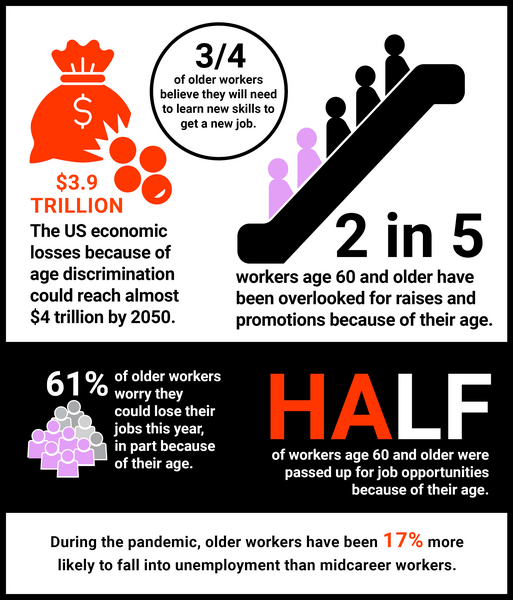
Here’s how age bias is playing out today.
Here’s how age bias is playing out today.
Content
Sources The Value of Experience: AARP Multicultural Work & Jobs Study Chartbook for Total Respondents , AARP, 2018; “ Age Discrimination Costs the Nation $850 Billion, Study Finds ,” AARP, 2020; “ Age Bias Could Lead to Job Loss This Year, Many Workers Fear , ” AARP, 2021; “ A First in Nearly 50 Years, Older Workers Face Higher Unemployment Than Mid-Career Workers ,” Schwartz Center for Economic Policy Analysis, 2020; 2020 Report on Age Discrimination in the Workplace , Senior Living, 2020
Sources The Value of Experience: AARP Multicultural Work & Jobs Study Chartbook for Total Respondents, AARP, 2018; “Age Discrimination Costs the Nation $850 Billion, Study Finds,” AARP, 2020; “Age Bias Could Lead to Job Loss This Year, Many Workers Fear,” AARP, 2021; “A First in Nearly 50 Years, Older Workers Face Higher Unemployment Than Mid-Career Workers,” Schwartz Center for Economic Policy Analysis, 2020; 2020 Report on Age Discrimination in the Workplace, Senior Living, 2020
Content
Read more from CTDO magazine : Essential talent development content for C-suite leaders.
Read more from CTDO magazine: Essential talent development content for C-suite leaders.