
CTDO Magazine Article
The Gig Workforce Is Growing
Content
Companies may still prefer to take on full-time hires, but more than half are tapping the contingent workforce to fill roles.
Companies may still prefer to take on full-time hires, but more than half are tapping the contingent workforce to fill roles.
Thu Sep 15 2016

Content
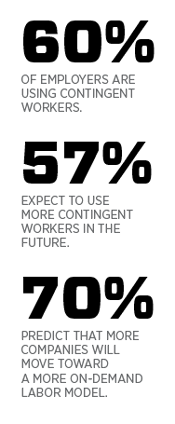
Companies may still prefer to take on full-time hires, but more than half are tapping the contingent workforce to fill roles, according to new data from the Aspen Institute's Future of Work Initiative, the Markle Foundation, Burson-Marsteller, and Time magazine. In fact, the Workforce of the Future Survey finds that 60 percent of respondents are using contingent workers and 57 percent expect to use more contingent workers in the future.
Companies may still prefer to take on full-time hires, but more than half are tapping the contingent workforce to fill roles, according to new data from the Aspen Institute's Future of Work Initiative, the Markle Foundation, Burson-Marsteller, and Time magazine. In fact, the Workforce of the Future Survey finds that 60 percent of respondents are using contingent workers and 57 percent expect to use more contingent workers in the future.
Content
Further, 70 percent of those surveyed predict that more companies and organizations will move toward a more on-demand labor model. "This new survey reveals we are at a critical point in the evolution of the modern workforce," says Donald A. Baer, worldwide chairman and CEO of Burson-Marsteller.
Further, 70 percent of those surveyed predict that more companies and organizations will move toward a more on-demand labor model. "This new survey reveals we are at a critical point in the evolution of the modern workforce," says Donald A. Baer, worldwide chairman and CEO of Burson-Marsteller.
Content
Employers cite using independent contractors for the flexibility of hiring workers with specific skills as the need arises (90 percent). "Employers who use contingent workers do so because it allows them to quickly adjust to changing workforce needs or to hire people with specific in-demand skills," says Zoe Baird, CEO and president of Markle.
Employers cite using independent contractors for the flexibility of hiring workers with specific skills as the need arises (90 percent). "Employers who use contingent workers do so because it allows them to quickly adjust to changing workforce needs or to hire people with specific in-demand skills," says Zoe Baird, CEO and president of Markle.
Content
"This makes it all the more important to ensure all workers have the skills they need in today's ever-changing labor market, whether they are full-time employees or contingent workers. A more highly skilled workforce, one that can easily find pathways to train and retrain, is critical to enabling everyone to see themselves in the digital economy," adds Baird.
"This makes it all the more important to ensure all workers have the skills they need in today's ever-changing labor market, whether they are full-time employees or contingent workers. A more highly skilled workforce, one that can easily find pathways to train and retrain, is critical to enabling everyone to see themselves in the digital economy," adds Baird.
Content
However, 50 percent of employers surveyed don't think they should be responsible for providing training or education to independent contractors. Perhaps that's because 97 percent of employers who use independent contractors report they are satisfied with their performance.
However, 50 percent of employers surveyed don't think they should be responsible for providing training or education to independent contractors. Perhaps that's because 97 percent of employers who use independent contractors report they are satisfied with their performance.
Content
Despite the benefits, two-thirds say their companies seek to limit the number of contingent workers. Why? More than half of all employers (56 percent) say that having traditional employees makes it easier to accommodate the ebbs and flows in work volume.
Despite the benefits, two-thirds say their companies seek to limit the number of contingent workers. Why? More than half of all employers (56 percent) say that having traditional employees makes it easier to accommodate the ebbs and flows in work volume.
Content
What's more, employers are looking for loyal, engaged employees, and independent contractors don't seem to meet that expectation. More than half (58 percent) of employers who hire independent contractors agree that nonemployee contingent workers are "not as loyal." Additionally, 54 percent of employers agree that nonemployee contingent workers are "not always available when I need them." Finally, 52 percent agree that nonemployee contingent workers are "not as invested in their product."
What's more, employers are looking for loyal, engaged employees, and independent contractors don't seem to meet that expectation. More than half (58 percent) of employers who hire independent contractors agree that nonemployee contingent workers are "not as loyal." Additionally, 54 percent of employers agree that nonemployee contingent workers are "not always available when I need them." Finally, 52 percent agree that nonemployee contingent workers are "not as invested in their product."
Content
To compile data for the study, Penn Schoen Berland conducted 800 online interviews with employers—business owners or employees who make hiring decisions for their organizations. The survey defines nonemployee contingent workers as those who work for an organization on a nonpermanent basis and typically work on a form 1099.
To compile data for the study, Penn Schoen Berland conducted 800 online interviews with employers—business owners or employees who make hiring decisions for their organizations. The survey defines nonemployee contingent workers as those who work for an organization on a nonpermanent basis and typically work on a form 1099.
Content
Read more from CTDO magazine : Essential talent development content for C-suite leaders.
Read more from CTDO magazine: Essential talent development content for C-suite leaders.