
CTDO Magazine Article
What’s the Market Value of Your Leadership?
Content
Leadership matters, and most people acknowledge that leaders affect an organization's value. However, by just observing that a particular leader is visionary or inspiring, by focusing only on the person at the top and ignoring the larger leadership team, or by failing to assess whose leadership capability is woven into the organization's DNA, investors make simplistic and intuitive assessments of value. Enter the leadership capital index—a Moody's or Standard & Poor's (S&P) rating for leadership. A leadership capital index provides investors a way to systematically and predictably determine the quality of leadership within an organization. Keep in mind, though, that an index is not a standard for leadership; rather, it is a rigorous and replicable set of guidelines to improve the assessment of leadership capital.
Leadership matters, and most people acknowledge that leaders affect an organization's value. However, by just observing that a particular leader is visionary or inspiring, by focusing only on the person at the top and ignoring the larger leadership team, or by failing to assess whose leadership capability is woven into the organization's DNA, investors make simplistic and intuitive assessments of value. Enter the leadership capital index—a Moody's or Standard & Poor's (S&P) rating for leadership. A leadership capital index provides investors a way to systematically and predictably determine the quality of leadership within an organization. Keep in mind, though, that an index is not a standard for leadership; rather, it is a rigorous and replicable set of guidelines to improve the assessment of leadership capital.
Tue Dec 15 2015
Content
A leadership capital index can help investors assess an organization's leadership quality.
A leadership capital index can help investors assess an organization's leadership quality.
Content
Leadership matters, and most people acknowledge that leaders affect an organization's value. However, by just observing that a particular leader is visionary or inspiring, by focusing only on the person at the top and ignoring the larger leadership team, or by failing to assess whose leadership capability is woven into the organization's DNA, investors make simplistic and intuitive assessments of value. Enter the leadership capital index—a Moody's or Standard & Poor's (S&P) rating for leadership.
Leadership matters, and most people acknowledge that leaders affect an organization's value. However, by just observing that a particular leader is visionary or inspiring, by focusing only on the person at the top and ignoring the larger leadership team, or by failing to assess whose leadership capability is woven into the organization's DNA, investors make simplistic and intuitive assessments of value. Enter the leadership capital index—a Moody's or Standard & Poor's (S&P) rating for leadership.
Leadership capital index requirements
Content
A leadership capital index provides investors a way to systematically and predictably determine the quality of leadership within an organization. Keep in mind, though, that an index is not a standard for leadership; rather, it is a rigorous and replicable set of guidelines to improve the assessment of leadership capital.
A leadership capital index provides investors a way to systematically and predictably determine the quality of leadership within an organization. Keep in mind, though, that an index is not a standard for leadership; rather, it is a rigorous and replicable set of guidelines to improve the assessment of leadership capital.
Content
Currently, the components of leadership valuation consist of confusing concepts and murky language, such as:
Currently, the components of leadership valuation consist of confusing concepts and murky language, such as:
Content
ability to make decisions
ability to make decisions
Content
authenticity
authenticity
Content
charisma
charisma
Content
emotional intelligence
emotional intelligence
Content
use of power and influence
use of power and influence
Content
organizational culture
organizational culture
Content
investment in management
investment in management
Content
talent.
talent.
Content
To condense the broad domain of leadership, organization, talent, culture, and human capital into an index that others can use to determine leadership readiness, these complex concepts need to be simplified into a practical framework. At first glance, this may sound impossible, but this sort of thing has been done before. Consider how S&P created an analytic framework in structured finance securitization that includes five domains. Once these domains were identified, S&P then created a credit ratings index with specific factors and metrics within each domain.
To condense the broad domain of leadership, organization, talent, culture, and human capital into an index that others can use to determine leadership readiness, these complex concepts need to be simplified into a practical framework. At first glance, this may sound impossible, but this sort of thing has been done before. Consider how S&P created an analytic framework in structured finance securitization that includes five domains. Once these domains were identified, S&P then created a credit ratings index with specific factors and metrics within each domain.
Content
Similarly, a leadership capital index has two domains: individual and organizational. The individual domain refers to the personal qualities (competencies, traits, characteristics) of the top leader and key leaders in the organization. The organizational domain focuses on the systems these leaders create to manage leadership throughout the organization.
Similarly, a leadership capital index has two domains: individual and organizational. The individual domain refers to the personal qualities (competencies, traits, characteristics) of the top leader and key leaders in the organization. The organizational domain focuses on the systems these leaders create to manage leadership throughout the organization.
Domain 1: Individual leader competencies
Content
Out of the myriad studies that have attempted to define the qualities of an effective leader, my colleagues and I have defined the metaphor leadership brand, which consists of a core code and multiple differentiators. The leadership code addresses the question of whether leaders can accomplish their basic duties. The leadership differentiators address the extent to which leaders engage in behaviors that are uniquely suited to the firm, given its external brand.
Out of the myriad studies that have attempted to define the qualities of an effective leader, my colleagues and I have defined the metaphor leadership brand, which consists of a core code and multiple differentiators. The leadership code addresses the question of whether leaders can accomplish their basic duties. The leadership differentiators address the extent to which leaders engage in behaviors that are uniquely suited to the firm, given its external brand.
Content
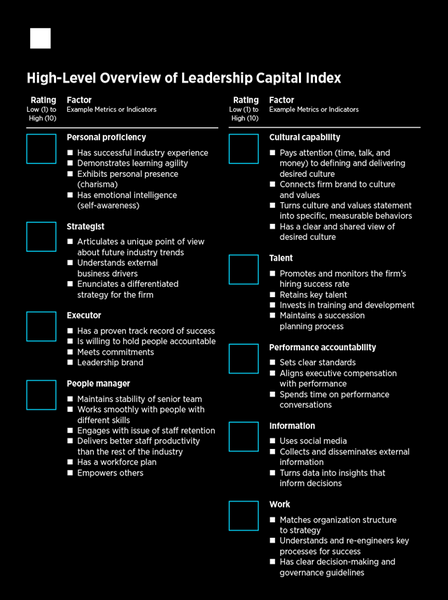
The leadership capital index addresses five factors from the individual leader's domain—four from the basic code and a fifth from the differentiator:
The leadership capital index addresses five factors from the individual leader's domain—four from the basic code and a fifth from the differentiator:
Content
Personal proficiency—To what extent does the leader demonstrate the personal qualities required for effectiveness?
Personal proficiency—To what extent does the leader demonstrate the personal qualities required for effectiveness?
Content
Strategist—To what extent does the leader articulate a point of view about the future and strategic positioning?
Strategist—To what extent does the leader articulate a point of view about the future and strategic positioning?
Content
Executor—To what extent does the leader make things happen and deliver as promised?
Executor—To what extent does the leader make things happen and deliver as promised?
Content
People manager—To what extent does the leader build the competence, commitment, and contribution of employees today and tomorrow?
People manager—To what extent does the leader build the competence, commitment, and contribution of employees today and tomorrow?
Content
Leadership brand—To what extent do leaders inside a company act in ways customers expect?
Leadership brand—To what extent do leaders inside a company act in ways customers expect?
Content
With these five elements in mind, investors can do a rigorous job of assessing leadership capital. Investors who are serious about leadership can perform a leadership audit through interviews, observations, and surveys of potential investments.
With these five elements in mind, investors can do a rigorous job of assessing leadership capital. Investors who are serious about leadership can perform a leadership audit through interviews, observations, and surveys of potential investments.
Domain 2: Organizational capability and human capital
Content
Besides the quality of the individuals currently holding leadership positions, a firm's leadership capital includes its investment in cultural development and talent development practices designed to build future leaders. As with personal competencies of effective individual leaders, this domain is far-reaching, ranging from specific HR-related practices such as executive compensation to human capital issues such as training investments, to broader issues such as culture.
Besides the quality of the individuals currently holding leadership positions, a firm's leadership capital includes its investment in cultural development and talent development practices designed to build future leaders. As with personal competencies of effective individual leaders, this domain is far-reaching, ranging from specific HR-related practices such as executive compensation to human capital issues such as training investments, to broader issues such as culture.
Content
For human capital to be accurately assessed in valuation discussions, the complex domain of processes, practices, metrics, tools, and ideas must be simplified. Here are five organizational factors for a leadership capital index—one overall, and four devoted to aspects of the talent practices that drive culture.
For human capital to be accurately assessed in valuation discussions, the complex domain of processes, practices, metrics, tools, and ideas must be simplified. Here are five organizational factors for a leadership capital index—one overall, and four devoted to aspects of the talent practices that drive culture.
Content
Cultural capability—To what extent has the leadership created a customer-focused culture that is shared throughout the organization?
Cultural capability—To what extent has the leadership created a customer-focused culture that is shared throughout the organization?
Content
Talent—To what extent has the leadership invested in practices that manage the flow of talent into, through, and out of the organization?
Talent—To what extent has the leadership invested in practices that manage the flow of talent into, through, and out of the organization?
Content
Performance accountability—To what extent has the leadership created performance management practices that reinforce the right behaviors?
Performance accountability—To what extent has the leadership created performance management practices that reinforce the right behaviors?
Content
Information—To what extent has the leadership managed information flow to gain information asymmetries?
Information—To what extent has the leadership managed information flow to gain information asymmetries?
Content
Work—To what extent has the leadership created organization and work practices that deal with the increasing pace of change in today's business setting?
Work—To what extent has the leadership created organization and work practices that deal with the increasing pace of change in today's business setting?
Content
Investors can assess the human capital of an organization by determining if leaders wisely invest in these organization practices.
Investors can assess the human capital of an organization by determining if leaders wisely invest in these organization practices.
Putting the leadership capital index into practice
Content
Investors come with many intents and approaches. The leadership capital index supplements financial (earnings, income statement, balance sheet) and intangible (strategy, brand, information systems, operational processes) insights. In essence, it enables active investors to gain more rigorous insights into the elements of leadership.
Investors come with many intents and approaches. The leadership capital index supplements financial (earnings, income statement, balance sheet) and intangible (strategy, brand, information systems, operational processes) insights. In essence, it enables active investors to gain more rigorous insights into the elements of leadership.
Content
For example, a private equity investor may screen 200 organizations to identify 40 that meet financial and intangible investment criteria. But it needs to do deeper analyses—a thorough leadership audit—of those firms to select 20 that it ultimately will invest in. I propose four stages of this sort of assessment.
For example, a private equity investor may screen 200 organizations to identify 40 that meet financial and intangible investment criteria. But it needs to do deeper analyses—a thorough leadership audit—of those firms to select 20 that it ultimately will invest in. I propose four stages of this sort of assessment.
Content
Stage 1: Leadership general observations. Investors realize that leadership matters to sustainable performance. These observations will include making judgments about the CEO or top team based on casual interviews. But remember that these impressionistic views of talent are often biased and risky.
Stage 1: Leadership general observations. Investors realize that leadership matters to sustainable performance. These observations will include making judgments about the CEO or top team based on casual interviews. But remember that these impressionistic views of talent are often biased and risky.
Content
Stage 2: Leadership domain awareness. Investors recognize both individual and organizational domains of leadership. This awareness leads to observations and some light probing such as, "Tell me about your leadership team" or asking "How effective is your organization?" These queries at least acknowledge the impact of individual competencies and organization capabilities.
Stage 2: Leadership domain awareness. Investors recognize both individual and organizational domains of leadership. This awareness leads to observations and some light probing such as, "Tell me about your leadership team" or asking "How effective is your organization?" These queries at least acknowledge the impact of individual competencies and organization capabilities.
Content
Stage 3: Leadership element assessment. Investors have a more robust way of conceiving both individual and organizational domains. A more thorough assessment addresses the questions outlined in the 10 factors.
Stage 3: Leadership element assessment. Investors have a more robust way of conceiving both individual and organizational domains. A more thorough assessment addresses the questions outlined in the 10 factors.
Content
Stage 4: Leadership item assessment. Investors probe deeply into each of the 10 factors. For each factor, there are five or six specific items that may indicate the quality of leadership. The results can then be plotted into a chart to capture the quality of leadership for either the top leader, leadership team, or organization capabilities.
Stage 4: Leadership item assessment. Investors probe deeply into each of the 10 factors. For each factor, there are five or six specific items that may indicate the quality of leadership. The results can then be plotted into a chart to capture the quality of leadership for either the top leader, leadership team, or organization capabilities.
Content
By having a consistent and reliable metric of leadership, companies could give investors increasing confidence in the leadership that could affect intangibles and financial performance over time. What does this mean for the C-level executives inside organizations? The answer is simple: They need to be using this same framework to assess the leadership capital that investors will value.
By having a consistent and reliable metric of leadership, companies could give investors increasing confidence in the leadership that could affect intangibles and financial performance over time. What does this mean for the C-level executives inside organizations? The answer is simple: They need to be using this same framework to assess the leadership capital that investors will value.
Content
Content
Read more from CTDO magazine : Essential talent development content for C-suite leaders.
Read more from CTDO magazine: Essential talent development content for C-suite leaders.