
The Public Manager Magazine Article
Member Benefit
Compliance Training That's More Than Checking Boxes
Content
Mandated training can be meaningful, relevant, and engaging.
Mandated training can be meaningful, relevant, and engaging.
Fri Mar 10 2017
Content
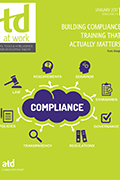
Federal laws and guidance relating to compliance stipulate that training must be effective. For example, Title IX requires "rigorous and effective" training, according to Travis Waugh's " Building Compliance Training That Actually Matters ," the January bonus issue of TD at Work .
Federal laws and guidance relating to compliance stipulate that training must be effective. For example, Title IX requires "rigorous and effective" training, according to Travis Waugh's "Building Compliance Training That Actually Matters," the January bonus issue of TD at Work.
Content
Why, then, do far too many leaders, managers, and employees treat compliance training as an infringement on their closely shielded time, rather than as a valuable means to change behaviors around critical matters such as safety, data security, harassment, and discrimination?
Why, then, do far too many leaders, managers, and employees treat compliance training as an infringement on their closely shielded time, rather than as a valuable means to change behaviors around critical matters such as safety, data security, harassment, and discrimination?
Content
Waugh—an instructional technologist for the Georgia Institute of Technology—reminds managers and trainers alike that compliance training can be relevant and engaging. He explains how instructional designers can modify their training to capture the attention of learners and help them retain important compliance information, changing their behavior.
Waugh—an instructional technologist for the Georgia Institute of Technology—reminds managers and trainers alike that compliance training can be relevant and engaging. He explains how instructional designers can modify their training to capture the attention of learners and help them retain important compliance information, changing their behavior.
Content
Using the ADDIE model of instructional design, Waugh encourages instructional designers to get to the root of what the law and other regulations mandate what must be taught. This can be a challenge, as Waugh illustrates in his story of a subject matter expert who claimed "we had no choice but to include 77 text-heavy slides in an annual compliance tutorial." In reality, the law mandated only that employees receive annual training in the area but did not stipulate what the training must include.
Using the ADDIE model of instructional design, Waugh encourages instructional designers to get to the root of what the law and other regulations mandate what must be taught. This can be a challenge, as Waugh illustrates in his story of a subject matter expert who claimed "we had no choice but to include 77 text-heavy slides in an annual compliance tutorial." In reality, the law mandated only that employees receive annual training in the area but did not stipulate what the training must include.
Content
The issue of TD at Work also emphasizes that compliance training should address problems and challenges that actually exist. To determine that, Waugh suggests instructional designers "get out and talk with our learners to determine where they are and what they need, just as we would for any other learning project where we hope to achieve real results."
The issue of TD at Work also emphasizes that compliance training should address problems and challenges that actually exist. To determine that, Waugh suggests instructional designers "get out and talk with our learners to determine where they are and what they need, just as we would for any other learning project where we hope to achieve real results."
Content
In determining what content to include in training, Waugh encourages instructional designers to meet the SMARTER criteria: material that is specific, measurable, achievable, relevant, traceable, efficient, and reviewable. For example, use a story or explain how a point will be relevant to the audience—and don't use training that involves a scenario that takes place in a factory if your employees work in an office.
In determining what content to include in training, Waugh encourages instructional designers to meet the SMARTER criteria: material that is specific, measurable, achievable, relevant, traceable, efficient, and reviewable. For example, use a story or explain how a point will be relevant to the audience—and don't use training that involves a scenario that takes place in a factory if your employees work in an office.
Content
Waugh also advises designers to be considerate of employees' schedules by using the least amount of time and fewest words possible to convey learning points. Employees and managers will appreciate it, even if they don't actually utter the words "thank you."
Waugh also advises designers to be considerate of employees' schedules by using the least amount of time and fewest words possible to convey learning points. Employees and managers will appreciate it, even if they don't actually utter the words "thank you."
Content
Learners will also take a cue from how the training is packaged. Who wants to spend time on a course titled "FERQ Mandatory Compliance Training Initiative 2016/17"? If training is conducted online, make sure the lessons are attractively packaged, Waugh writes. Focusing on the learning that will take place and its relevance to the employee, rather than the applicable law, will make the training more palatable.
Learners will also take a cue from how the training is packaged. Who wants to spend time on a course titled "FERQ Mandatory Compliance Training Initiative 2016/17"? If training is conducted online, make sure the lessons are attractively packaged, Waugh writes. Focusing on the learning that will take place and its relevance to the employee, rather than the applicable law, will make the training more palatable.
Content
For both private and public sector employees and managers, attention to compliance helps ensure an environment free from bullying, maintain data—such as citizen Social Security numbers—in a secure fashion, and abide by appropriate hiring and retention practices. Waugh's guidance can make training more enjoyable and effective at meeting these goals.
For both private and public sector employees and managers, attention to compliance helps ensure an environment free from bullying, maintain data—such as citizen Social Security numbers—in a secure fashion, and abide by appropriate hiring and retention practices. Waugh's guidance can make training more enjoyable and effective at meeting these goals.