
Talent Development Leader
A Modernized L&D Strategy
Content
The NAIC prioritized stakeholders and team members when revamping its training strategy.
Fri Jan 19 2024

Content
The NAIC prioritized member experience when revamping its training strategy.
Content
Solution: Reimagine the company’s L&D strategy to provide accessible, practical, and relevant training and professional development programs.
Content
Business impact highlight: An analysis uncovered four pillars for modernizing the education and training function, including plans to convert 80 percent of weeks-long training courses into modularized coursework.
Content
The days of the five- or 10-year strategic plan are over. Tech innovations, market volatility, and changing workforce demographics require organizational leaders to adapt their business models and goals more frequently. The National Association of Insurance Commissioners is no different.
Content
Every three years, the NAIC updates its strategic plan. The association assesses the operational facets of the company, member expectations, and changes to its industry. Analysis revealed that the NAIC’s training audience has evolved significantly in recent years. The audience, which once primarily comprised seasoned professionals seeking ongoing professional development and general knowledge updates, now included a younger workforce new to the insurance industry. Rather than seeking training that led solely to credentialing, the NAIC’s current audience members sought for just-in-time, on-demand training and knowledge that they could quickly apply to their work.
Content
So, the NAIC’s latest strategic plan, which focuses on 2023 to 2025, specifically called for modern training formats and delivery mediums for the more than 10,000 insurance regulators and other insurance industry professionals to which the training department caters.
Content
While the L&D function had been making small changes behind the scenes for a few years, such as implementing automation and logic in the learning management system, the strategic plan gave us the larger-scale support needed to conduct a complete overhaul of our L&D strategy.
Where to start
Content
The NAIC is a member association serving insurance regulatory agencies in all 50 US states; Washington, DC; and the five US territories. The NAIC staff provide insurance regulatory support via technological tools, member meetings, and training programs. To follow through on the strategic plan, the L&D team relied on our training expertise and applied ADDIE methodology to begin.
Content
We spent a lot of time on the project’s analysis phase—probably more time than anyone expected. We needed a clear picture of the current state of the entire training function, giving us a gap analysis from which to chart the project path. To start the analysis, we reviewed member meeting notes, course evaluations, audience suggestions, and general member survey results for the previous two years.
Content
Once sorted and consolidated, data showed that we had obsolete formatting and delivery methods. For example, we offered content in two- and three-week training courses, which may have worked well in the past, but today’s learners require a more agile approach to content packaging and delivery. Another challenge was a clunky registration process with no on-demand learning available.
Content
Following that exercise, we dug a little deeper. As a starting point, we reviewed already-collected data from the member meeting notes and member survey. Although the majority of the materials did not garner feedback specifically on training programs, there was a data gold mine. For example, we unearthed several role-specific training needs and found that some regulatory job roles needed additional training that we didn’t currently offer.
Content
Next, we conducted several targeted surveys to glean further details about the top knowledge and skill needs for specific types of roles, as well as their preferred access to training and information.
Content
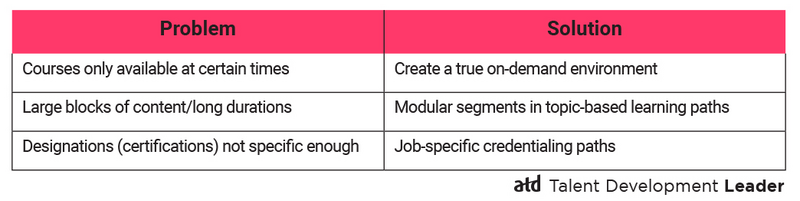
We ultimately created a problem-statement chart:

Content
Then, we formed a steering committee comprised of eight members of our audience who hold senior-level roles in their agencies, meaning they are both our learners and the leaders of our learners.
Content
All the front-end activities empowered us to determine four specific deliverables that would move us toward accomplishing identified outcomes.
Content
Content update and modularization. When someone is new to a role, their employer typically offers on-the-job training. Our analysis found that it didn’t make sense to only offer those workers lengthy courses because they may need quick access to information they can apply immediately to tasks.
Content
The NAIC should be the source for complementary information and learning; therefore, our team plans to review 100 percent of our online content, which comprises the majority of training offerings. From there, we intend to update and modularize approximately 80 percent of those online deliverables.
Content
A redesign of the credentialing program. The current program structure involves completion of required courses with an associated exam. We are updating the program’s framework to offer modularized coursework (some of which will become optional) potentially with an overarching exam for each credential.
Content
Shared knowledge hub. As a response to numerous requests, we have conceptualized a centralized hub for regulators to share any nonstate-specific training and resources that could help their peers in different jurisdictions. The goal is for 50 percent of the member jurisdictions to use resources available in the knowledge hub.
Content
Technology updates. We plan to replace the existing LMS with one that offers more robust capabilities to optimize the learner experience. The LMS also creates efficiencies on the back end for administrators, which enables us to spend more time focusing on building, deploying, and maintaining content. For example, the current LMS doesn't allow for self-enrollment in the 70 available courses. Learners must register in a different system; then, administrators pull rosters and manually upload the information into the LMS. Registration capabilities in the new LMS will eliminate that redundancy.
Engage and communicate with stakeholders
Content
One of the biggest lessons learned was that I should have spent more time on engaging stakeholders from the beginning. The project had the advantage of being one of the organization’s main strategic focus areas, but that didn’t mean stakeholders understood what the training team was doing.
Content
Moving forward with the L&D strategy’s revamp, I need to focus on determining the stakeholders and defining their individual needs. That way, I can better share what is going on, why it is happening, how it involves them, when the plan will kick off or move forward, as well as ask what our function needs from them to achieve its goals.
Content
For example, the chief financial officer is one of our stakeholders. I typically ask the CFO for funding and other resources, and they’re looking for information about how changes in training will affect the organization’s bottom line.
Content
Another group of stakeholders is the L&D team itself. The new strategy requires major changes to the training we develop and how we deliver and track it. The project will require a different team structure or new job roles to be successful. During our front-end analysis, we carefully thought about the job roles we would need. When considering the necessary job roles moving forward, we will take existing employees out of the picture and evaluate whether current staff can perform newly defined roles and whether any team members need upskilling or reskilling.
Content
For example, the NAIC now needs an LMS administrator, a role we did not previously have. To meet the requirements for the role, we will offer a reskilling opportunity to a current employee.
Content
Prioritizing the L&D team’s buy-in was important from the get-go. As we implement the new strategy, I need to be sure to ask for feedback and seek to understand their concerns and needs.
Stay the course
Content
Many teams get stuck. Our team certainly did, especially early in the project. We took a time-out to refocus on defined outcomes. Then, we homed in on why we were stuck, which enabled us to brainstorm next steps and create an action plan—which got us moving again.
Content
Maintaining that momentum toward executing the plan is our path forward. Step 1 is to get the new LMS up and running. Step 2 is for us to outline role-specific learning paths focused on job roles rather than broad industry topics.
Content
The instructional design team will start with 12 job roles, creating learning paths supported by just-in-time training courseware. Following a rolling phase approach to content development, we will add deliverables to the LMS. The process will include a review and maintenance cycle for content as well as ways to evaluate training effectiveness and engagement.
Content
Because the NAIC is a member association, member feedback weighs heavily as a success factor and our team’s success metrics may look a little different than other companies’. As we transition into the implementation phase, we plan to add training satisfaction to a member scorecard.
Content
By establishing those four deliverables, we have set distinct project pillars that will become the foundation of our modern L&D strategy (in the design and development phases). It was a tremendous amount of work, but the project team had—and continues to have—a clear vision of desired results.
Content
Read more from Talent Development Leader .
Read more from Talent Development Leader.

Content