
Talent Development Leader
Prepare Your Deskless Workers, All Year Round
In a recent Talent Development Leader webinar, industry experts discussed how talent leaders can better provide training that facilitate deskless employees’ success in their work all year-round.
Wed Feb 19 2025
Brought to you by

In a recent Talent Development Leader webinar, Talent and Development Manager at RSM US, Beth McGoldrick, Training and Development Manager at Rosendin, Phillip Browning, and Talent Development Manager at MAREK, Shannon Davis, discussed how talent leaders can provide training to facilitate deskless employees’ success in their work.
While this webinar was titled, Prepare Your Deskless Employees for the Busy Season, panelists provided tips and tricks that can be used for frontline worker training year-round.
Start by Asking Powerful Questions
When a training request comes in, it is often contextualized as something employees don’t do. No matter what the skill gap is, communicating the problem is the first step to a solution. McGoldrick says the key to identifying the problem is asking the right questions." The question we need to come back to the business with is: Did they ever know how to do (fill in the blank)? If not, then let's talk about further training needs,” she explained.
Gilbert’s Behavior Engineering Model
One tool that the panel recommends for assessing training needs is Gilbert’s Behavior Engineering Model (BEM), a tool that’s been in use since the 1960s.
Gilbert’s BEM is a data collection technique that identifies two workplace areas: the environment that supports employees, and individual performance and behavior. Within these two areas there are three categories for assessment: information, instrumentation, and motivation. The goal is to determine how the individual and their environment intersect, and to identify specific areas for training implementation.
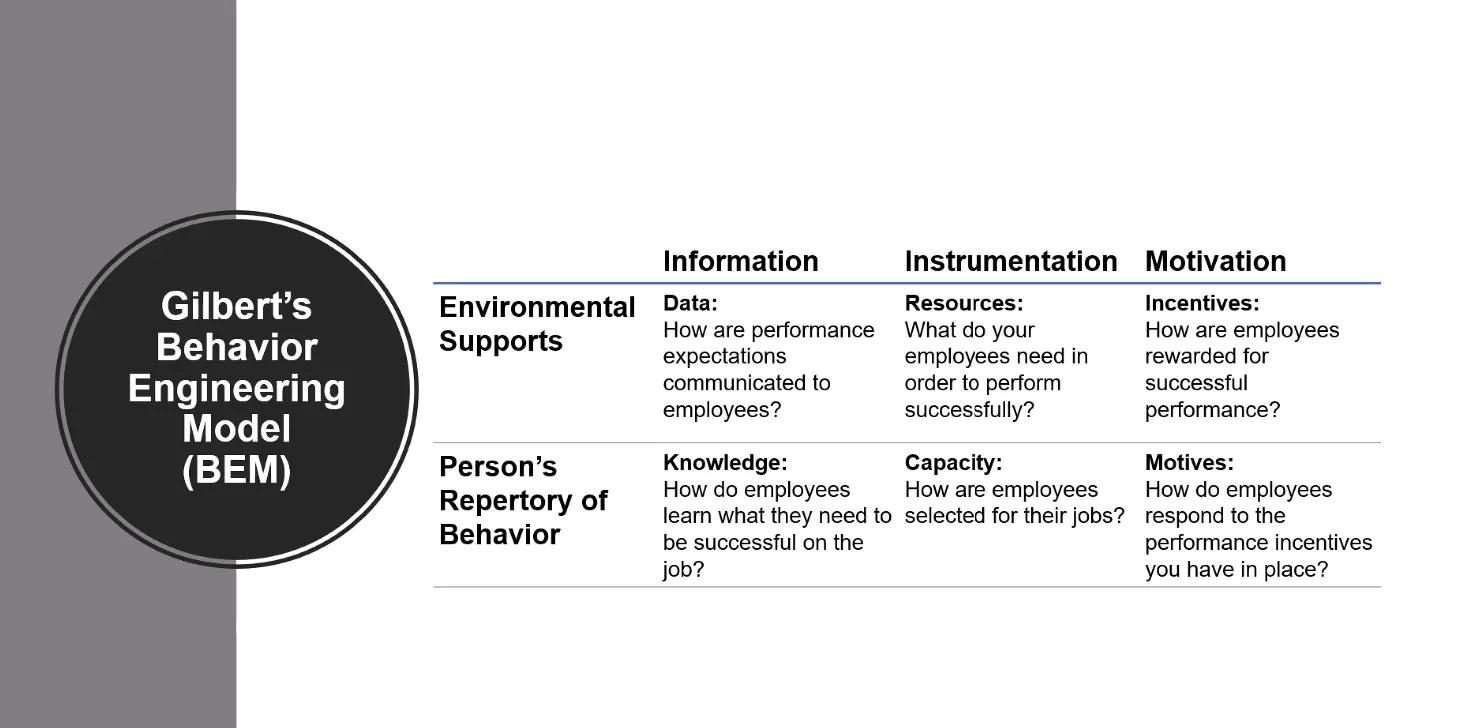
Use this tool from the top down, left to right. Since shifting an individual’s internal motivation is usually the most difficult task, that element is broached last. For quicker results, first track behaviors that are easier to change.
“It seems kind of silly, but if you're talking about changes going on at the business, a lot of times people just want to see the changes in the results. But we have to remind them that we're working with people and, people need to have reasons to do things and they need to have the tools and this is where all of this comes in and where your value comes in and where they're going to come back and keep asking you questions going forward,” explained McGoldrick.
Training Is Just One Piece of the Puzzle
For Shannon Davis and MAREK, the talent development team’s goal has always been to engage frontline workers. Creating opportunities, providing tools for productivity, and staying connected have been core values since day one for deskless employees.
Davis explains how their plan began as custom training that just checked the box. While that solution worked at the time, it wasn’t the best in the long-term. More than nine years later, the talent development function has positioned themselves as strategic partners. MAREK is moving away from learning = training. Instead, they’re adopting a mindset of learning as a solution. Now, they ask questions like: “How can we help you?” and “How can we deliver a solution that's going to make a difference?” Davis’s advice is to have bigger conversations.
“When someone comes to me and says, I need training, I'm like, great. Training is just a piece of the puzzle. So, here's all the things we can do, right? We can build a simulation. My team can build the best e-learning. They can do an eight-hour ILT (instructor-led training) if that's really what you think, but let's first go back to the beginning,” Davis said.
Broader deliverables may include providing a streamlined process or connecting teams across the organization, instead of just training support. Davis and her team aim to change behaviors, not just check a box.
Moving On From the Past
For Phillip Browning at Rosendin, an electrical contracting company with 7,500 field employees in union contractor positions, talent development has often depended on the past. There’s an apprenticeship program to train electricians, but it doesn’t always provide the necessary training, and it doesn’t focus on the tasks of today.
At Rosendin, the project managers, field leaders, and safety teams are also deskless. When one of these leaders requests training, Browning explores what that training should focus on. The answer is sometimes . . . everything. In such cases, Browning turns to the data, resources, and motivation of deskless employees.
“In the construction world, the data is the drawings. Do they have the drawings that they're going to build to? And the resources are the tools. Do they have the drills and the benders and everything they need to get that work done in place. And then the motivation could come from whether they are recognized as workers, if there are paid incentives, and if they get something extra if they beat the time hack,” explained Browning. “And all those things come into play when we start looking at how well our training works, because it needs to meet those needs.”
One way to meet those needs is to clearly define roles and responsibilities. When roles, tools, and goals are well defined, it is easier to take note of where things are falling short. It’s also useful to tap into other parts of the organization. If your team doesn’t have the necessary measurements or data available, it is likely that another team is tracking those benchmarks. Alignment that looks to the future will rely on open communication and cross-organizational teamwork.
Training Methods for Deskless Workers
Think about your preferred development methods and those you’ve used in the past. What worked for you? Why did it work? Was it successful because the company provided support? Or because managers gave permission for people to attend?
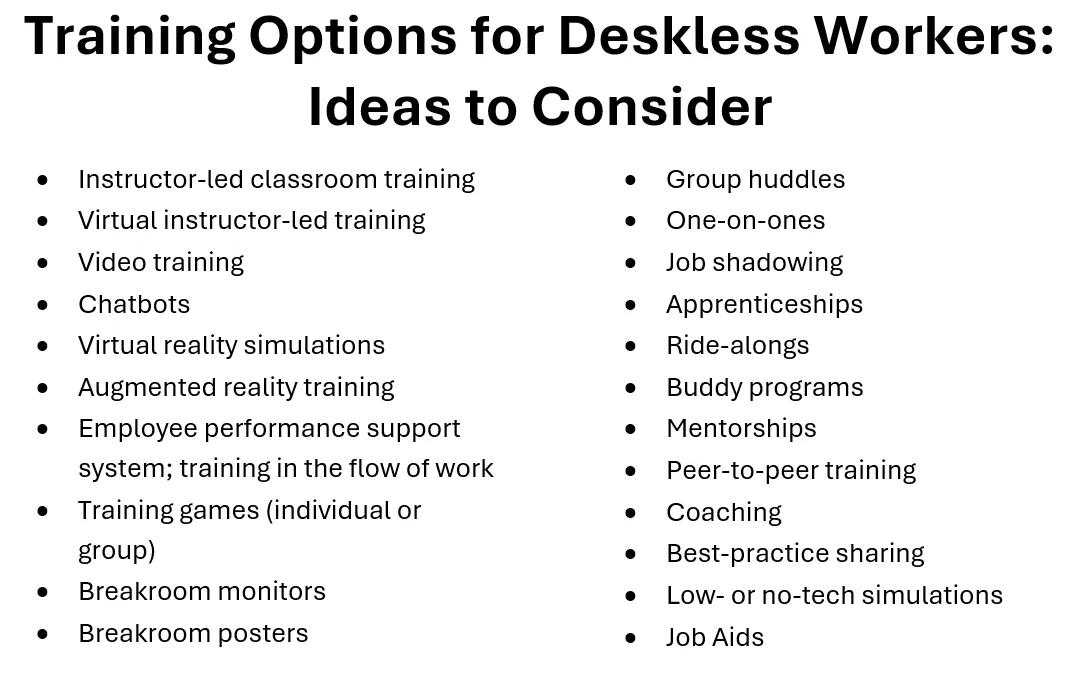
Keep the traditional methods that show results and eliminate those that aren’t helping. Here are ideas for both traditional and modern training solutions for deskless workers:
Video training: Tried and true. Videos can be fun and bite-sized for on-the-go training. If employees have tablets or computers, videos can make training more accessible.
Chatbots: Sometimes training happens on the job. With chatbots, employees don’t have to guess. A chatbot can provide whatever is needed in real time, without disrupting workflow.
Employee performance support systems: Training that occurs alongside employees as their work not only keeps learning in the flow, but also puts less pressure on the worker-in-training. Training games and breakroom monitors may seem old school, but they still work!
Break room posters or group huddles: Morning group huddles—five or ten-minute talks about the key points for the day— can be enough to shift daily routines.
One-on-one solutions: Job shadowing, apprenticeships, ride-alongs, or paired training can aid new hires and seasoned employees. If an employee is looking to take on more tasks and needs to upskill, a one-on-one training solution provides both in-depth training and real practice in the flow of work. These can also take the form of a buddy or mentorship program.
Simulations and job aids: These come in all different forms. They can be as fancy as augmented reality or as simple as a paper drawing.
Panelists reviewed this full list of training options for deskless workers, and participants discussed which have been most effective for their frontline employees.
Every organization is unique, and every workforce is different; the solutions you choose for deskless workers need to fit the context. “Always challenge what's always worked, what assumptions we've made. Maybe it worked for a reason. So, it's okay if it's not broken. Maybe there's not a need to fix it,” said Davis. “But if there is a need to fix it, go ahead and try.”
Finally, panelists also shared practical tips for those leading frontline employees. These approaches help meet workers where they are and empower them toward stronger performance.
Listen to the frontline workers: Find out what training style they want. Talent leaders are experts, but not the only ones with ideas. Forums are a great way to start listening.
Be adaptive: Don’t stick to a training solution just because of a sunk cost. If something isn’t working, shift. You don’t need to start from scratch; small adjustments can turn an okay training into a great one.
Assess right from the start: Conduct a skills assessment when you hire someone. Evaluating them doesn't affect their employment ability, but it might affect where they get placed and inform the trainings they should undergo in the future.
Create competition: Friendly competition, regardless of the modality, has been successful among teams and deskless workers to foster unity, purpose, and motivation. Providing a reward at the end, such as a swag item or extra learning hour, offers an extra drive to win and a sense of pride.
Boost champions of the training: Elevate those who go through the training and have a positive experience. Allow them to share with others to encourage training participation at a grass-roots level. This will increase the program’s credibility.
Put yourself in their shoes: Sometimes in-classroom training is possible, but it can be hard to pull people off the floor. Virtual instructor-led training can help make it as easy as possible. Are people in different time zones? Can the training be recorded or broadcast? Are there language or accessibility barriers? Can you follow up with a live discussion of the content?
For more on this topic, watch the webinar recording here or read the full transcript here.
View Courses Recommended for You