
Talent Development Leader
The Science Behind Change Fatigue and Burnout
Content
Britt Andreatta shares her most recent research concerning a huge challenge nearly every organization faces currently: The resistance to change that change fatigue and burnout create.
Thu Jun 27 2024

Content
Keeping up with critical research is essential for talent professionals. It’s not just about knowing new information, but using it to inform your strategy and problem-solving in effective ways. Last month at ATD24, I presented my most recent research concerning a huge challenge nearly every organization faces currently: The resistance to change that change fatigue and burnout create.
Content
Here, you’ll find a summary of my key findings and discover how understanding the brain science that causes these negative effects can help us create healthier work environments for employees. You’ll also get a glimpse of my recommendations on what we as talent professionals can do to reduce change resistance and fatigue in our organizations.
Content
Takeaway #1: The pandemic has completely altered people’s bandwidth to handle change.
Content
The challenge we’re facing is not an easy one. Employees’ ability to cope with change is 50 percent of pre-pandemic levels. Today, the average employee experiences 10 planned organization-wide changes a year, up from just two in 2016. Their willingness to support changes has collapsed from 74 percent in 2016 to only 43 percent. Smaller scale, personal changes such as a new manager or moving to a new team are 2.5 times more fatiguing than larger organizational changes like mergers or acquisitions.
Content
This means a high number of employees are exhibiting the symptoms of change fatigue, which are:
Content
Disengagement
Disengagement
Content
Emotional exhaustion
Content
Absenteeism
Absenteeism
Content
Conflict, cynicism
Conflict, cynicism
Content
Low performance and productivity
Content
Increased stress and anxiety
Content
Takeaway #2: Change resistance is wired into our brains.
Content
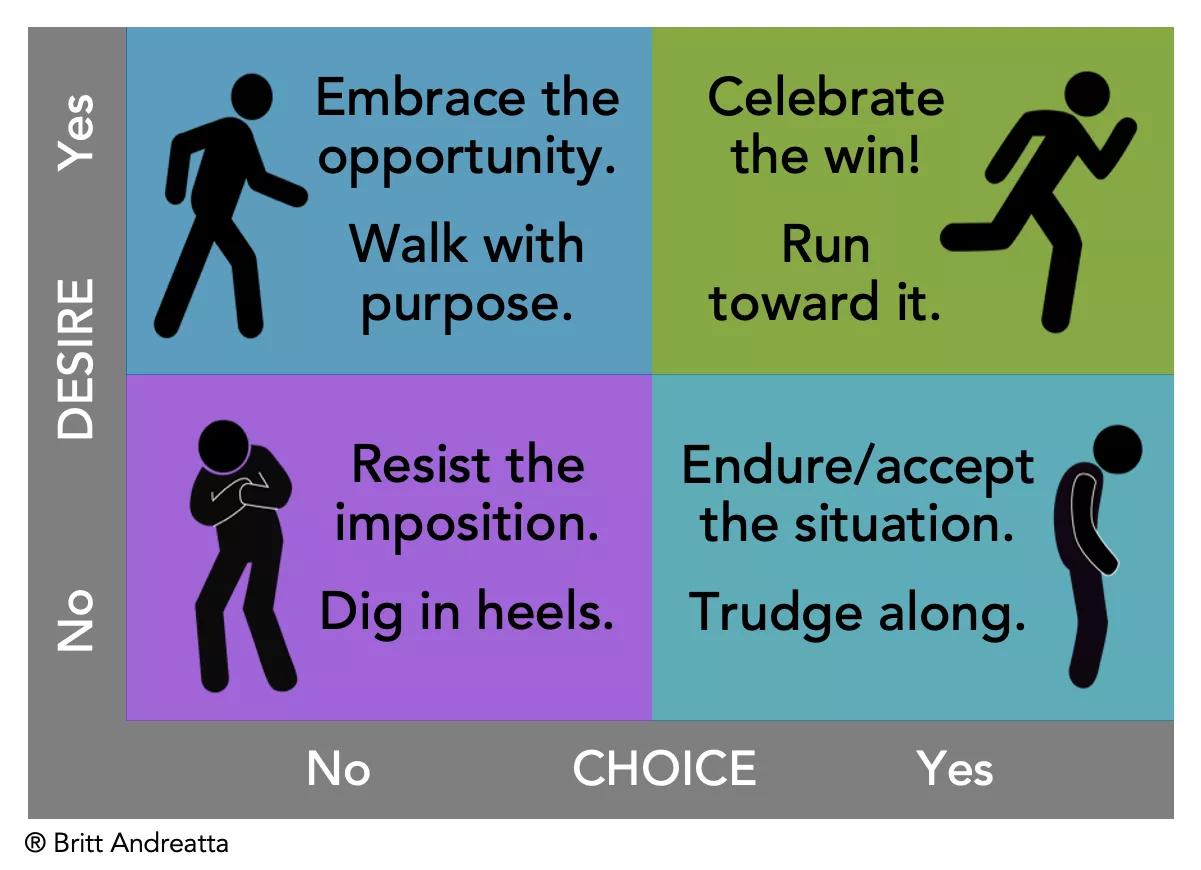
Humans are predisposed to resist change. Our brain, and particularly the amygdala, sees all change as potential danger. Humans naturally first react by focusing on what could be lost because of a change. Our motivation for change is largely shaped by two things: Did we want the change, and did we choose the change?
Content
I’ve created this matrix that will help you assess your people’s motivation for any particular change initiative. This will also help you gauge the kind of leadership and support your team needs to bring to override any lack of motivation.
Content
Repetition builds habits, which are well-grooved neural pathways of behaviors that can be done on autopilot. But change disrupts this flow and asks people to develop new habits—which are awkward and uncomfortable at first and can lead people to default to the old behavior if proper training is not provided. To make change successful, we must proactively counteract those failures with proper training and practice along with positive recognition and rewards.
Content
Takeaway #3: Creating successful change starts with you.
Content
There are several evidence-based strategies that drive successful change (to learn more, read my book, Wired to Resist ). Here are four tips to create successful change:
There are several evidence-based strategies that drive successful change (to learn more, read my book, Wired to Resist). Here are four tips to create successful change:
Content
Increase emotional intelligence:
Content
Change creates a range of emotions for people, so the leaders and managers must have the emotional intelligence and skills to effectively manage those emotions—both their own as well as those they lead. A good leader understands that when employees struggle with change, they are not being difficult—they are being human. One study found that nearly halfof managers say emotional intelligence is most important when leading teams through times of change.
Content
Communicate clearly and consistently:
Content
Be prepared to answer questions and be direct. When surveyed about change messaging, only 68 percent of leaders could name what was happening and why (should be 100 percent), which led to only 53 percent of managers and 40 percent of employees. This has a huge detrimental impact on people’s buy-in and trust. Use multiple channels (meetings, documents, videos, and others) to get the word out and repeat your messaging frequently.
Content
Map the route:
Map the route:
Content
Create a visual representation of the change journey, complete with destination and the milestones along the way. It’s important to note though, solving a problem is a more appealing activity for the brain than executing a task, so framing a change initiative as a series of phases to solve for different issues may be a more effective way to get people on board.
Content
Celebrate effort and progress:
Content
People’s brains are wired to avoid future failure with the habenula restricting dopamine and serotonin for negative messages like being over budget or behind schedule. Combat that biological reaction by first celebrating effort and progress before focusing in on areas for improvement.
Content
Leverage the power of learning:
Content
Provide people the tools to build the skills and habits they will need to make the change successful. But to get all these things right, it’s essential to have an onboarding or training process. During my session, I asked participants if their organizations currently offered training on change: 42 percent responded that they have an in-house training; 20 percent have an outsourced one, and over almost 40 percent have none yet. We can’t expect people to embrace change without giving them the resources they need to do it well.
Content
Change is hard for everyone, but understanding the science of why humans initially resist change, and what we can do to mitigate those effects, will make our people more resilient and our organizations more agile.
Content
Read more from Talent Development Leader .
Read more from Talent Development Leader.
Content
About Britt Andreatta
Content
Britt Andreatta, PhD. is an internationally recognized thought leader who uses her background in leadership, neuroscience, psychology, and education to create science-based solutions for today’s workplace challenges. Britt is the CEO of Brain Aware Training and former CLO for Lynda.com (LinkedIn Learning). She has more than 10 million views worldwide of her online courses and is the author of several best-selling books on the brain science of success including Wired to Grow , Wired to Resist , Wired to Connect , and Wired to Become . In 2024, she was awarded the ATD Thought Leader Award. She has also been named as a Top 10 Influencer in Learning and a Top 20 Influencer for Leadership Development. Britt regularly consults with organizations on leadership development and learning strategy.
Britt Andreatta, PhD. is an internationally recognized thought leader who uses her background in leadership, neuroscience, psychology, and education to create science-based solutions for today’s workplace challenges. Britt is the CEO of Brain Aware Training and former CLO for Lynda.com (LinkedIn Learning). She has more than 10 million views worldwide of her online courses and is the author of several best-selling books on the brain science of success including Wired to Grow, Wired to Resist, Wired to Connect, and Wired to Become. In 2024, she was awarded the ATD Thought Leader Award. She has also been named as a Top 10 Influencer in Learning and a Top 20 Influencer for Leadership Development. Britt regularly consults with organizations on leadership development and learning strategy.