ATD, association for talent development

Talent Development Leader

Workflow Learning Has a Mistaken Identity

By and

Mon May 15 2023

Workflow Learning Has a Mistaken Identity
Loading...

Content

There is a misconception about what workflow learning is, and that misunderstanding is costing organizations substantially.

There is a misconception about what workflow learning is, and that misunderstanding is costing organizations substantially.

Content

There is a great deal of confusion in industry-wide conversations about workflow learning. Some assume that any learning solution accessed from within the workflow constitutes workflow learning. That is incorrect. For example, microlearning made available in the workflow still requires an employee to stop work to learn.

There is a great deal of confusion in industry-wide conversations about workflow learning. Some assume that any learning solution accessed from within the workflow constitutes workflow learning. That is incorrect. For example, microlearning made available in the workflow still requires an employee to stop work to learn.

Content

Several years ago, the chief learning officer of a retail company invited us to help his team expand its learning reach into the workflow with measurable solutions. At the outset, we co-developed a learning and job performance strategy that enabled employees to learn while working. A key deliverable was a communication deck for corporate leadership.

Several years ago, the chief learning officer of a retail company invited us to help his team expand its learning reach into the workflow with measurable solutions. At the outset, we co-developed a learning and job performance strategy that enabled employees to learn while working. A key deliverable was a communication deck for corporate leadership.

Content

In the cost-justification section, we highlighted the direct organizational costs incurred for lost work whenever employees stopped working to participate in traditional learning experiences. The cost of stopping work to learn was twice the cost of developing and delivering traditional training solutions.

In the cost-justification section, we highlighted the direct organizational costs incurred for lost work whenever employees stopped working to participate in traditional learning experiences. The cost of stopping work to learn was twice the cost of developing and delivering traditional training solutions.

Content

The CLO let us know he wouldn’t be sharing that hidden cost with his leadership. It was and remains incomprehensible to us that any talent development leader would ignore the most significant cost of training services and then fail to responsibly address and justify that investment.

The CLO let us know he wouldn’t be sharing that hidden cost with his leadership. It was and remains incomprehensible to us that any talent development leader would ignore the most significant cost of training services and then fail to responsibly address and justify that investment.

Content

The average organization had a direct learning expenditure of $1,290 per employee in 2021 and used 33 learning hours per employee, according to the Association for Talent Development’s 2022 State of the Industry report . Assuming the US Department of Labor’s estimated employee cost burden of $41.86 per hour, the annual work stoppage cost per employee is $1,381.38. When added to the original expenditure, that more than doubles the average organizational cost of training.

The average organization had a direct learning expenditure of $1,290 per employee in 2021 and used 33 learning hours per employee, according to the Association for Talent Development’s 2022 State of the Industry report. Assuming the US Department of Labor’s estimated employee cost burden of $41.86 per hour, the annual work stoppage cost per employee is $1,381.38. When added to the original expenditure, that more than doubles the average organizational cost of training.

Content

That is a simple math problem that every TD leader should solve for their organization. Once you know the cost of an employee stopping work to learn, answer two questions:

That is a simple math problem that every TD leader should solve for their organization. Once you know the cost of an employee stopping work to learn, answer two questions:

  • Content

    What does cost-justify that investment, and what doesn’t?

    What does cost-justify that investment, and what doesn’t?

  • Content

    How does intentionally enabling learning while working mitigate those costs and deliver measurable business impact?

    How does intentionally enabling learning while working mitigate those costs and deliver measurable business impact?

What does cost-justify stopping work to learn, and what doesn’t?

Content

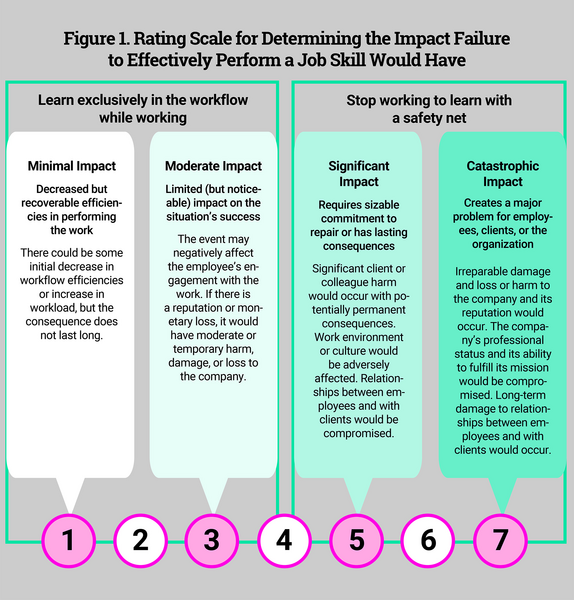
The fundamental cost justification for pulling employees away from their work to learn is the impact that failure to perform successfully would have on the organization and its people. For job skills with a low critical impact of failure (see Figure 1), employees can and should learn them exclusively in the workflow. Of course, that requires immediate access to what’s needed at the moment of need to successfully perform those low-impact-of-failure job skills.

The fundamental cost justification for pulling employees away from their work to learn is the impact that failure to perform successfully would have on the organization and its people. For job skills with a low critical impact of failure (see Figure 1), employees can and should learn them exclusively in the workflow. Of course, that requires immediate access to what’s needed at the moment of need to successfully perform those low-impact-of-failure job skills.

Content

Performance support pioneer Gloria Gery first sorted out the means for doing so—an electronic performance support system. According to Performance Improvement Interventions: Performance Technologies in the Workplace, Gery describes an EPSS’s capabilities as “The use of technology to provide on-demand access to integrated information, guidance, advice, assistance, training, and tools to enable high-level job performance with a minimum of support from other people.”
Performance support pioneer Gloria Gery first sorted out the means for doing so—an electronic performance support system. According to Performance Improvement Interventions: Performance Technologies in the Workplace, Gery describes an EPSS’s capabilities as “The use of technology to provide on-demand access to integrated information, guidance, advice, assistance, training, and tools to enable high-level job performance with a minimum of support from other people.”

Workflow Learning Has a Mistaken Identity-Hottopic_chart1_spring2023_TDL_xl.jpg

Content

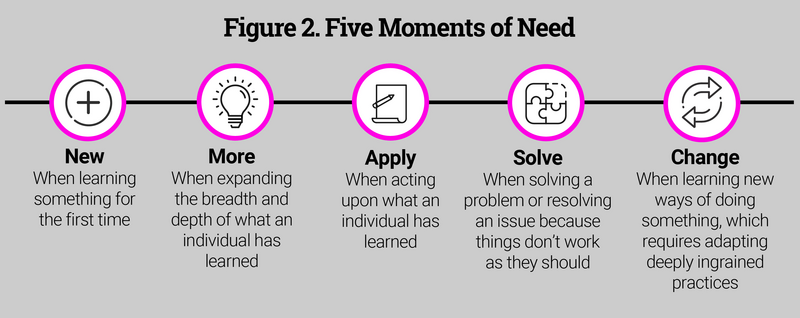
Regardless of the technology used, any time a TD team can orchestrate those capabilities in a way that meets all five moments of need (see Figure 2), that is an EPSS, which is sometimes referred to as a digital coach.
Regardless of the technology used, any time a TD team can orchestrate those capabilities in a way that meets all five moments of need (see Figure 2), that is an EPSS, which is sometimes referred to as a digital coach.

Workflow Learning Has a Mistaken Identity-Hottopic_chart2_spring2023_TDL.jpg

Content

Here’s how employees learn low-impact-of-failure job skills while continuing to perform the work that companies hire them to do: Within two clicks and 10 seconds (which is best practice based on our research and usability testing), workers access the steps for a specific job skill they need to perform. As they follow those steps, they also have fingertip access to cascading levels of job support for each of the five moments of need that surface while performing that job skill.

Here’s how employees learn low-impact-of-failure job skills while continuing to perform the work that companies hire them to do: Within two clicks and 10 seconds (which is best practice based on our research and usability testing), workers access the steps for a specific job skill they need to perform. As they follow those steps, they also have fingertip access to cascading levels of job support for each of the five moments of need that surface while performing that job skill.

Content

Gery notes that each time a worker successfully performs a reoccurring job skill with the help of an EPSS, they are learning “unconsciously.” In other words, they are learning experientially while doing their work.

Gery notes that each time a worker successfully performs a reoccurring job skill with the help of an EPSS, they are learning “unconsciously.” In other words, they are learning experientially while doing their work.

Content

It has been our experience during the past 20 years that, on average, half the job skills slated for traditional training have low impact-of-failure ratings. Because of their low impact, there isn’t sufficient cost justification for interrupting work to learn the skills. Therefore, TD should push that skills training into the workflow so employees learn exclusively while working.

It has been our experience during the past 20 years that, on average, half the job skills slated for traditional training have low impact-of-failure ratings. Because of their low impact, there isn’t sufficient cost justification for interrupting work to learn the skills. Therefore, TD should push that skills training into the workflow so employees learn exclusively while working.

Content

For example, consider a manager in a sales function who has a skill set around managing operations. Specific skills, such as how to manage and approve expense reports, are minimal-impact tasks, whereas how to manage correspondence with customers is a moderate-impact task. Thus, the TD team should put support and guidance on how to best complete those tasks into the workflow—when the manager must perform them—rather than provide formal training.

For example, consider a manager in a sales function who has a skill set around managing operations. Specific skills, such as how to manage and approve expense reports, are minimal-impact tasks, whereas how to manage correspondence with customers is a moderate-impact task. Thus, the TD team should put support and guidance on how to best complete those tasks into the workflow—when the manager must perform them—rather than provide formal training.

Content

That should not be the case when the impact of failure to successfully perform a job skill is significant to catastrophic. In such scenarios, there is a compelling cost justification for workers to stop their work to safely learn.

That should not be the case when the impact of failure to successfully perform a job skill is significant to catastrophic. In such scenarios, there is a compelling cost justification for workers to stop their work to safely learn.

Content

For instance, a significant-impact task for the sales manager may include allocating expense budgets or distributing regional sales goals, and a catastrophic-impact task may be reviewing and understanding sales forecasts. Those are bigger-picture, bigger-impact tasks that require more in-depth knowledge about the skill, company, or industry. Such significant-to-catastrophic impact-of-failure skills merit the full measure of training practices.

For instance, a significant-impact task for the sales manager may include allocating expense budgets or distributing regional sales goals, and a catastrophic-impact task may be reviewing and understanding sales forecasts. Those are bigger-picture, bigger-impact tasks that require more in-depth knowledge about the skill, company, or industry. Such significant-to-catastrophic impact-of-failure skills merit the full measure of training practices.

Content

We once reviewed a five-day training course that involved more than 1,000 presentation slides.

We once reviewed a five-day training course that involved more than 1,000 presentation slides.

Content

We used critical-impact-of-failure ratings, with provisions for shifting that learning into the flow of work, as a guide to reducing the content.

We used critical-impact-of-failure ratings, with provisions for shifting that learning into the flow of work, as a guide to reducing the content.

Content

The course entailed 56 job skills, and we determined that employees could safely learn more than half of them exclusively while working. That led to reducing the course to two days while diversifying the provision of training methods. Almost half the course time shifted from presentation to using guided and unguided practice with direct feedback—a vital requirement when the impact of job skill failure is significant to catastrophic.

The course entailed 56 job skills, and we determined that employees could safely learn more than half of them exclusively while working. That led to reducing the course to two days while diversifying the provision of training methods. Almost half the course time shifted from presentation to using guided and unguided practice with direct feedback—a vital requirement when the impact of job skill failure is significant to catastrophic.

Why intentionally enable learning while working?

Content

The journey to job skill productivity involves three stages: train, transfer, and sustain. Most organizations live solely in the first phase. After that, they have no intentional response to the latter two—they simply hope for the best as learners attempt to navigate through the most challenging transfer phase and then grow in experience. Workers close their own skills gaps to keep up with change during the sustain phase.

The journey to job skill productivity involves three stages: train, transfer, and sustain. Most organizations live solely in the first phase. After that, they have no intentional response to the latter two—they simply hope for the best as learners attempt to navigate through the most challenging transfer phase and then grow in experience. Workers close their own skills gaps to keep up with change during the sustain phase.

Content

Here’s the rub: A training-only approach abandons learners during the most significant learning times that always occur during the transfer and sustain phases.

Here’s the rub: A training-only approach abandons learners during the most significant learning times that always occur during the transfer and sustain phases.

Content

During the transfer phase, workers must reinforce what they have learned during training, translate it to their specific work environments, and integrate all they have learned with their previous experience and knowledge. That is no small feat.

During the transfer phase, workers must reinforce what they have learned during training, translate it to their specific work environments, and integrate all they have learned with their previous experience and knowledge. That is no small feat.

Content

Without just-in-time access to an EPSS or digital coach, the transfer phase takes too much time in which learners often:

Without just-in-time access to an EPSS or digital coach, the transfer phase takes too much time in which learners often:

  • Content

    Lose confidence and motivation.

    Lose confidence and motivation.

  • Content

    Fall prey to the forgetting curve and quietly fail.

    Fall prey to the forgetting curve and quietly fail.

  • Content

    Become overwhelmed in their thinking processes.

    Become overwhelmed in their thinking processes.

  • Content

    Develop dependence on other workers.

    Develop dependence on other workers.

  • Content

    Adopt inefficient work habits.

    Adopt inefficient work habits.

Content

Learners need to experience immediate success and move rapidly through the transfer phase to transition from whatever level of skill mastery they have achieved to the beginning stages of job competence. As they do so, they are most certainly learning in the workflow.

Learners need to experience immediate success and move rapidly through the transfer phase to transition from whatever level of skill mastery they have achieved to the beginning stages of job competence. As they do so, they are most certainly learning in the workflow.

Content

The sustain phase is where professional growth occurs. Here, with the aid of workflow learning, employees grow through experience as they adapt their existing skill sets in response to the dynamic nature of real-world work. They accelerate their growth each time they resolve issues and develop their adaptive capacity by closing their own skills gaps in response to change.

The sustain phase is where professional growth occurs. Here, with the aid of workflow learning, employees grow through experience as they adapt their existing skill sets in response to the dynamic nature of real-world work. They accelerate their growth each time they resolve issues and develop their adaptive capacity by closing their own skills gaps in response to change.

Content

There are two primary approaches to workflow learning. The first is when the TD team blends workflow learning with formal training to extend learning support across all three phases of train, transfer, and sustain.

There are two primary approaches to workflow learning. The first is when the TD team blends workflow learning with formal training to extend learning support across all three phases of train, transfer, and sustain.

Content

The second is when skill development occurs exclusively in the workflow. The distinguishing characteristic of that true approach to workflow learning is the degree to which employees learn as they do their work, so they don’t have to stop work to learn. In those cases, the transfer phase is immediate.

The second is when skill development occurs exclusively in the workflow. The distinguishing characteristic of that true approach to workflow learning is the degree to which employees learn as they do their work, so they don’t have to stop work to learn. In those cases, the transfer phase is immediate.

The impact of blending workflow learning with training

Content

In the past 10 years, we have observed a global shift from a training-only approach to one that intentionally enables learning in the workflow. We are especially encouraged by the number of learning leaders who are courageously pursuing the power and potential of workflow learning. In every case, there is significant and measurable impact that captures the full attention of organizational leaders at every level. Here are a couple examples.

In the past 10 years, we have observed a global shift from a training-only approach to one that intentionally enables learning in the workflow. We are especially encouraged by the number of learning leaders who are courageously pursuing the power and potential of workflow learning. In every case, there is significant and measurable impact that captures the full attention of organizational leaders at every level. Here are a couple examples.

Content

A global consulting firm transformed its onboarding program for work teams located on three continents. Rather than new hires spending hours on formal instruction for each specific skill, they spent less than 30 minutes getting a quick walkthrough from the trainer and then used the digital coach to learn independently.

A global consulting firm transformed its onboarding program for work teams located on three continents. Rather than new hires spending hours on formal instruction for each specific skill, they spent less than 30 minutes getting a quick walkthrough from the trainer and then used the digital coach to learn independently.

Content

One of the most challenging skill areas was learning how to use the job request sheet. Onboarding training focused on reviewing why and when new hires would need to use the job request sheet.

One of the most challenging skill areas was learning how to use the job request sheet. Onboarding training focused on reviewing why and when new hires would need to use the job request sheet.

Content

Meanwhile, the digital coach presented two-click access to step-by-step instructions and prompts on how to correctly fill out the sheet as well as where and how to submit it. Incorporating a digital coach into the training phase reduced the time to proficiency for that skill area from six weeks to one day.

Meanwhile, the digital coach presented two-click access to step-by-step instructions and prompts on how to correctly fill out the sheet as well as where and how to submit it. Incorporating a digital coach into the training phase reduced the time to proficiency for that skill area from six weeks to one day.

Content

By implementing the blended training and workflow learning solution, the TD team reduced the total amount of classroom training to 20 days, and time to proficiency decreased from 18 months to five months. Reducing work stoppage from 30 to 20 days resulted in a lost work savings of $3,349 per employee.

By implementing the blended training and workflow learning solution, the TD team reduced the total amount of classroom training to 20 days, and time to proficiency decreased from 18 months to five months. Reducing work stoppage from 30 to 20 days resulted in a lost work savings of $3,349 per employee.

Content

As another example, a global manufacturing organization implemented a workflow learning solution and called its digital coach a CoW (coach on wheels). Formal training targeted significant or catastrophic impact-of-failure tasks using the CoW, such as checking bottle quality. The manufacturer considered that a significant task because there is great possibility for issues such as damage to customer confidence or financial impact.

As another example, a global manufacturing organization implemented a workflow learning solution and called its digital coach a CoW (coach on wheels). Formal training targeted significant or catastrophic impact-of-failure tasks using the CoW, such as checking bottle quality. The manufacturer considered that a significant task because there is great possibility for issues such as damage to customer confidence or financial impact.

Content

Of the 214 job skills required to operate four machines on the manufacturing line, only 18 percent were rated 5 and above, requiring formal training. For the remaining 82 percent skills, employees were able to learn while working on the shop floor by accessing task guidance and other support materials made available via the CoW.

Of the 214 job skills required to operate four machines on the manufacturing line, only 18 percent were rated 5 and above, requiring formal training. For the remaining 82 percent skills, employees were able to learn while working on the shop floor by accessing task guidance and other support materials made available via the CoW.

Content

By pushing 82 percent of the skills into the workflow, work-stoppage costs reduced from $8,958 to $1,340 per employee.

By pushing 82 percent of the skills into the workflow, work-stoppage costs reduced from $8,958 to $1,340 per employee.

Content

The intent of all organizational learning is to enable and sustain effective job performance in ever-changing work environments. TD leaders must do so in a way that justifies any interruption to the work employees must do. Employers can only achieve that by embracing the power and potential of workflow learning.

The intent of all organizational learning is to enable and sustain effective job performance in ever-changing work environments. TD leaders must do so in a way that justifies any interruption to the work employees must do. Employers can only achieve that by embracing the power and potential of workflow learning.

Content

Read more from Talent Development Leader .

Read more from Talent Development Leader.

You've Reached ATD Member-only Content

Become an ATD member to continue

Already a member?Sign In


Copyright © 2026 ATD

ASTD changed its name to ATD to meet the growing needs of a dynamic, global profession.

Terms of UsePrivacy NoticeCookie Policy