
ATD Blog
How Microlearning Will Shape the Future of Work
Wed Aug 30 2017

When I first started experimenting with microlearning in 2010, Amazon sold one book on the topic: The Didactics of Microlearning. Written in dense academic text translated from German, the book made me feel like I was slogging through an instruction manual for an infinitely complex blender.
Today, we are awash in microlearning platforms, certificate programs, conference swag items, and perhaps soon a microlearning flavor of Ben & Jerry’s ice cream. Per ATD’s own research, 92 percent of organizations using microlearning plan to do more of it in 2017, and over 67 percent of organizations not using microlearning plan to start.
### Figure 1. Interest in Microlearning Over Time, From Google Trends
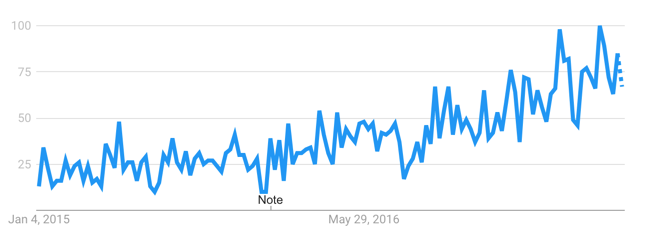
You can chalk this up to mere trendiness, but there’s an equally simple explanation for the hype: microlearning works. Short, focused bursts of learning provide organizations three primary benefits. Here’s why:
Microlearning is cheaper and faster. To-the-point materials take less time to source, produce, maintain, and consume than traditional classroom sessions or longer-form e-learning. This enables under-resourced L&D teams to focus on quality without sacrificing speed, and gives well-resourced teams more ways to make an impact.
People are more engaged. Employees today devote 1 percent of their time to learning (roughly 24 minutes a week), check their phones 150 times a day, and switch tabs every minute. Microlearning fits perfectly into this continuous diet of email, Slack, and social media. For employees accustomed to short bursts elsewhere, microlearning significantly lowers the barrier to engagement.
People learn more. Though there are many factors that drive effective learning, managing cognitive load is one of the most important. The problem with typical learning experiences like lectures or long e-learning videos is that they present too many things at once for too long a period of time. On the contrary, short bursts respect the limitations of working memory, and allow people the time to properly reflect on what they are learning and connect it to what they already know.
These are real benefits, but they don’t necessarily translate to improved performance on their own. What savvy L&D practitioners have figured out is that if you want to drive business results with microlearning, timing is everything.
Next-Gen Microlearning Is all About Motivation
One of the most difficult and least scalable things organizations must do is motivate their employees, and learning requires a lot of sustained motivation. Unfortunately, we all ride on what behavioral psychologist BJ Fogg describes as motivation waves. What we are motivated by, and whether we feel motivated at all, changes constantly.
But motivation isn’t entirely unpredictable.
There are reliable triggers that open up motivational windows in which employees are willing, even excited, to learn and change their behaviors. These windows can last from a few months (Think: when someone is given a new role or responsibility), to a few weeks (Think: when someone has a big deadline or presentation coming up), to a few minutes (Think: when someone is walking into a big meeting for which they’re not fully prepared).
Organizations must be prepared to facilitate a learning experience at a moment's notice to capitalize on these motivational windows before they close. The margin for error is very thin.
This is where a new generation of microlearning solutions is making an impact. By serving up short, learning experiences right when employees desperately feel the need, organizations can get around the longstanding challenge of having to motivate employees to engage fully with L&D offerings.
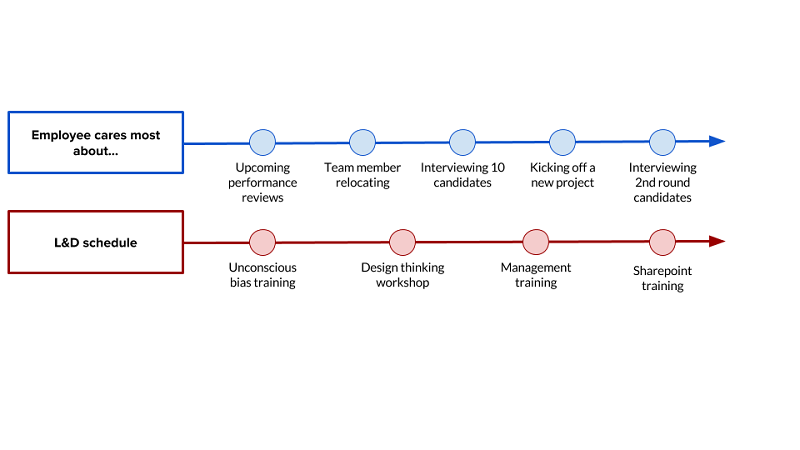
Through microlearning, you can take a misaligned schedule (see Figure 2)...
**
Figure 2. Misaligned L&D Schedule
**
and align it like what we see in Figure 3:
**
Figure 3. Aligned L&D Schedule
**
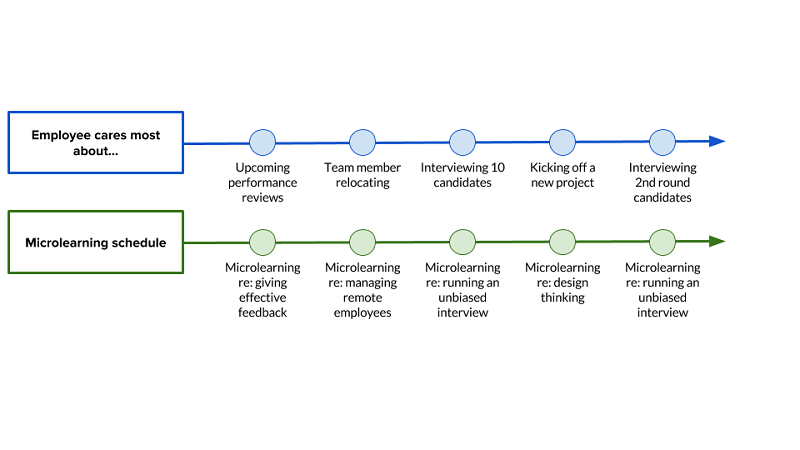
The moments of need become motivational anchor points surrounded with microlearning experiences and resources. They also present entry points for difficult challenges like addressing bias by tying them to specific events, such as an upcoming interview.
And there is also a very important side benefit: microlearning is automatically spaced over time based on the natural cycle of employee behaviors. Learning is reinforced because people encounter the same kinds of needs throughout their career, such as interviewing candidates, not based on an arbitrary spacing schedule.
Vanishing Line Between Learning and Work
-----------------------------------------
New API technology is helping companies get better and better at injecting themselves into the moment of need. Next-generation learning platforms can now ingest data from across an organization’s entire technology stack, including HRIS systems, CRMs, communication tools, and productivity apps, to identify when and where high-motivation moments occur. As a result, organizations can be much more precise with how they push out L&D materials. At the same time, user-friendly microlearning platforms make it possible for employees to quickly pull up relevant learning experiences in the flow of their work.
On the flipside, technology companies like Google, who already focus on the moment of need, are beginning to invest more in learning. Remember the much-maligned Google Glass? Google spent two years quietly revamping the technology to be used for workplace applications, leading to the release of the new Glass Enterprise Edition. Organizations including GE, DHL, and Sutter Health have been using Glass prototypes to send instructions, training videos, and checklists to their workforce, improving efficiency, safety, and productivity. More development-focused use cases are soon to follow.
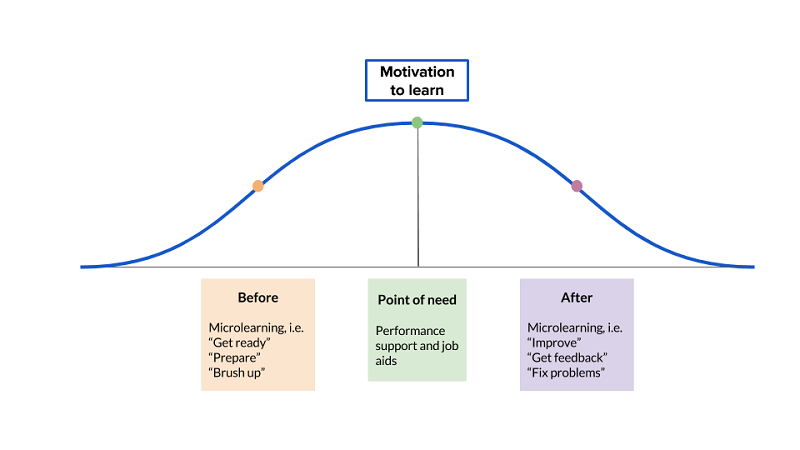
As technology improves and AI comes online, the line between learning and work will break down. Google Glass and other augmented-reality devices will serve up optional microlearning experiences before and after the moment of need, changing how we talk about learning in the workplace (see Figure 4).
### Figure 4. Positioning Microlearning Before and After Point of Need
In the future, critics of microlearning will get what they want: we’ll stop using the word. That’s because it will simply be how things are done.
Editor’s note: This is the first in a three-part series on implementing microlearning in the workplace to drive business results.
View Courses Recommended for You