ATD, association for talent development

ATD Blog

What Are You Doing to Enable Learning in Your Organization?

By

Mon Feb 22 2021

What Are You Doing to Enable Learning in Your Organization?
Loading...

Content

What is your strategy for enabling and supporting employees to continually build new skills so they can be successful as their work changes? For years Jane Hart has been collecting data about how employees learn and refers to this as modern workplace learning (MWL). This definition includes the ways employees learn, the tools they use, and the times they learn. Her insights from the research inform L&D professionals on ideas to enable and support all learning processes and assets that catalyze the organizational system to performance excellence.

What is your strategy for enabling and supporting employees to continually build new skills so they can be successful as their work changes? For years Jane Hart has been collecting data about how employees learn and refers to this as modern workplace learning (MWL). This definition includes the ways employees learn, the tools they use, and the times they learn. Her insights from the research inform L&D professionals on ideas to enable and support all learning processes and assets that catalyze the organizational system to performance excellence.

Content

How does this happen? And how could you and your organization use the research to enhance ways employees build capability? The ATD Forum was fortunate to have her share her research at a recent ConnectSpark. She expanded on the research with the following ideas, but more details are on her website.

How does this happen? And how could you and your organization use the research to enhance ways employees build capability? The ATD Forum was fortunate to have her share her research at a recent ConnectSpark. She expanded on the research with the following ideas, but more details are on her website.

Content

First, some MWL principles are needed to set context.

First, some MWL principles are needed to set context.

  • Content

    Employees are primarily workers rather than learners, so the context is always the work and the behaviors and skills employees need to be successful. It is not learning for the sake of learning, but it is targeted learning.

    Employees are primarily workers rather than learners, so the context is always the work and the behaviors and skills employees need to be successful. It is not learning for the sake of learning, but it is targeted learning.

  • Content

    Learning is defined by Hart as “the acquisition of knowledge or skills through study, experience, or being taught.” It is not a product nor can it be designed, delivered, or managed. It can be enabled by an environment that focuses on it and supports it with the right type of assets, collateral, and content.

    Learning is defined by Hart as “the acquisition of knowledge or skills through study, experience, or being taught.” It is not a product nor can it be designed, delivered, or managed. It can be enabled by an environment that focuses on it and supports it with the right type of assets, collateral, and content.

  • Content

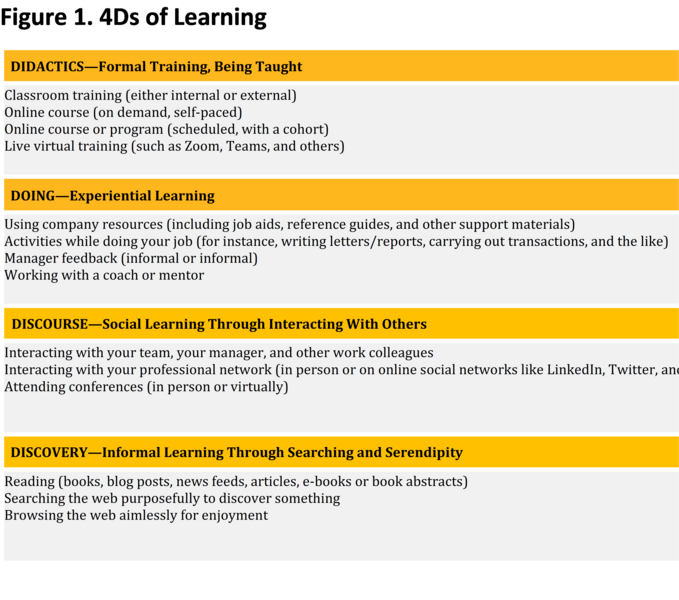
    There are four primary ways we learn whether on the job or on our own—didactically, by doing, by discourse, and by discovery as shown in Figure 1.

    There are four primary ways we learn whether on the job or on our own—didactically, by doing, by discourse, and by discovery as shown in Figure 1.

  • Content

    There are various tools we can use to support these four ways of learning. While these include tools like learning management systems that allow consumption of content, platforms to support communicating (video) and working with others, such as Zoom and Teams, and apps for collaboration, such as whiteboards, file sharing, brainstorming, are included.
    There are various tools we can use to support these four ways of learning. While these include tools like learning management systems that allow consumption of content, platforms to support communicating (video) and working with others, such as Zoom and Teams, and apps for collaboration, such as whiteboards, file sharing, brainstorming, are included.

What Are You Doing to Enable Learning in Your Organization?-FORUM_Figure_4DsofLearning.png

Content

Second, it is critical to understand that everyone is responsible for learning; however, the roles they play differ. The starting place is the L&D function tasked with knowing how learning happens and providing assets and support for it. The manager and the individual employees play significant roles. The manager focuses employees on work practices, provides frequent feedback, and acts as a coach for providing tips, ideas, and support for learning. The individual is responsible for their personal learning, which means being more self-sufficient and being more in tune with self-directed learning and metacognition. This includes not only thinking about how they think and learn but building habits and practices to get better at getting better with learning every day. This habituation process includes what Catherine Lombardozzi calls wherewithal .

Second, it is critical to understand that everyone is responsible for learning; however, the roles they play differ. The starting place is the L&D function tasked with knowing how learning happens and providing assets and support for it. The manager and the individual employees play significant roles. The manager focuses employees on work practices, provides frequent feedback, and acts as a coach for providing tips, ideas, and support for learning. The individual is responsible for their personal learning, which means being more self-sufficient and being more in tune with self-directed learning and metacognition. This includes not only thinking about how they think and learn but building habits and practices to get better at getting better with learning every day. This habituation process includes what Catherine Lombardozzi calls wherewithal.

Content

Hart’s research enables L&D teams to understand the overarching system and suggests ways to enable and support learning when it is needed and in the various ways employees prefer it.

Hart’s research enables L&D teams to understand the overarching system and suggests ways to enable and support learning when it is needed and in the various ways employees prefer it.

Content

What could this look like for the L&D team?

What could this look like for the L&D team?

Content

• Creating a variety of learning assets that can be accessed in many ways and times

• Creating a variety of learning assets that can be accessed in many ways and times

Content

• Delivering microcontent or microtraining opportunities

• Delivering microcontent or microtraining opportunities

Content

• Curating learning opportunities and making them easily available

Curating learning opportunities and making them easily available

Content

• Running short, interactive live virtual training sessions on the platforms you have

• Running short, interactive live virtual training sessions on the platforms you have

Content

• Facilitating asynchronous group learning sessions

• Facilitating asynchronous group learning sessions

Content

• Designing hybrid learning programs such as a 30-day challenge or a campaign-style event

• Designing hybrid learning programs such as a 30-day challenge or a campaign-style event

Content

• Offering access to learning hub with numerous resources

• Offering access to learning hub with numerous resources

Content

• Helping managers become more successful coaches

• Helping managers become more successful coaches

Content

• Helping employees become effective and efficient self-directed learners

• Helping employees become effective and efficient self-directed learners

Content

• Supporting knowledge sharing as part of daily work

• Supporting knowledge sharing as part of daily work

Content

• Encouraging reflective practices throughout the entire organizations

• Encouraging reflective practices throughout the entire organizations

What Is a First Step?

Content

Start where you are. Focus on becoming a champion at self-directed learning. While this entails a defined purpose and detailed plan, it also requires a time commitment, tracking the evidence, and sharing the results. With time limited, start small with reflective practices. Learning happens every day through problem-solving, learning from mistakes, talking with colleagues, and asking questions. Set up a system to reflect and capture this learning through journaling, notetaking , or videos. Share this learning with colleagues at team meetings and through internal communication channels. Delve deeper into the ideas and build the concepts into your work practice.

Start where you are. Focus on becoming a champion at self-directed learning. While this entails a defined purpose and detailed plan, it also requires a time commitment, tracking the evidence, and sharing the results. With time limited, start small with reflective practices. Learning happens every day through problem-solving, learning from mistakes, talking with colleagues, and asking questions. Set up a system to reflect and capture this learning through journaling, notetaking, or videos. Share this learning with colleagues at team meetings and through internal communication channels. Delve deeper into the ideas and build the concepts into your work practice.

Content

As your daily learning evolves into patterns and themes connect the dots for detailed concepts. Use design thinking or other tools to visualize these concepts and share them with others. Ask for feedback. Ask questions. As these “new ways of thinking” morph into new insights, share these learnings with your professional networks through comments and blogs or even case studies at conferences, articles in magazine, or a “how-to” venue like TD at Work .

As your daily learning evolves into patterns and themes connect the dots for detailed concepts. Use design thinking or other tools to visualize these concepts and share them with others. Ask for feedback. Ask questions. As these “new ways of thinking” morph into new insights, share these learnings with your professional networks through comments and blogs or even case studies at conferences, articles in magazine, or a “how-to” venue like TD at Work.

Content

As a leader in the L&D arena, your role is to enable and support all the ways employees learn. This includes modeling and teaching ways for everyone in the organization to continually learn. This supports a learning culture constantly upskilling performance capability. How will you use this research to build effective continuous learning personally and in your organization?

As a leader in the L&D arena, your role is to enable and support all the ways employees learn. This includes modeling and teaching ways for everyone in the organization to continually learn. This supports a learning culture constantly upskilling performance capability. How will you use this research to build effective continuous learning personally and in your organization?

You've Reached ATD Member-only Content

Become an ATD member to continue

Already a member?Sign In


Copyright © 2026 ATD

ASTD changed its name to ATD to meet the growing needs of a dynamic, global profession.

Terms of UsePrivacy NoticeCookie Policy